
Fractal Audio's FM3 Mark II is claimed to be a tube amp replacement. But is the FM3 Mark II better than a Line 6 Stadium?
Fractal Audio FM3 Mk II Inside and Out Review 2026
FM3 - is it better than a Line6 Stadium?
Introduction and Preamble
You know what, I always said I would never buy another Fractal Audio product after creating a review and being harassed by, lets call them 'fan boys'. But hey, when all is said and done, I have to reserve the right to create a closeup review whatever products for guitarists that I want to, surely. And with that frame of mind I went out and bought the FM3 and a little later the FC6 controller for it so I could create a genuine real review from a bona-fide user. And why not I say!
Let's face it, just because some people don't like a review from an owner and based on what I find should not really be a reason not to create an Inside and Out review as I do with many other brands of guitar gear - and no-one else moans if they happen to not like what my findings are. So I spent the money and bought one. But of course the question should be really, did I keep it? or did I decide I wanted to get my investment back and spend the money on something else? As an ordinary user I might even be like you, after all I was interested in the FM3 and if I could like it enough to keep it then that could be a good basis for a review. Of course things don't always go to plan so you'll have to read the review to find out how I fared.
Hardware of the FM3 Modeler
It makes a change to actually take a look at the FM3 close up and personal. You know, the controls, the I/O, the insides (where on some equipment bad things have been known to lurk) as well as all the good things generally found in many types of devices, so lets look closer.
So why will I be taking a look inside the FM3? Well, firstly, its what I do with every piece of equipment without exception. And on earlier Fractal Audio equipment I bought there were some things that just did not fit what I, or some reasonable people might call a quality build and once you see those sort of things then you always check if you get some more of the same brand. I have checked for example item after item of Roland, Boss, Marshall, Line 6 and so many more products to show the continuing quality (or not) to readers and viewers in my reviews.
Then there's the 'change of manufacturing' that has gone on with Fractal Audio. At one time they used to ship Chinese assemblies via sea to the USA, then assemble them in to whichever device they were making at the time. But that changed, and with the FM3 for example, these are now made in China and the USA assembly seems to be no more. Maybe that's affected the quality of the device in a good or bad way? We shall see in this inside and out review.
And of course the reader should be able to see the chips and other components used inside the device, and see if they are maybe 'old models', or 'under powered', or even 'obsolete' parts simply because no one else ever shows this stuff and in my opinion its important when trying to understand what you might buy before you buy it. I doubt many readers would be happy if something relating to these sort of things in a bad way were inside the pedal.
In the range is this FM3 with just 3 foot switches (great for tap dancing), then there's the FM9 that has 9 foot switches and (so I believe I could be wrong) a second £40 processor to help it along, and if course the Axe FX III now called 'Turbo' that costs overall around twice the price of the FM3.
But in any case first I'm going to take a cursory look at the top and rear of the FM3 and then we can move on.
A Top View of The FM3
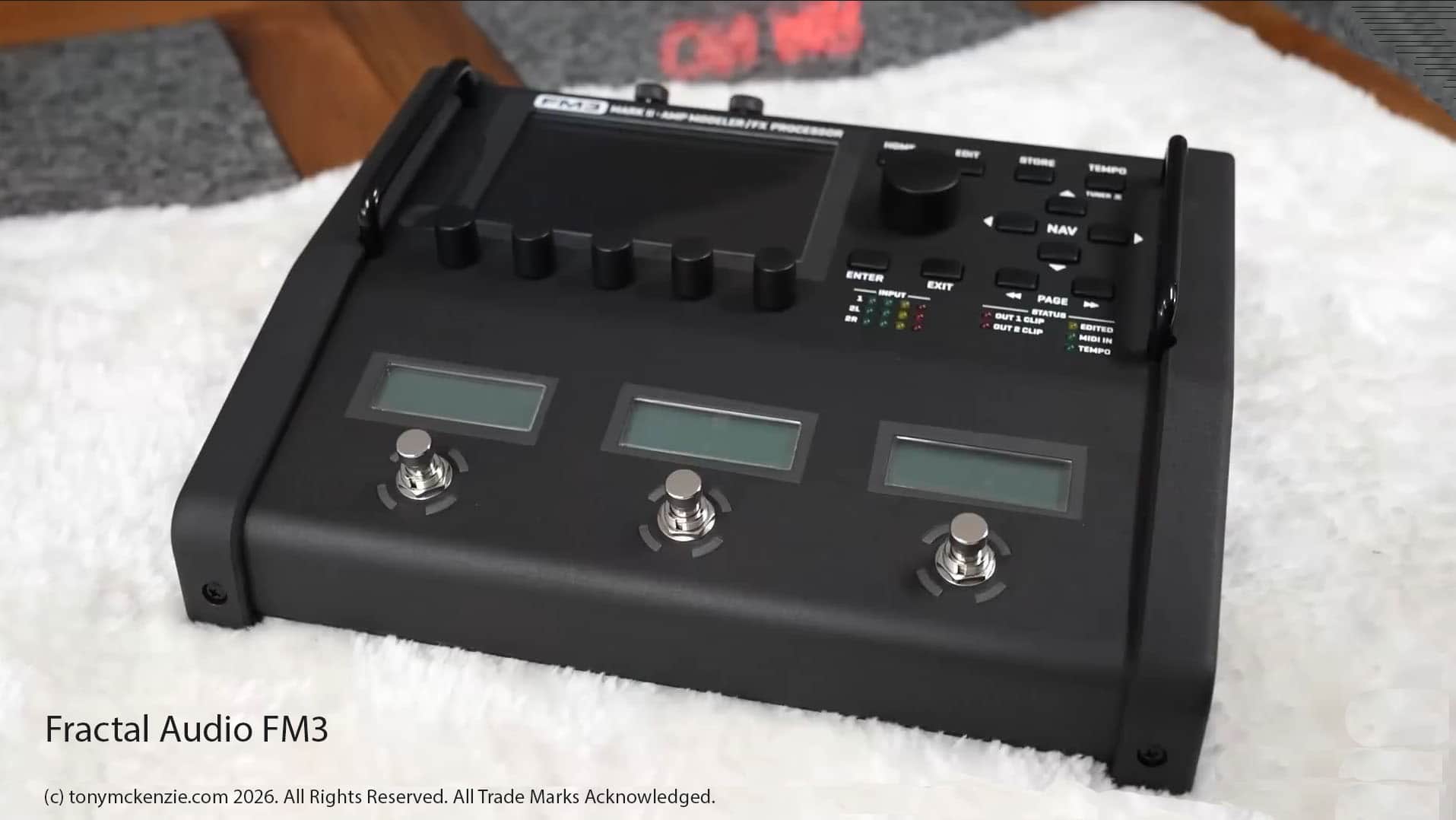
As you will see from the larger image the design is not at all bad, but of course using the unit with just 3 switches might make you do a lot of dancing around as you try and manipulate the settings or presets. More on that later. There's also some cooling holes on the side of the unit to let out the hot air when the device is being used. And there's an array of I/O on the rear of the unit - don't worry, I'll take a look at all of that later.
Main Board
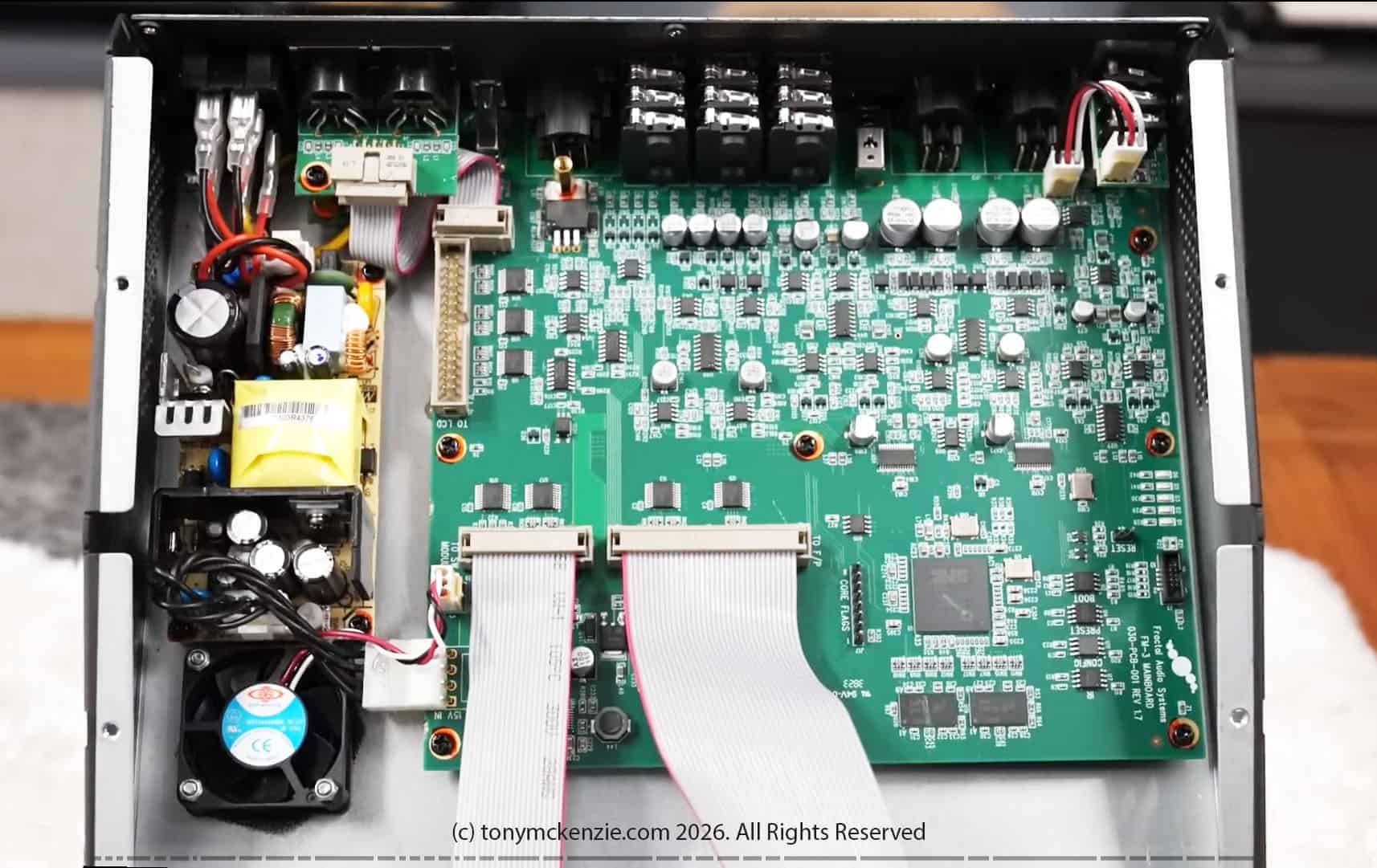
Looking at the main board assembly, this is a pretty well made device and very typical of what you might expect when this FM3 device was made not that long ago in 2025 I think. It encompasses a third party power supply, it includes components for the I/O stuck on the main board,
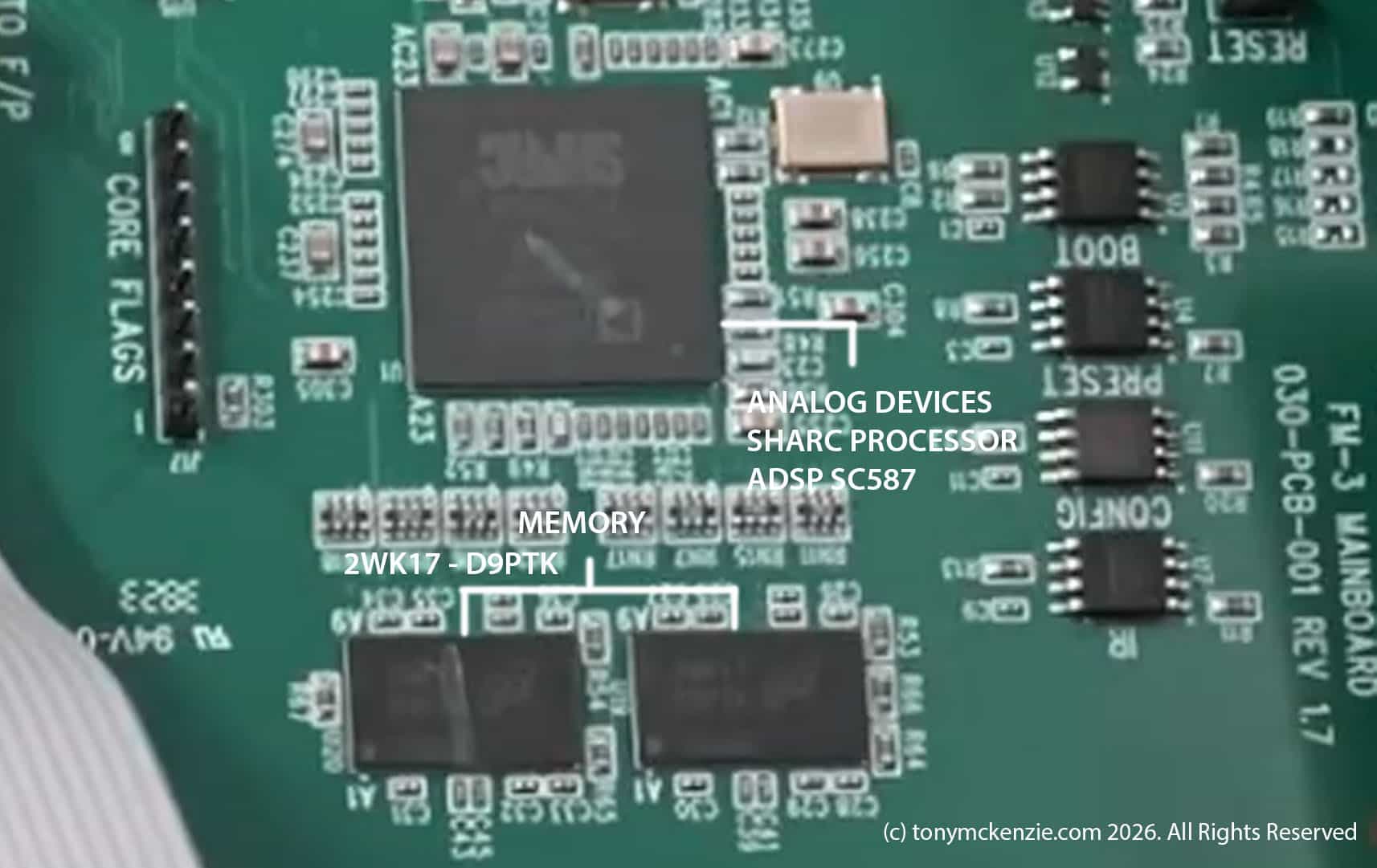
There is a processor, some ram and a host of other SMD across the whole main board and typical of what has been produced on a machine. I'll mention a few things now but cover the main 'chips' later on in the review.
Power Supply
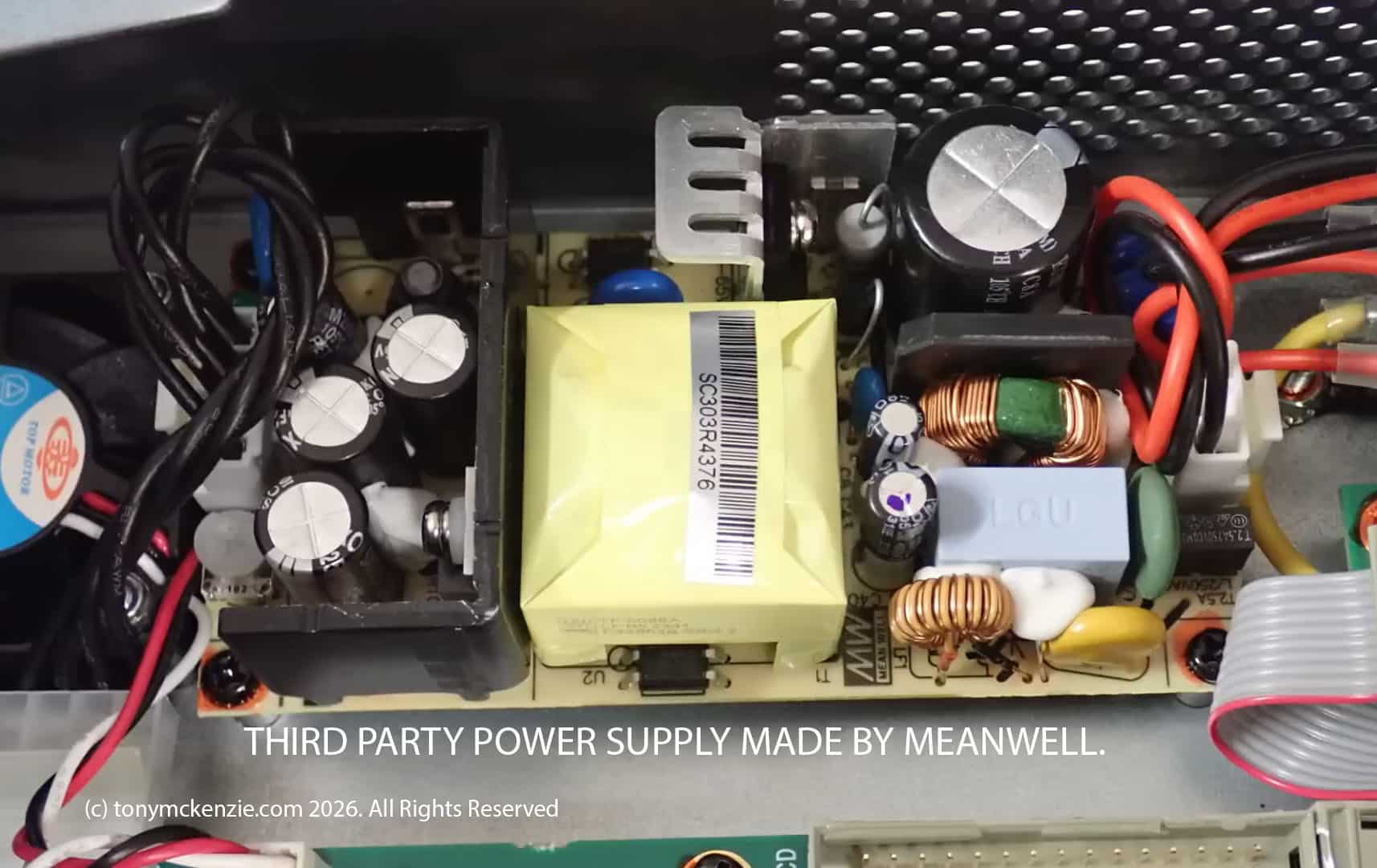
The power supply is a third party device created most likely in China and seems to me to be like an 'off the shelf' type of affair. This one is made by a company in China called 'MEAN WELL' and while it seems to do the job I doubt that it's cost is very substantial. Their motto encompasses 'Have Good Intentions' - so let's hope those are applied accordingly. It's a company that has been around for some time so likely the PSU will be ok, with maybe the added advantage if it fails out of warranty you could buy one cheap. Indeed I have bought similar devices myself for less than $10 from the far east when I was at my last company.
I/O etc.
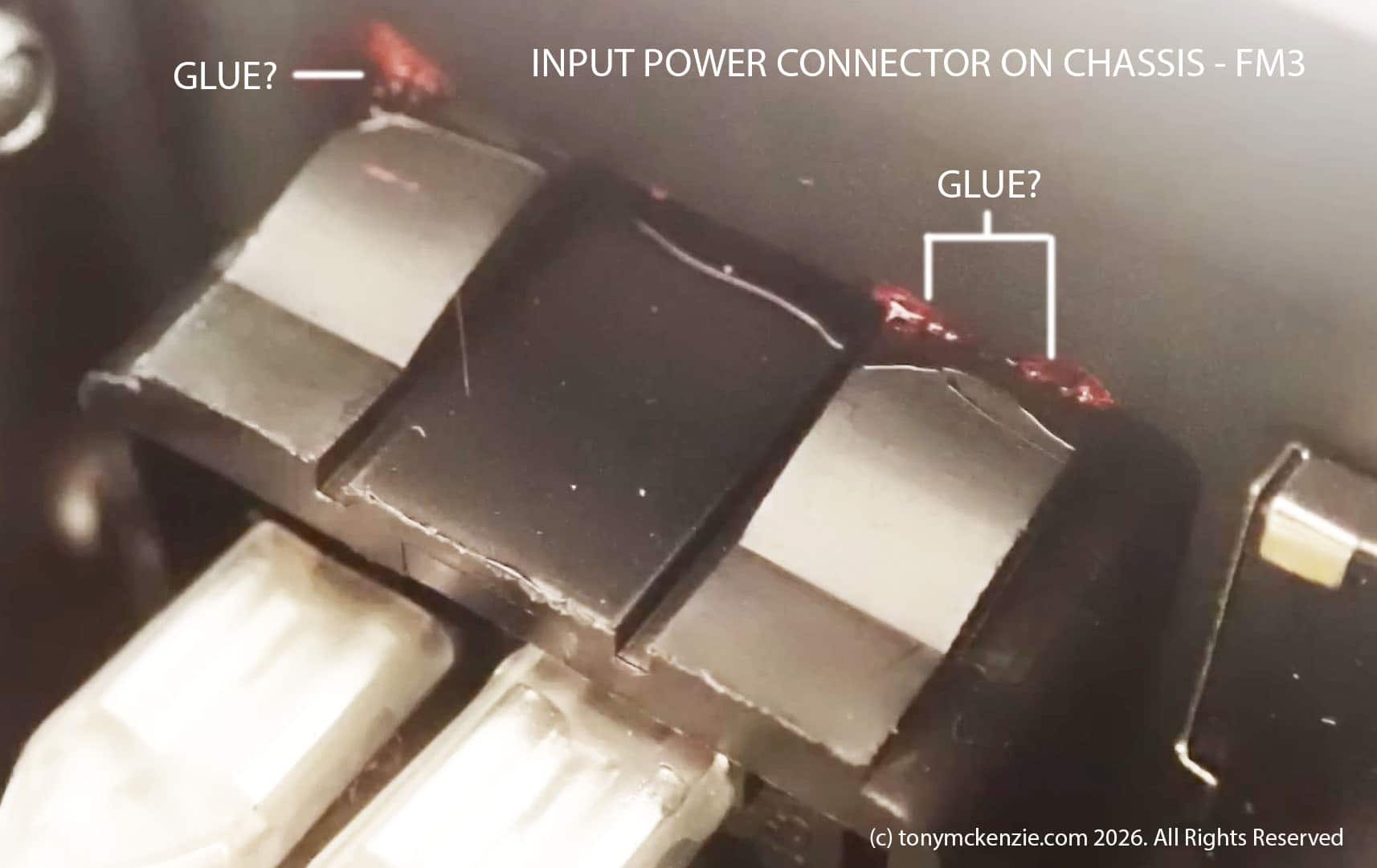
Often I have seen on Fractal Audio devices (think Axe-FX II and Axe-FX III where the power connectors (or switch connector) has been surrounded by silicone sealant, not unlike that used for glazing and that sort of thing, applied to help 'hold in place' the particular component. But on the FM3 it seems that the power input on the unit has what I would describe as a sort of red glue to help hold the connector in place. While this is not unique, its far from what I see in Marshall, Line 6, Fender, Headrush and so many more devices that I point it out when I see it. You might be 'OK' with that, but somehow for me it would be better to fit the component in a better way as many other makers have.
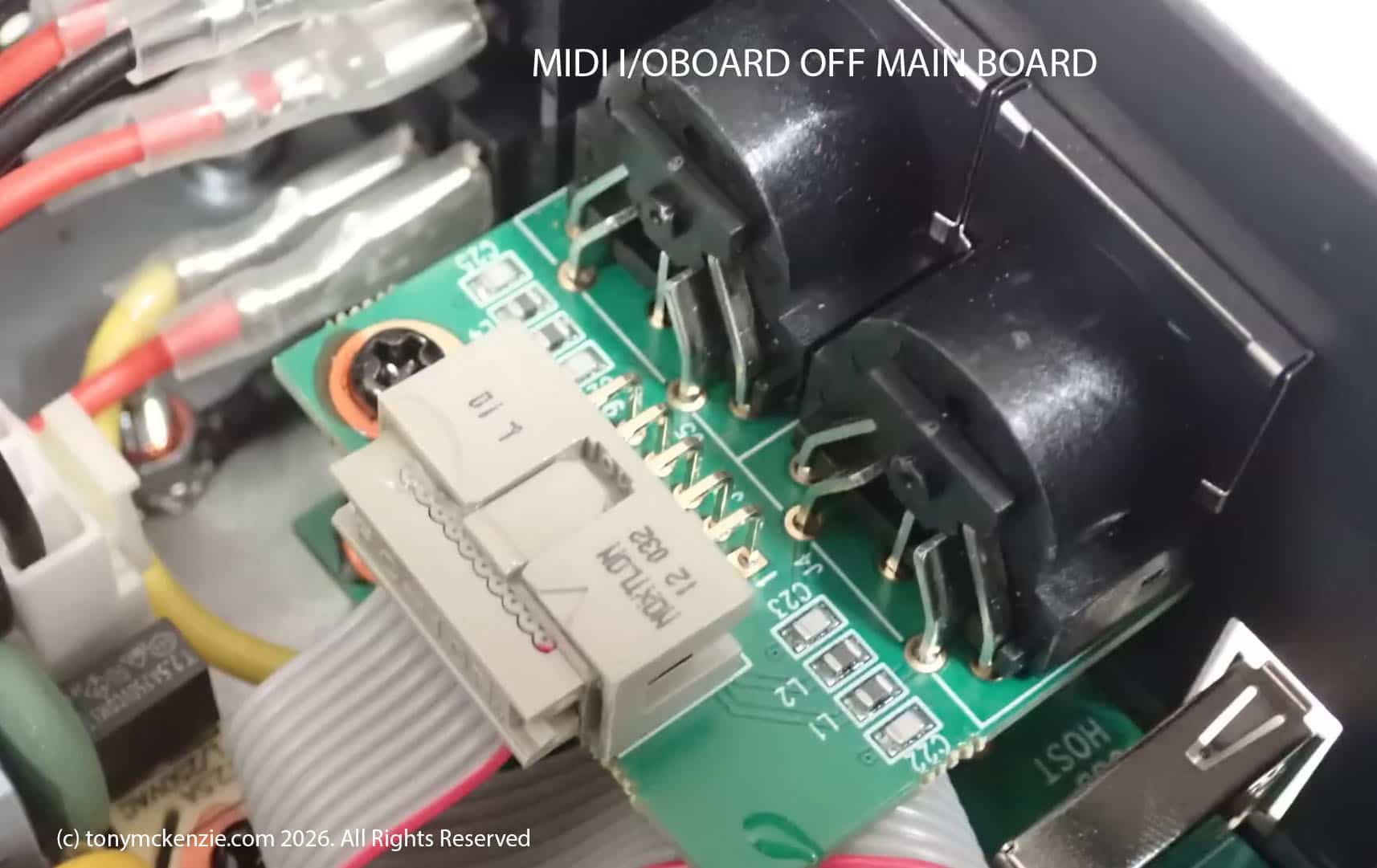
The MIDI I/O board is thankfully on a separate daughter board and mounted on the rear of the device. This is a good thing simply because if it gets damaged on those external connectors, you could get another board (maybe) or make your own replacement.
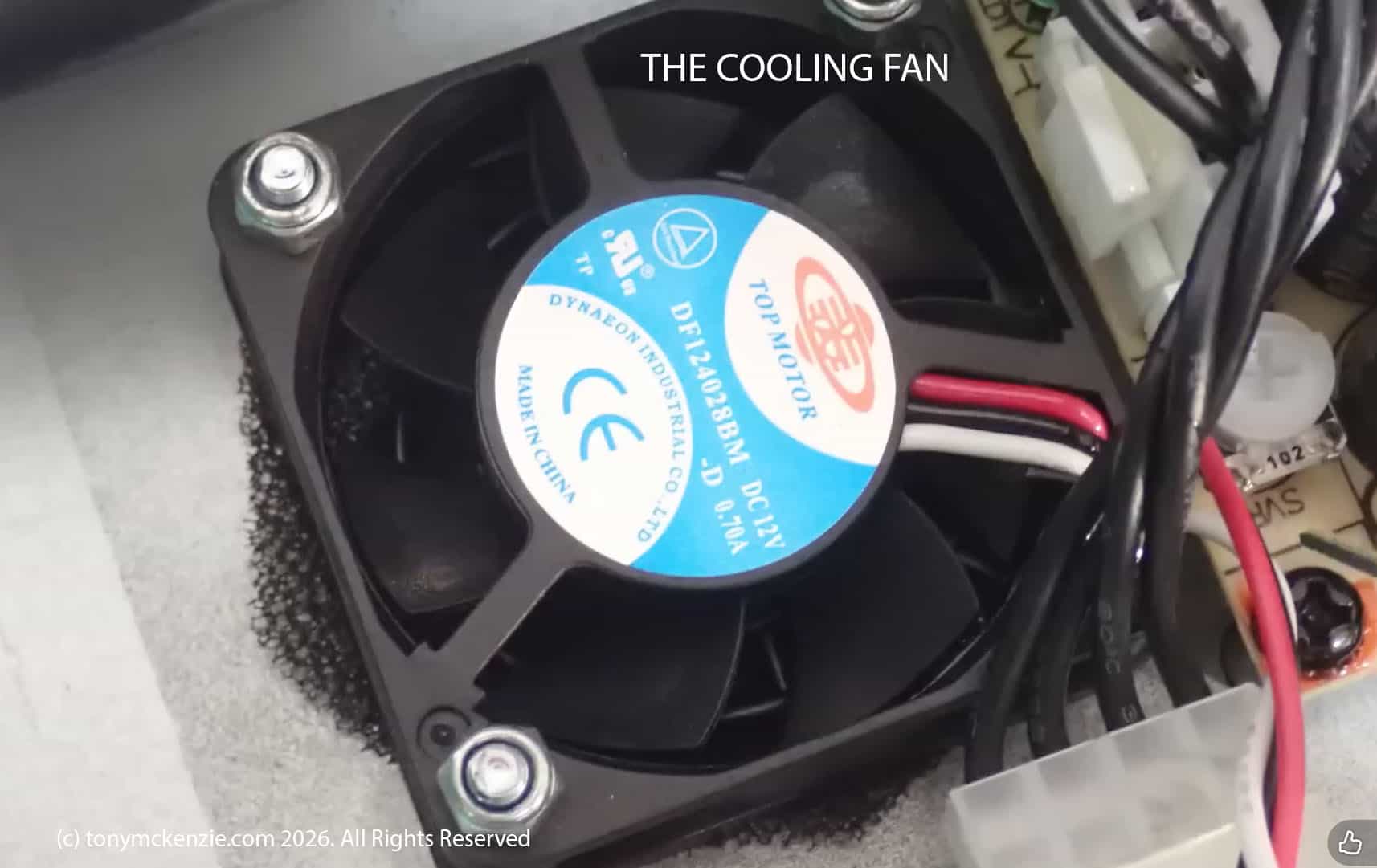
The cooling fan - yes it has one, is a brushless design made by dynaeon industrial in Taiwan and seems like it might last a while, its rather like what you see on some computers. And it's made in China although the Taiwan company might have moved to China from Taiwan at some stage.
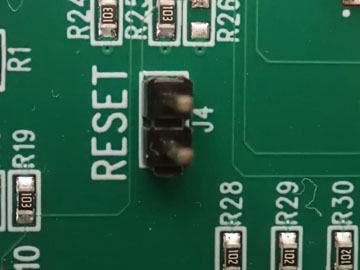
There's a little 'reset jumper' on the main board and undocumented anywhere.
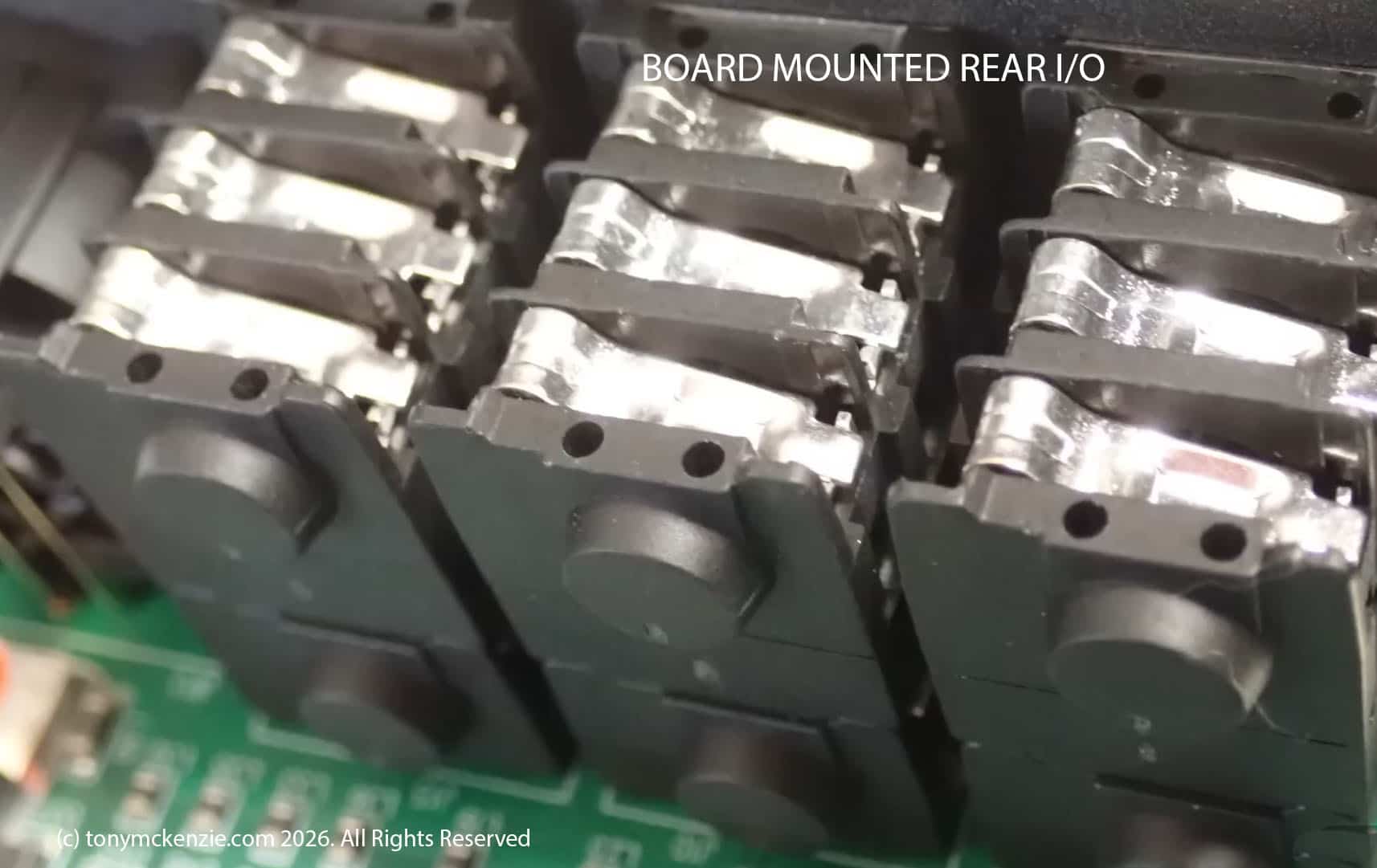
This is a picture of the rear I/O sockets - there are SIX of those. And they look rather like plastic manufacture to me. These might get lots of use over the years of being used at gigs etc. and how well they stand up to that use is really anyone's guess. Note they are double ganged also. Could you get these later down the road... maybe or not. But mounted on the main board is also not really the best idea in my opinion, so do bear in mind these are main board mounted. The USB connector, while board mounted is made of metal and far more resilient than plastic I think.
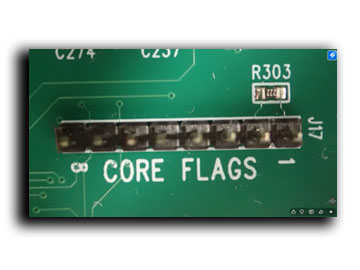
I also found this 'core flags' J17 connector on the main board. It's undocumented so who knows what that could be although I think its a test point when being tested after being made. There are many other components but none of them are out of the normal, are expected to be there and are well enough made for this type of device./p>
Other Boards in the FM3
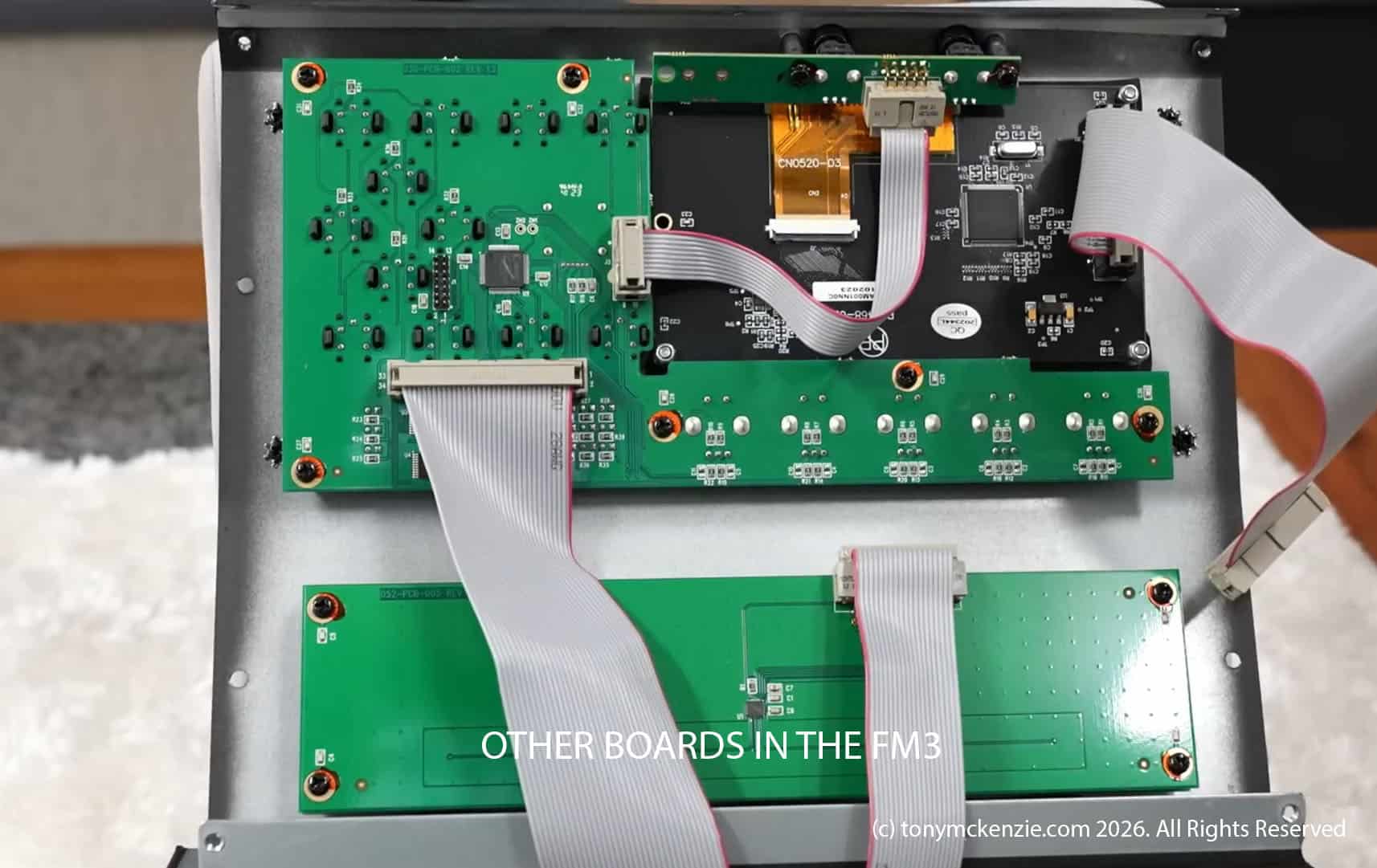
The top board that you see has all of the external buttons on the other side that you use from the top of the FM3 - I wonder how easy or hard they might be to change if you spill your beer over the pedal from the top? On the right hand side is the screen assembly, that looks like a bought in device (I could be wrong) and typical of what's generally out there in other devices of similar use. Note the screen does have a QC sticker emblazoned on it thus showing that the screen assembly has at the very least been checked. I did not see any QC stickers elsewhere. Lastly down the bottom is the foot switch board - on the other side are the switches that control the FM3 from above and are located on the front of the unit.
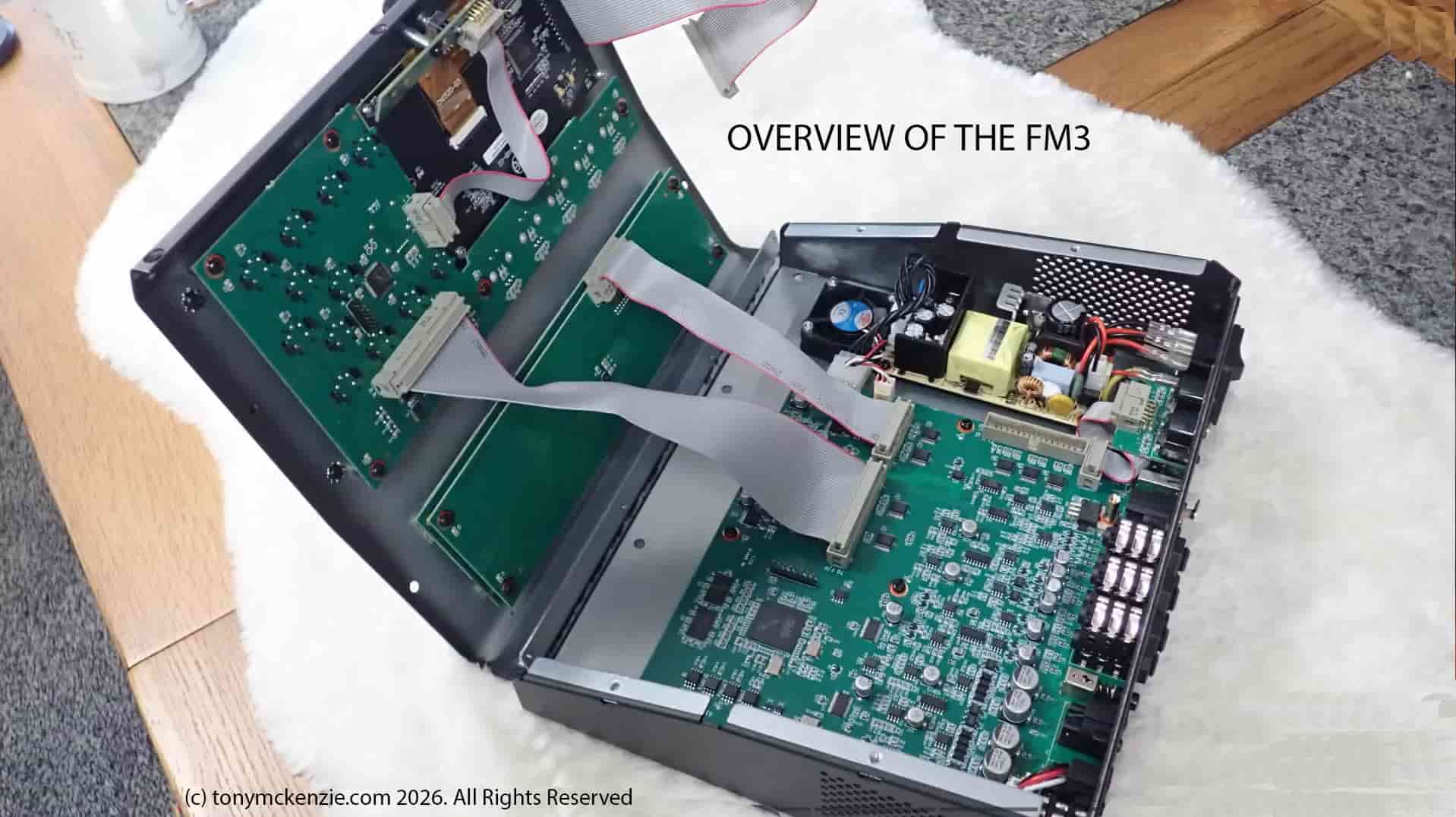
Lastly here is an image of the FM3 when opened up. You can see how compact it really is, and how many components are installed inside the case assembly. My guess is that now you know why it needs a fan, but I assume you noted that the processor did NOT have a fan on it? Maybe its a slower or cut back device who knows, but we will see the processor later on in this review.
The Rear I/O on the FM3
There are a load of I/O connections around the back of the FM3 so let's take a look at what's included.
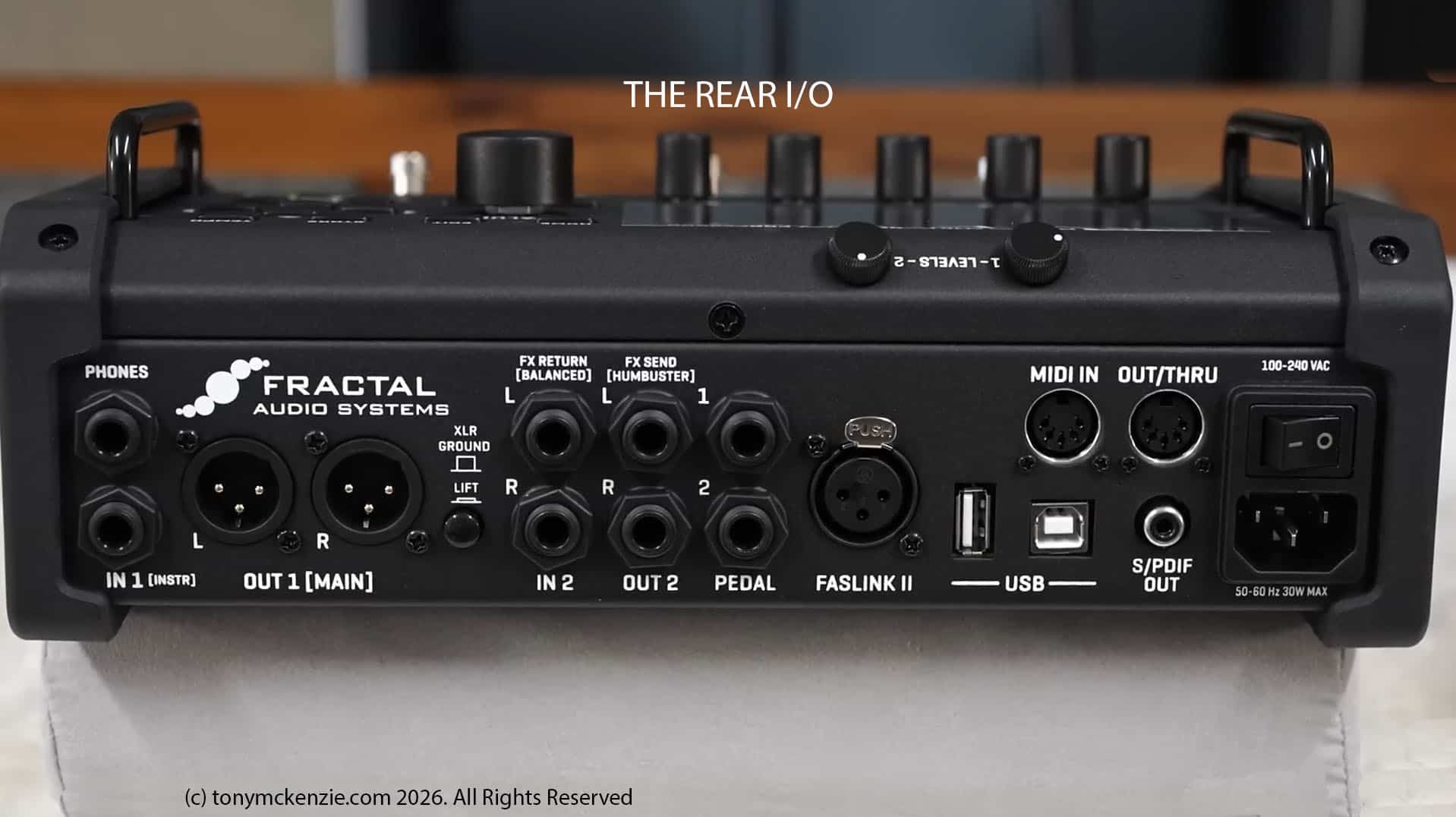
Below are the list of connectors - I won't spend all day in this section...
- Headphones out
- Input 1 is for the instrument - or guitar for guitarists :)
- 2xXLR left and right outputs can be used mono etc.
- XLR ground lift button if you need to do that
- IN 2 is L and R with the top being attributed for balanced FX return
- Out 2 is again L and R and the top (Hum buster it says) is also FX send
- There's 2 pedals that can be fitted in respective sockets
- The Faslink II allows for connecting an FC6 pedal for switch expansion etc.
- There's a USB A and a USB B port
- MIDI in and out/through connectors
- S/PDIF digital connector if you need one
- 1 and 2 Level controls near the top of the unit
- Mains Input is 100 to 240v AC
And there's even an on and off switch so you can turn the thing off when you have done with it. A lesson for some of the Roland Boss gear I think!
Now the I/O is all pretty much par for the course so I'll leave it at that for this section.
Approvals
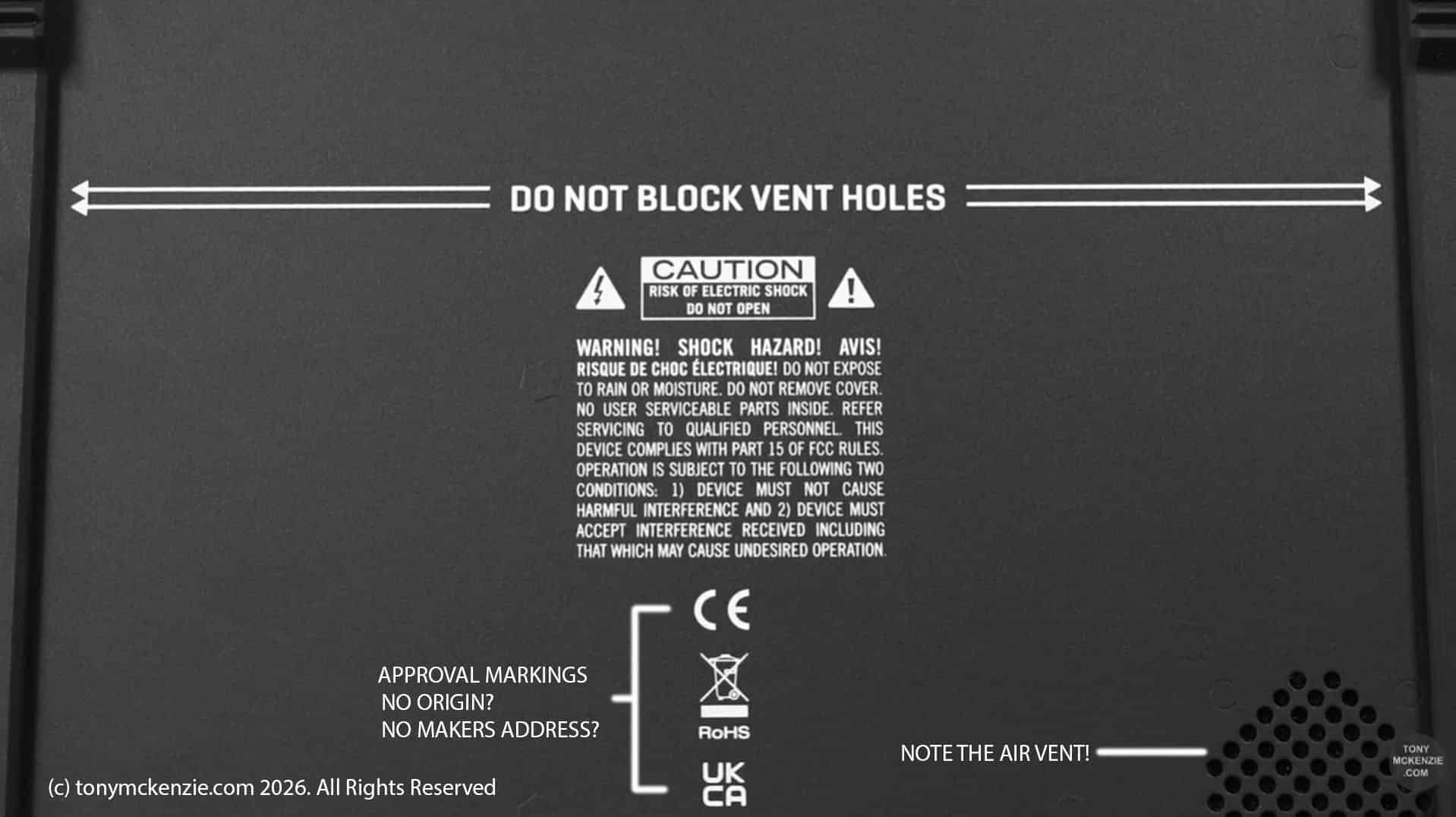
Approvals are always important really, more so because they are really safety related, and also whether lead is used inside in the solder and components, and also for disposal with the WEEE directives. These are often European directives and there can be big problems if the device is not adequately CE approved for example. On Roland Boss equipment you will often see the country of origin (which I don't see on the underneath of this device, and the name and address of the company where they can be contacted. bearing in mind that this particular FM3 was purchased within the EU area I'm surprised about that. The EU is known for their strong application towards anything that is not properly CE approved and what's more they can hold the importer to task if CE is breached in some way. I bought a (non music related) device that I asked the UK government about and they immediately confiscated it! Yes they can if there are issues and I was advised to 'get my money back' which was a little hard as the company was in China. I'm not saying this FM3 is not compliant but from experience the markings seem different than on other equipment such as Roland or Boss. But do note that the 'RoHS' compliance logo - is actually NOT the RoHS logo, but the 'WEEE' mark. Very Strange.
The Top of the FM3
Let's examine the top of the FM3 and it's control layout.
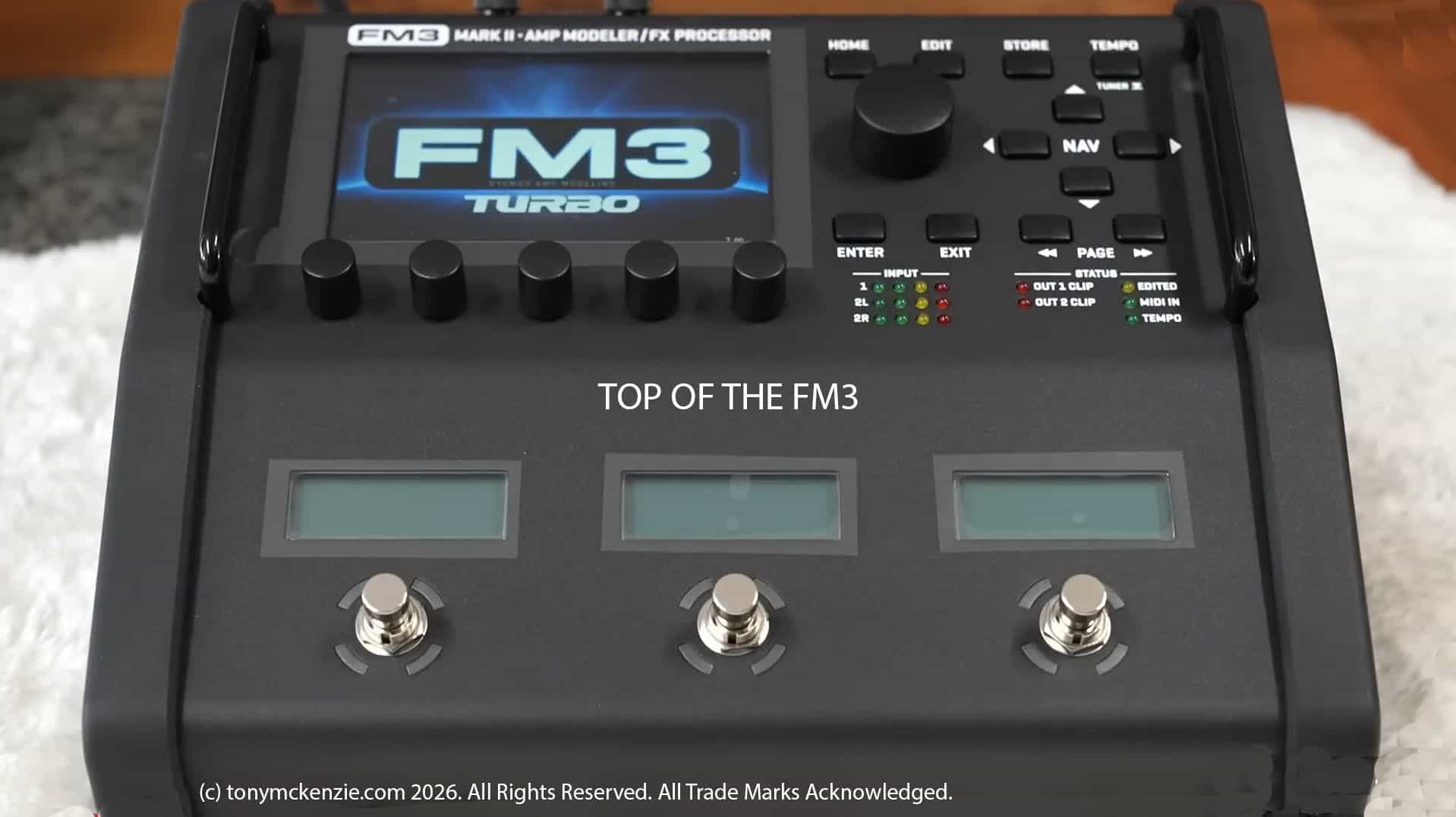
When you fire up the FM3 it takes a while to come alive and be ready to operate... it does not matter until at a gig it restarts and you have to wait while that time passes - it would seem like hours! So let's look at the top rather that waiting around for a reboot!
There's a color screen a 5 inch affair that is NOT a touch screen. Its clear enough but many will miss the 'no touch' ability. There are 5 knobs/buttons under the screen that vary in what they do depending on which screen you are on. There's those two level controls on the top edge of the screen,
Above the three foot switches are three scribble strips that can tell you what each button represents (again depending on what you have it all set up to) and they were made a little bigger than on the older mark 1 device. Scarily you can have up to 12 different settings for these switches so please do practice tap dancing before you learn guitar. You CAN of course buy the FC6 controller if you have about £500 for one (or more) so that you can get past the three buttons available. Its not in my opinion a good answer. But Fractal Audio also created a way of using those 12 settings with the three foot switches which helps a little, but its still a real pain without actual real switches available, but at this price you might question the value content for the price.
Also on the top of the unit is the inimitable 'Home' button. Maybe I'm wrong here but did that come from Line 6? There's also an edit button and a store button to save your masterpiece after modding or creating it. There's a dual button for 'tuner' or keep hitting it for the tempo setting. The large knob is a value knob that changes what your cursor is on at the time, There is the navigation section that includes a L,R,U and Down set of buttons. Self explanatory enter, exit and page left and right buttons for when you're editing.
There's also a matrix of LED's that tell you about signal strength and input as well as a second matrix of LED's that show the status of the outputs. There's also a LED that shows whether the preset is edited, whether there's a MIDI in going on another LED and also a tempo LED lastly. So you have all the info on the top of the FM3.
Conclusions So Far
There are some things to take in to account and now is a reasonable point in the review to go through those.
What I will say at this point is that the overall build quality of the FM3 right away is noticeable as being better than the previous devices I have bought. Its quite good whether I'm looking inside or around the back at the I/O or even on the top - its not cluttered either where you can't see for looking so to speak.
I can tell - believe me I can, that this FM3 was not 'cobbled together' by less than perfect builders. It's just obvious, and if I was to fall back to getting images out to show you of previous devices and some of the things I saw previously, its clear that firstly those are not in this device, but also that this has been assembled elsewhere. Thankfully. I hope that trend continues.
How robust the FM3 really is who knows, only time will tell, but many products that are used for gigging can face a hard life and I wonder just how good those I/O connectors sitting on that main board will stand up to the rigors of those gigs. I think the warranty might be 1 year and that might be a little concerning because of the I/O and how its attached to the main board. At least from here in the UK my supplier would be G66, who I have to say have a very good attitude towards their customers, contrary to the experiences I had from the USA.
The FM3 Closer Features
Here's a quick mention of some of the features of the FM3 according to the maker.
- The three switches - 12 different things from 3 switches...
these were not really great to me and ultimately I would
recommend the FC6 - the price is crazy, but if you insist on
buying the FM3 do it all the hard way or buy the FC6.
- Price. Here in the UK at the time of writing is £1149.00 and
that has reduced in price from the £1250 I paid when I bought
mine. Maybe external things have had an effect on the price of
the FM3. There's been a number of other devices at the £1200 area
here in the UK and well everywhere else too, including Fractal
land. So maybe it was time to drop the price a little. Just FYI
the FC6 has dropped from £525.00 down to £499.00 also, but its
still a crazy price for not a lot. I recently bought a 12 button
MIDI pedal for £120.00 and I hope that brings the FC6 in to
perspective a little.
- It's reported that there are 'hundreds' of accurate models
of amps and other devices, and that there is a REAL tube
amp sound and feel. Listen all the makers have been saying that
for years. So long in fact that the newer guitarists have maybe
never even played through a tube amp (the real ones!) so they
just believe the hype and crazy descriptors that some makers
throw at them. Make no mistake that while the tones are getting
nearer, the 'FEEL' aspect is actually miles away and I have yet
to find ANY modeler that can reproduce the feel of a decent
Marshall or Diezel amp when would up.
- The Signus aspect developed for the Axe FX III - NO you
can't have it the same, and that's because of the cut down
processor against those in the FX III and even the FM9 has extra
processors than this FM3. So I guess (even after owning one)
that it's flavored that way. If you think that this FM3 is an
Axe FX III then prepare to have a rude awakening.
- Thousands of Cabs and 1024 user cabs. Clearly created as
some sort of 'mine is bigger than yours' type of ridiculous
marketing thing. You will NEVER use them all whether theirs or
yours.
- The effects they say are 'based on' those of the Axe FX III.
Based on does not mean the same.
- The software is free. Correct it is... that's just like
everyone else's! I don't understand the point as its just the
same as all the other brands.
The other features mentioned are not really features, they are more like 'also ran' comments about things that all the other gear out there also has. So enough of the features before I fall asleep listing them.
The Obsolescence Theory
Have you ever wondered whether makers (any of them) design with obsolescence built right in to the shiny new product?

When you first fire up this device you will see that 'FM3' graphic and the word 'TURBO' underneath that and even a 'Mark II' on the case. And there is a little story to that it seems. From what I gather, the original FM3 had a particular Analog Devices processor inside it, and guess what? Yes, Analog Devices decided to discontinue the SHARC processing chip that the FM3 included. Right off the bat, that tells you that unless you check the longevity of ANY device you're going to base YOUR product on, then it can quickly become obsolete or discontinued with newer devices. Of course the problem there, is that firstly the new device may cost more to buy, and secondly, it can often result in a complete redesign of the unit internally AND recertification must take place for the FCC, CE, and UKCA certifications and those are not cheap.
In the case of the FM3 I understand that Fractal Audio did tell their audience about the 'upgrade' to the newer 'TURBO' chip, but my own guess is that there was no choice but to upgrade and make it appear as an improvement (it was) for marketing purposes. Of course it would have carried certain costs when that happened. This is why longevity of the components matters. It's all conjecture on my part of course, and ha maybe Fractal Audio 'out of the goodness of their heart' upgraded to a new chip and the old one is still being made, and the costs of re-approval don't matter etc. so I'll let you decide about how and why the 'TURBO' version appeared.
If you think about this sort of issue, clearly its not about the FM3 maker, it has a far wider catchment than that. I have even reviewed some gear at about one year old or so and some of the components were marked as obsolete right there on the internet for all to see. Its almost like no-one ever checks the component age and oops what do they do if products become obsolete early? While makers can rework and re-implement the spanking new component(s) what happens is an immediate devaluation of the 'old model' that is replaced by the sparkling well hyped new unit. Just a thought that you should consider about ANY maker as they could all suffer this way in one way or another. So could you!
The Processor & Other Chips in the FM3 MK II
Its time to take a quick look in to the processor and chips used in the FM3 Mk II TURBO
Analog Devices ADSP-SC587 SHARC Processor
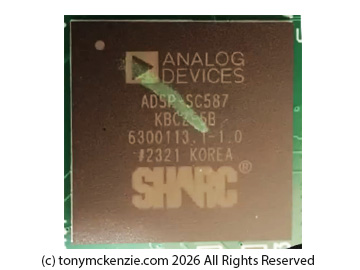
The ADSP-SC587 processor is a high-performance, power-efficient digital signal processor (DSP) designed for real-time applications. It features two enhanced SHARC+ cores and advanced DSP accelerators, delivering over 24 giga floating-point operations per second. This processor is suitable for various applications, including automotive audio, multi-axis motor control, and energy distribution systems. It consumes less than 2 watts, making it more than 5 times more power-efficient than previous SHARC products. The ADSP-SC587 supports ARM Cortex-A5 processing and includes features like Gigabit Ethernet and USB High-Speed connectivity for flexible system designs. Ha it supports DDR3 and older... Importantly this processor costs about £40.00 and NOT the hundreds of pounds once suggested by others. The FM9 has TWO dual core processors. Axe FX III appears to use a Texas Instruments DSP but I did not find the exact chip code - so VERY DIFFERENT for the Axe FX III.
D9PTK DDR3 Memory Module
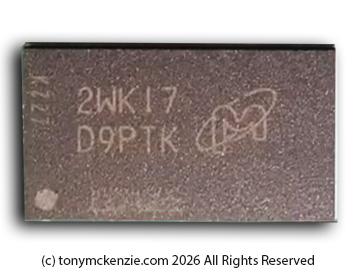
Basically what it says on the tin - a DDR3L memory module that is automotive grade 2gb memory. I saw two in the FM3. Scarily these cost all of $1.93 cents each.
XILINX XC9572XL CPLD
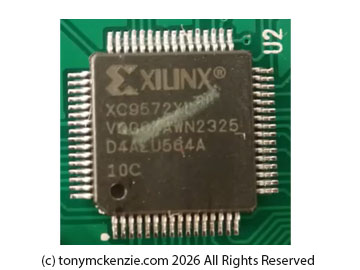
This is a CPLD - Complex Programmable Logic Devices 3.3V 72-mc CPLD. The XC9572XL is a 3.3V CPLD targeted for high-performance, low-voltage applications in leading-edge communications and computing systems. It is comprised of four 54V18 Function Blocks, providing 1,600 usable gates with propagation delays of 5 ns. It has 1600 gates... so I could call it a gate array. Cost? £8.27 and only one inside the FM3.
Summing up this section the FM3 is a cut down version of the FM9 that has twice the power of this device,
The Fractal Audio Software
As Fractal Audio said, the editor etc. is all 'free' but that's the case with all editing software these days?
Well that's true Tony, but the software is better than other examples you might say. It's a fact that the editor software for the Axe FX III (Now TURBO!) is powerful software, and I have always said that. But along with power comes other issues. Think about it like this: The editor software designed for use on the AXE FX III really has to be different than on the FM3. Why? Well the Axe FX III is substantially more powerful in every area, and the I/O is different. It's pretty clear that if you have a 'cut down' piece of hardware (which the FM3 really is) then it will not handle what the Axe FX II can, otherwise no one would buy the Axe FX III - they would all buy this FM3 instead.
When using the software of course you will have to connect the FM3 to a PC or Mac etc. - I have a PC and oops... there's no USB C? How old or archaic is this FM3 design? Surely they should have upgraded the USB to current specifications, but sadly they did not. I suppose that few dollars cost would break them... not!
I did cover the firmware in the video review of the FM3 that I covered but I've left those out fir this written review. It's worth looking at the video review as some things are in there that are not in this written review.
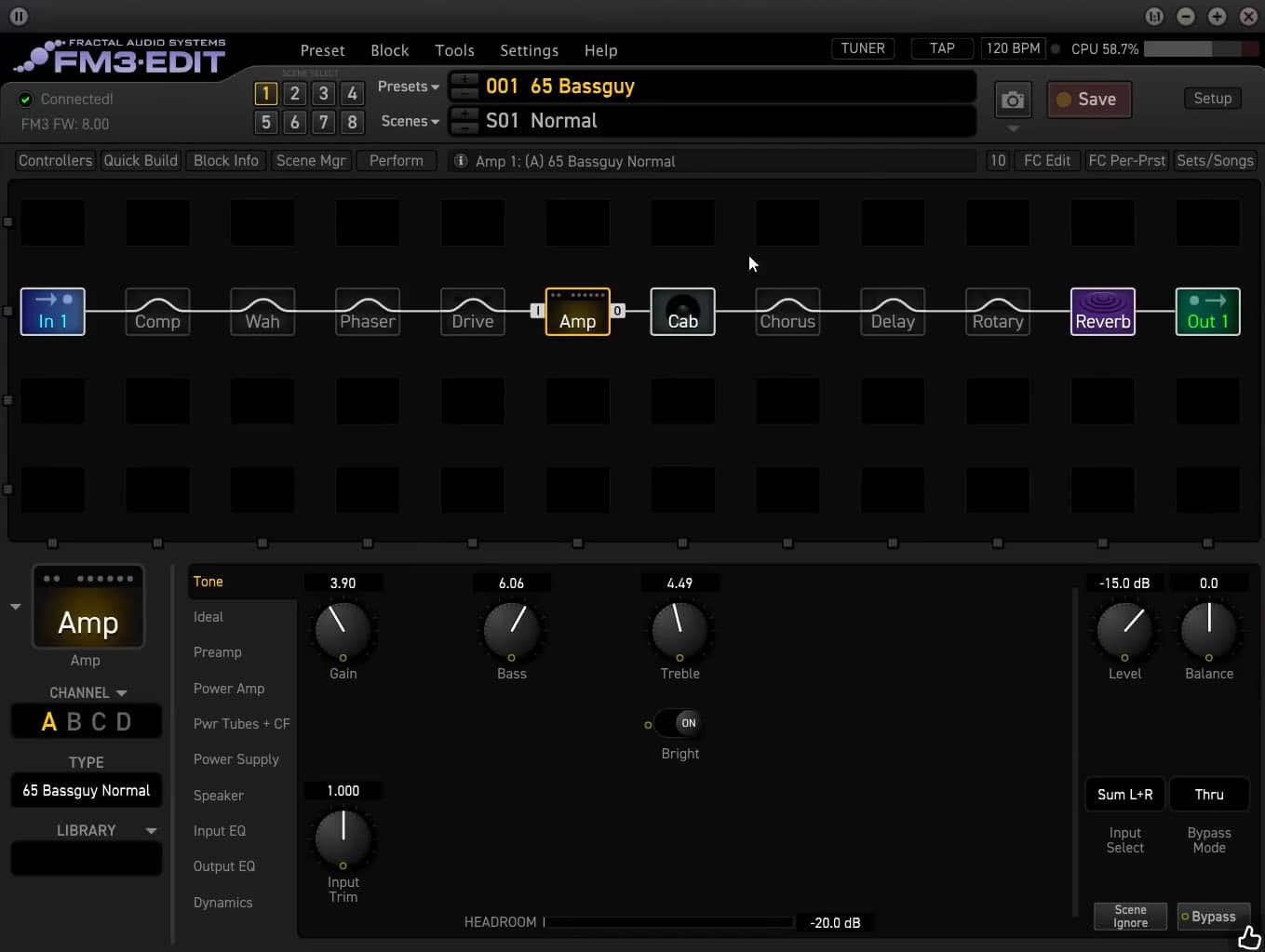
I could spend hours writing about the Fractal Audio Editor in this review. If you want to know what it looks like click the above image, but if you want me to show the Fractal Audio Editor watch this video. In any case I can sum the editor up in just a few words below.
If you have been and looked at my video review for the editor, you will see that the editor is a VERY comprehensive tool that is quite capable of allowing you to sit there and spend WEEKS learning all the intricacies and abilities, then spend months creating what you will think are 'your' sounds. Most modelers drive you down this road until you are familiar with the editing software and the hardware alike. Make no mistake your time investment will be high and later reduced but you will still need concentration to do that editing. And if you're older like me? It just gets harder as your memory slowly suffers. But through it all and over many years I'm 'OK' with it. But would you be?
I can sum up the editor and software in general with just one word:
C O M P L E X
I have used most editing software that's out there form most major brands of modelers and amp simulators etc. and not once have I come across software that is as complex as the Fractal Audio editor. It's not that the basics are difficult really, but this software goes way beyond anything you can imagine unless you are a professional musician or musician roadie that knows it all, and frankly the sales of the gear I believe the majority is sold to retail customers. While I'm sure the professionals do use this solution, make no mistake that the overall mass buyers are retail customers.
Feel free, go and buy one and I'll see you in three months ;-)
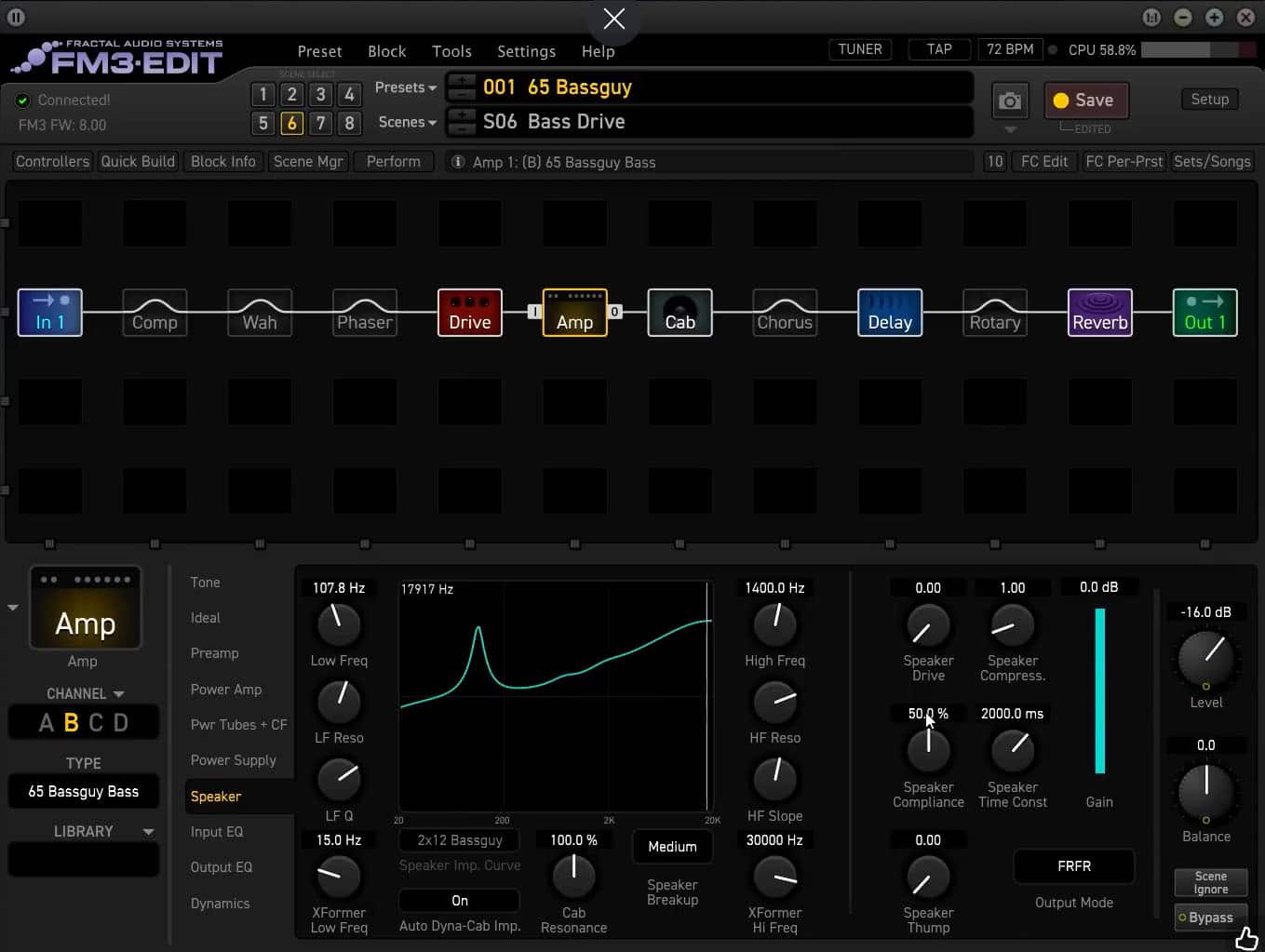
As a last comment take a look at the above image larger... You will notice lots of knobs with titles that you might well be unfamiliar with, and the reason is simple, its because you're an ordinary guitarist or musician. Changing things are great if you know what they are. And there's the aspect of (for example) choosing an amp, and going to the controls, then the controls that (honestly) are not on the real amp but are on the one in the editor - and often the knobs will have cryptic names and hey, you won't understand them or have to spend lots of time figuring it all out.
There are so many examples I could give about this complexity and I'm sure that most guitarists won't have a clue. And that complexity, even transferred to this FM3 cut down hardware, so there is simply no 'let up'. Ha and you thought you had finished college?
Final Summing Up of the FM3 Modeler
So here i talk about what my opinion is of the Fractal Audio FM3 and whether for me its good value and can meet my needs etc.
The Hardware: Frankly, this is really the first time that I have seen something from Fractal Audio that has not really got 'issues' regarding hardware quality. I saw the Axe-FX II and Axe-FX III and neither of those were what I would call a well built item (based on my own purchases remember). There was this or that or the other that was clearly not to the level of quality I expected for those high prices. But the FM3 Mark II 'TURBO' actually goes a long way to meeting the quality standards of what it should be. So in my opinion getting this FM3 made by people that 'can' in China has made a difference to the build quality and its so noticeable.
The USB as an old standard I thought was letting the unit down a little when the likes of Roland and Boss are all now on USB C type. The switching by 3 switches is pretty rubbish. Then asking for £500 for the FC6 is crazy.
There were a few other things but watch the video for those.
The Software: I have already said that the software is over complex for regular musicians and frankly I am really surprised that Fractal Audio never created a simpler Editor for the equipment that options the problematic complexity so you choose a simpler version? Let's face it, Line 6 Stadium does NOT have this complexity by a long way and they are proving over and over again that it's not necessary really. Line 6 WILL make cheaper devices than the Stadium and when they do if Fractal Audio stands still with this software it will cost them sales big time.
The Sounds: I have used this for a while and the sounds are acceptable for a modeling type of device. In my opinion they will NEVER be what those tube amps cranked are, and neither feel the same when you're playing through those. But the FM3 is quite acceptable for now. With the likes of the Stadium appearing with newer tones and the Kemper Mark II coming along, like everything I do think this device is slowly sliding backwards, but let's face it ALL types of devices like this fade over time. So don't hold it against the FM3 as being anything other than like everything else - but more complex!
So What's The Score For The FM3 Modeler
After a review this long, and also creating a video review of the Fractal Audio FM3 I decided to give it a score out of 10
I do have a full list of likes and dislikes in the video review just before the playing and I'll refer you to that if you want to learn more. But from the using, testing, examining, and playing through the FM3 My score is:
6 out of 10 Score
While I really did like the hardware far more than everything else, the tones were 'OK' but the rest and time involvement made me down mark the FM3 to a 6. Now a six score is not that bad actually, There are lots of pieces of gear that get a seven or somewhere there, and I can tell you when I reviewed the Fender Tone Master Pro the first time on video, I actually stopped the review and gave that device a ZERO out of ten! Yes it was THAT bad. So six is reasonable in my opinion.
Can I say it's worth buying? Well that's really down to if YOU are someone that likes to mess around with hardware and the editor for some time (and that you have the time to do that). Me? Honestly I don't have the time to spend on the FM3. It is a credible device but whether for you it would be a good choice, what I would say is read the reviews and watch my video review that includes even more information than this written version.
So Tony, have you still got the FM3? No I don't have it, nor the FC6 either as along came the Stadium XL and I bought that, negating the need for this device.
Thanks for reading this review and remember that this is an entirely unsponsored written review that has taken me days to complete.
Links:
Complete Video review of the Fractal Audio FM3
Video Review of the Software Editor
Video Audio of the FM3 Playing Example
Note that I'm completing 21 written reviews over the coming weeks and months that will show you all about the gear without spending hours on YouTube only. It is time I updated the website, it was not updated for a while, but now I have decided to offer everyone a few more insights rather than 'just' videos.
Thanks.
© A B McKenzie 1997-2026. All Rights Reserved. All Trade Marks Acknowledged.