
Friedman are supposed to be one of the best tube guitar amps out there. But is this JJ Jnr amp really as good as the hype suggests? Be prepared to be as shocked as I was!
Friedman JJ Jnr Amplifier Inside and Out Review
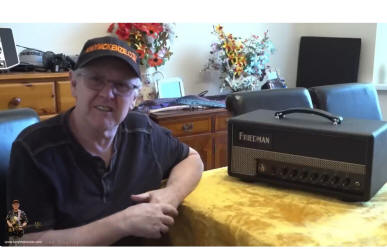
The Friedman JJ Jnr amplifier under review (the review is below the Intro Text)
Introduction and Preamble
I remember watching the videos on YouTube, listening to the incessant hype that Friedman was getting online... and I have to say that if I believed everything I MUST buy a Friedman amp! After all, from what I saw, the Friedman was the 'amp of choice' and I had to have one! Of course, I come from originally being a Marshall amplifier guy (and a short time with even Park and even some older brands of amps so choosing the Friedman (so they all insisted) would be a simple choice as basically the Friedman amps or their followers would tell me that the Friedman amps are really modified Marshall amps. Whether that was the case or not really was not the reason to buy one, but that hype could not be ignored. So I could say that I was rather like everyone else listening to the background chatter.
But I then did a little bit of checking out Friedman and how and where it was made etc. and to my surprise it was made by a different company seemingly somewhere on the west coast of the USA. Then I discovered that same build company made other brands of amps too? A sort of smorgasbord of brands seemingly all thrown in to one big pot. Of course I could be wrong about that, but my findings sort of suggested that. A little more investigation then told me that Mr. Friedman (I'll call him that) was said to sign each and every amp they made to 'confirm' that the amp meets with those 'high standards' that Friedman apparently has so I was told.
So I bought a Friedman JJ Jnr from Peach Guitars here in England (they are/were an authorized dealer of Friedman amps what ever that means) and I was looking forward to using the amp in my studio - the primary reason for buying it really. But along the way I thought I should create a review of the Friedman JJ Jnr tube amplifier for all to see the wondrous build of this amp, and signed by Mr. Friedman himself, so what could go wrong? Lets face it, for the £1450.00 it cost in the UK from Peach Guitars it should be perfect, after all the Marshall 20 watt amps typically sold in the UK for as much as half the price, so the Friedman JJ must me incredibly good. Right?
So I decided to create an inside and out review in just the same way, with the same criteria that I applied to all tube amps - I felt confident the review would exemplify Friedman as a leading brand, with great dealers that check the amps along the path to being sold retail to me. It was at the time an exciting purchase and one I looked forward to using in my studio to create some new music that could later be released worldwide as part of a new album.
I started by just playing the amp myself in the studio, and was not particularly 'overjoyed' by its sounds... it must be me, right? Then after a while I decided to flip the JBE switch and noticed immediately that it hardly changed the tone at all. After an hour or two, I decided to call Peach Guitars and point out the problem. They told me quite categorically that the JBE switch was 'subtle' and that was how this particular guitar amp really is. So ultimately the amp was really a bit of a letdown regarding its tones. It was not what all the online hype was saying so I thought, 'it must be me' so I decided to proceed with the removal of the chassis from its case, just to get on video and to ensure nothing had 'come loose' as the amp was shipped to me. So I started to create an 'Inside and Out' review of the amp in the same way I have for countless other amplifiers from Marshall, Fender, Selmer, Park, Hughes and Kettner, THD, Diezel, Mesa Boogie, Laney, Ceriatone and so many other brands of guitar amplifiers over the years.
I took a look at the top of the chassis, it all looked OK and I was creating that YouTube video so there could be no misinterpretation by me of the amp I had bought and certainly to document the amp as supplied. The review will hopefully create a great example of the JJ Jnr on camera for the first time. Sure enough, on the top of the amp it all looked OK to me, and sure enough, in one corner of the chassis, there was a scribble mark, reassuring me that Mr. Friedman himself had checked over this amplifier and it would all be really good inside, which seemed a reasonable assumption at the time. But nagging in the background was that horrible tone and that the JJ switch seemed to do little or nothing.
So I flipped over the chassis to see the internals of the amp. At first glance, upon a cursory look I never noticed any problem, but as I worked my way from the power supply area, through the preamp etc. then there it was - a particularly really bad botched area of this 'new' amplifier that had been supplied to me from Peach Guitars - the official dealer for the brand. That little mess was shown on my final video at 13:09 time stamp. Honestly I could not believe how bad this Friedman amplifier had been supplied to me brand new. Since 1971 I have to tell you that I have NEVER seen an amp supplied brand new to me in this condition. So what now?
Well as the first part of the final review video was documented at the start, I was not really wanting to show the final review video because of possibly 'hate mail' and other threats which I have seen before on the internet from what are often people that won't even accept what is right there ion camera in front of them showing the problems I found! But after real consideration for some time, I felt that I MUST report my findings no matter what, to potential others that might want to buy a Friedman amp. Of course this amp might be the 'only one' that was sold as bad as this, but in reality that might be hard to believe, bearing in mind that it was a third party building the amp. And of course then there is the 'squiggle' across the chassis apparently denoting that Mr. Friedman had 'personally' checked this guitar amplifier out? Right? Well ask yourself this... if it was checked by him, then he passed the botch at 13:09 as the quality level someone might expect? right? Or if it was not his 'squiggle' then the amp was not checked properly after being assembled by some third party company? Maybe that is a possibility.
There is of course an alternative scenario! Maybe the squiggle was Friedman's, and that amp was 'perfect' when they exported it and supplied it to Peach Guitars? Then potentially Peach Guitars opened the amp, botched the insides, and then sold it to an unsuspecting retail customer... me! But somehow I doubt that and I can tell you why (its just an opinion based on my experience with Peach Guitars). Some while before I had bought another different brand amp from them. It was (and still is) a really great amp that I still use to this day. Getting towards a year old it developed a problem. So I called Peach Guitars and they said send it back and they will fix it under warranty. On this particular amp (a Jackson Ampworks unit) there is a LED matrix that turns red when the drive channel is selected. Mine stopped changing colors. Back went the amp and Peach did a brilliant job of fixing it, and modifying the circuit a little to getting the amp working really well again so that the problem would not come back in the future. I did later check their work internally when the amp returned, and the repair was excellent. And to this day that tube amp has never failed despite being used lots of times.
But on the Friedman video at 13:09 that botch was far from what should be in a new amp or indeed ANY amplifier- so my own hunch is that Peach Guitars did not create the botch. You may have a different opinion, but my opinion is based at least on my own personal experience with Peach Guitars which should be taken in to account.
So where did that all leave me? A £1400.00 amplifier, supposedly brand new, and botched as supplied. I had the amp for a short time, so under the remote buying legislation I had 14 days to return it back to Peach Guitars and that's exactly what I did before the return period ran out.
Since the release of that review video not a single peep out of either the maker or the dealer about that amp and its condition? That in itself says a lot. Let's face it, it might be hard to criticize what is actually fact shown right there on the review video of the JJ Jnr amp on YouTube still on my channel today. But that also could be problematic in other ways. Not a single person involved seems to have investigated that amplifier to this day (this web page is written in April 2026) at least no one has spoken to me at all about that amplifier and its never been acknowledged by any of the players in the making and/or distribution of that amp. Do they even care? Who knows. Fan boys will tell me that somehow I'm at fault - for buying the amp and creating the video it's 'all my fault', or they also often tell me that if I contacted Friedman directly etc. that Friedman would 'take care of me' but whose responsibility is it? Certainly not mine as a paying customer. And of course I don't have the amp either thankfully.
Even more scarily, someone somewhere will have bought that exact guitar amp! And maybe they think the JJ switch is 'weak' or the tones are just 'average' without actually knowing that there is a likelihood of that amp having problems from an internal botch? What then? This is one reason why I published the review video of that amp exactly as supplied. It's always better to make an informed decision rather than just on some whim that something is as described on some forum - particularly the fan boy forums out there. Having said that, some forums are excellent too - it just depends which ones.
I never did have any issues from any other maker with their amps I have bought and what it says to me is really like a lesson for retail customers to heed. NEVER assume from some online hype or fan boy comments that the product you are going to buy is what it should be. Always look carefully at the return policy BEFORE you buy any product and always if the item appears to be used before you got it - as seen when it arrives, then send it right back.
This is overall a long review but there is much to be learned from it!
Here is the written review of the Friedman JJ Jnr:
Back in April 2020 following much hype I bought a JJ Jnr amp from a well known UK dealer because I wanted some of that 'great tone' that many were telling the Friedman amps had. So I invested in the amp and why not!
I decided to try the amp out in the studio as soon as it arrived and for me it did not quite sound as good as those others suggested. I was disappointed for sure and even the little JBE switch did hardly anything... so I called the dealer (Peach Guitars) and they told me 'that's how the JJ Jnr is - the switch has little effect' or words to that effect. Oh well I thought, maybe they are right but for my money the amp sounded not good at all.
Overview and a Look Inside the Amp
The Power Transformer
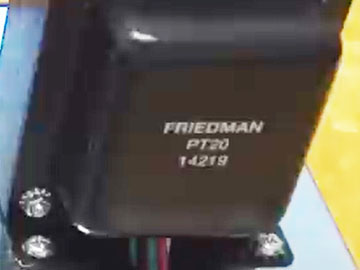
I always take a look inside every amp that I have ever reviewed - even ones with or without tubes and I always proceed to look at the chassis top, its components and look inside at the electrics just to ensure there is nothing that might or might not be what it should be. The chassis was really what I would expect. The power transformer is a Friedman PT20 (14219) that seems and looks adequate for the job.
Power Tubes
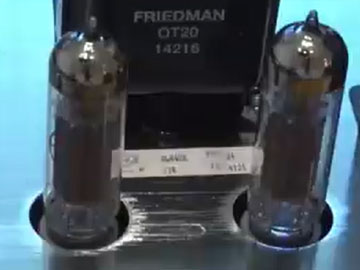
Next were two EL84 tubes which looked OK but were made by JJ. While those tubes might be fine, for me, they were not really the brand I expected (basically Chinese tubes) and would have been far happier with TAD tubes. TAD do sell Chinese tubes too (some of them) but the advantage is that TAD remove the problem tubes in their extensive and burn in tests so you get good ones!
Output Transformer
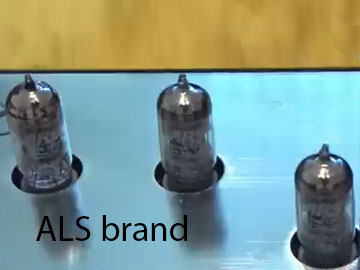
The output transformer again was branded Friedman, called the 'OT20' and had a part number of 14216. It all was as expected really. So far without the 'Friedman' branding it was very reminiscent on the top of the chassis rather like a Marshall 20 watt amp. Moving along a little more are the 'ALS' branded 12AX7 type tubes and again I wondered about those as I rarely came across them.
ALS - The Brand?
But I did do some research about the ALS stuff as I moved forward with this review and those were the 'brand' (I'll call it that) that the amp maker (or is it assembler) used for tubes they branded as well as actually making the amp itself. I was rather surprised from what I read from others that ALS actually assembled the Friedman amp itself. So how good or bad was this company? On further research ALS seemed to make other brands of amps too. Oh well.
The Friedman Signature
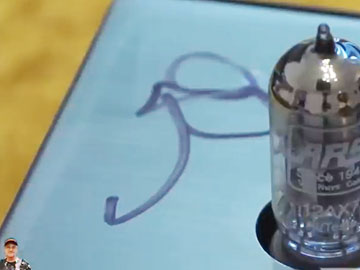
Above is what is termed as Friedman's signature on the amp chassis. While it could be a signature of course, how many people can actually read it, and how many can categorically confirm that this amplifier has been checked by Friedman himself? To me it just looks like some sort of squiggle and attribution for me is impossible. However, its a selling point as Mr. Friedman tells everyone that he 'signs every chassis' and presumably checks them too? and if not, why not? Why trust a third party company to build an amp that you sign, and then don't check their work on an amp that carries your company's name. Go figure.
Electronics in the Chassis
Click for larger image
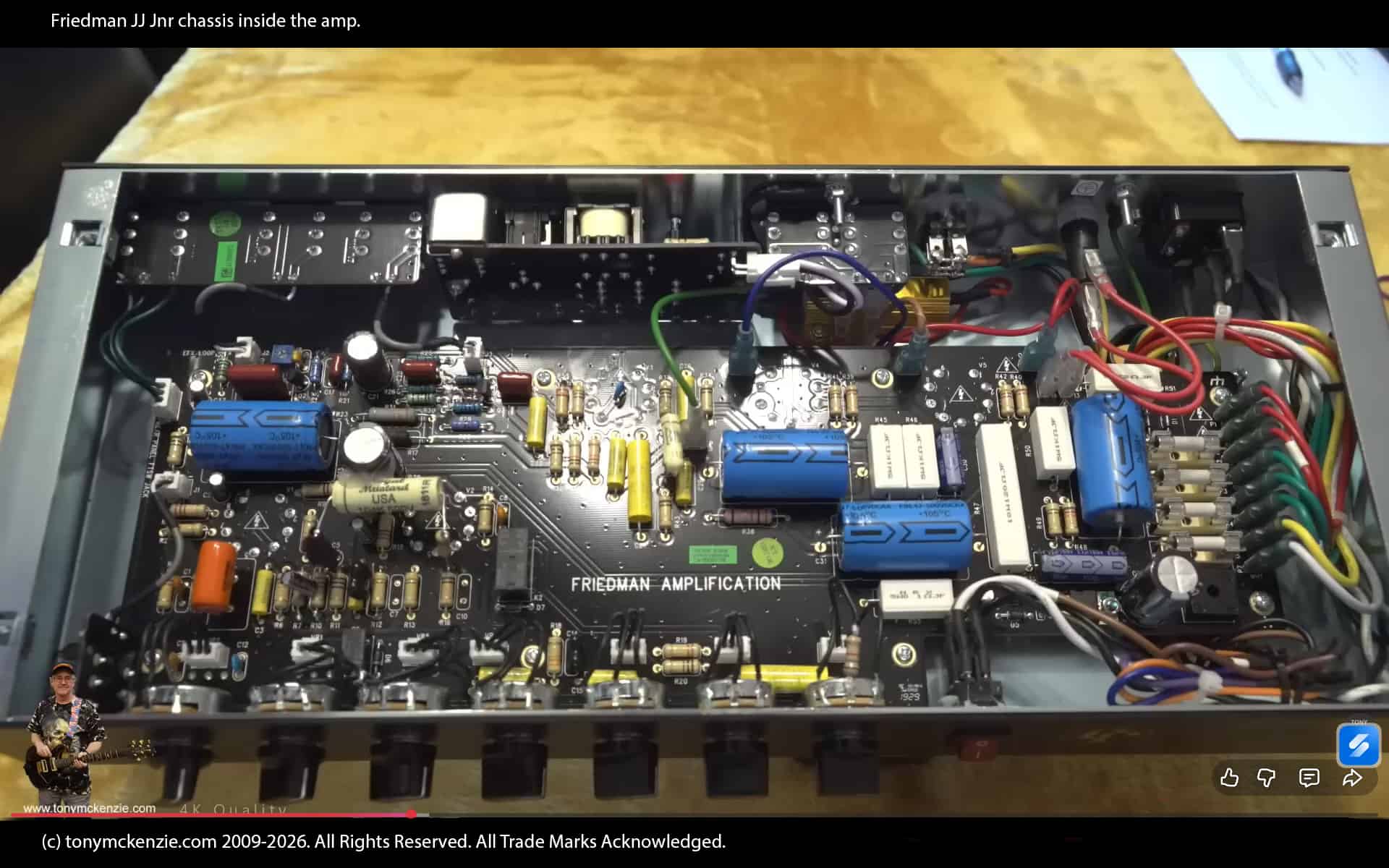
Once I turned over the chassis, with a quick look it all seemed OK at first. But what is usual for me, is to look closer at the electronics and the components and of course the quality and build.
The Power Supply Area
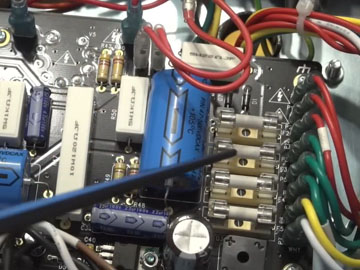
The power supply area is part of the main PCB made amplifier and it is pretty much as I would have expected. Again, in my opinion it had a passing view of looking rather Marshallesque if you will. Nothing wrong with that and its easy to see the fuses etc. that are similar in many other amps too. The quality of the build was 'fair enough' and those large capacitors (the blue large ones) were again the 'ALS' brand. So for me, the 'ALS' brand did not and does not hold any water for me. I would have certainly been happier with capacitor brands that would have maybe more befitting for the Friedman 'brand' like TAD capacitors or maybe F&T capacitors that have a world wide reputation for being the best out there. But it seemed that these cheaper capacitors sufficed for the JJ Jnr amp. To be fair, Marshall often use 'Samwha' capacitors that are hardly a top brand, but in the case of 'Samwha' they rarely fail.
Cement Resistors
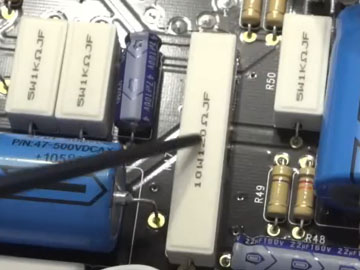
I was concerned that the cement resistors shown above are hard mounted on to the main PCB. These comprise of 5 watt and at least one 10 watt resistor. This will probably be a problem in the future when the capacitors burn the PCB. And if that does occur then the repairs will undoubtedly be harder to fix than some other simpler stuff, especially when it involves the PCB. Here's a shot of a cement resistor on a competitors amp that has about half the price of the JJ Jnr.
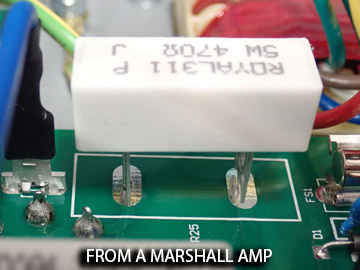
As you can clearly see from the above image compared to the one inside the Friedman JJ Jnr Marshall specifically lift off these high powered resistors off the main PCB to prevent damage because high wattage means heat dissipation. The capacitor shown in the Marshall is the same 5 watts that those (at least three) in the Friedman JJ Jnr are also but Friedman (or is it ALS) don't bother to lift them off the PCB. Even today I think this remains a problem for ANY company that fixes cement resistors hard on to the PCB.
Power Switch Silicone Sealer
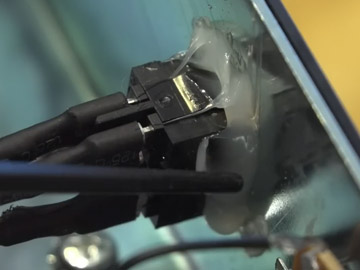
The power switch I also found a bit poor in my opinion really. I have seen a number of tube amps and even simulators like Fractal Audio Axe-FX devices with a similar way of working. Some have said its for this or that reason, often 'defending' that sort of work. But having seen so much gear over the years and so many amps etc. that were built correctly and did not need silicone sealer to help keep switches in place I disagree. Why not simply use decent switches that don't need this 'fix'. If a switch can come loose or pull out maybe its a good idea to make it so it can't come loose or fall out by engineering the components properly in the first place.
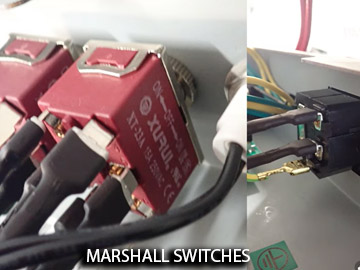
Well as you can clearly see for yourself, compare the above image compared to the JJ Jnr 'fix' of the power switch. In the case of the Marshall amp I also showed the input connector fixed to the chassis and the two pictures go some way in to what you are buying from each company. Personally also I never did see silicone on any Roland or Boss equipment either for example. I can also confirm that the input power connector on the JJ Jnr was fine and exactly as I might expect it.
General Board Build
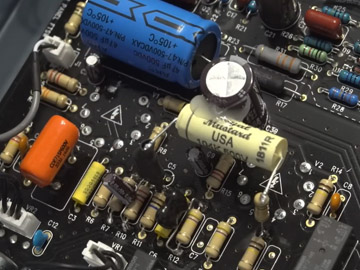
Some of the general build of this PCB is quite satisfactory and follows typical build styles by a number of companies that I have seen. I don't mind the silicone on that capacitor and most work seems to be adequate... I personally don't think its as good as some of the brands of equipment I have seen over the years, but it is generally acceptable at this part of the PCB on this JJ Jnr amp.
Small PCB Designs
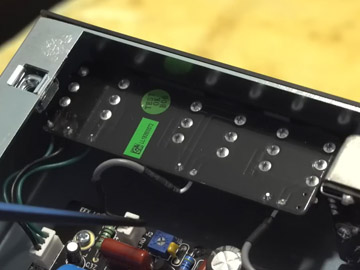
As you can clearly see from this design of the effects loop Friedman does use small PCB's to implement things like this. That's a good thing because if there is a failure then it is simple to change the board, or if no longer available you could make one! It's what I would expect to see in amps like this one.
The Friedman Botched PCB in the JJ Jnr
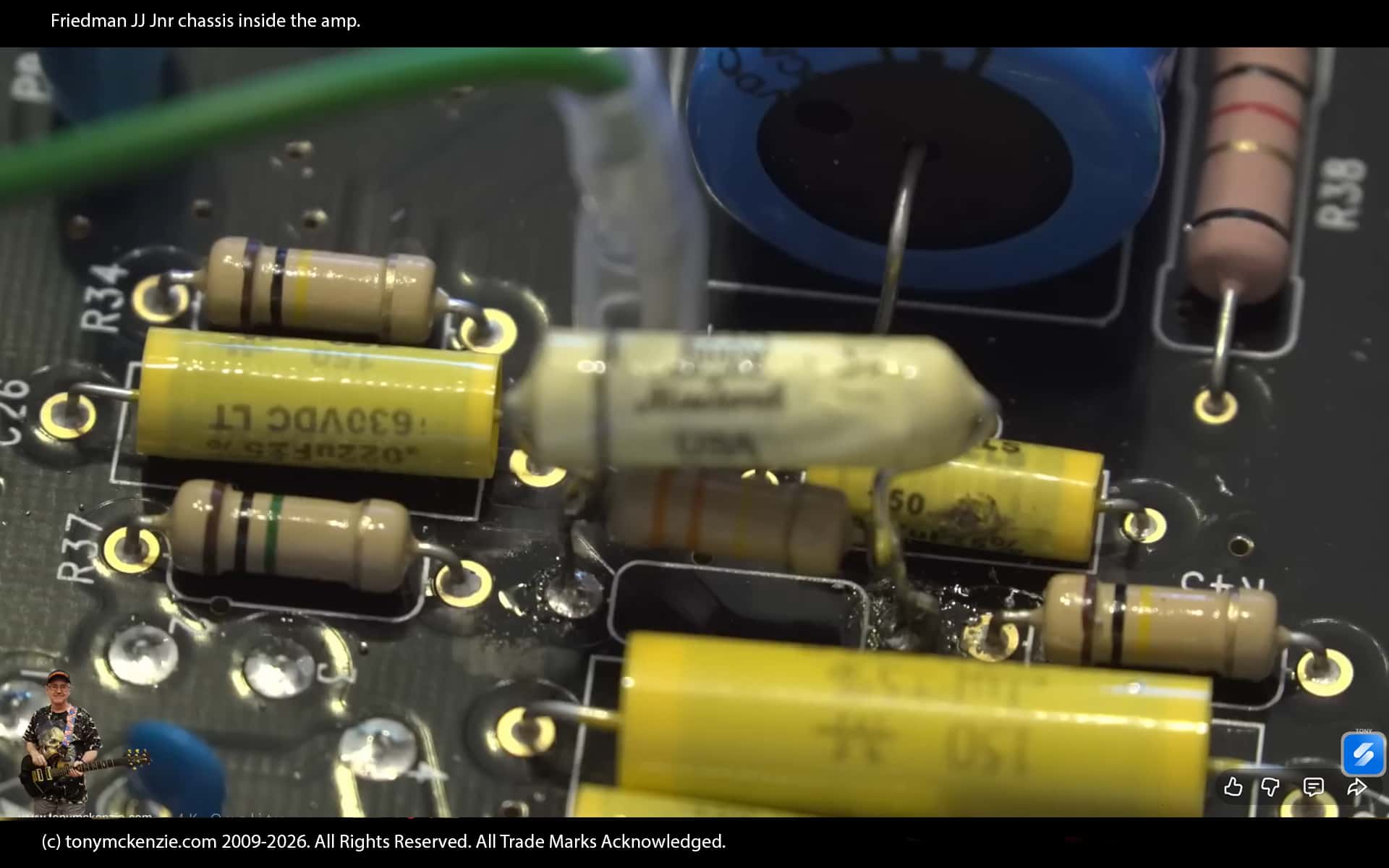
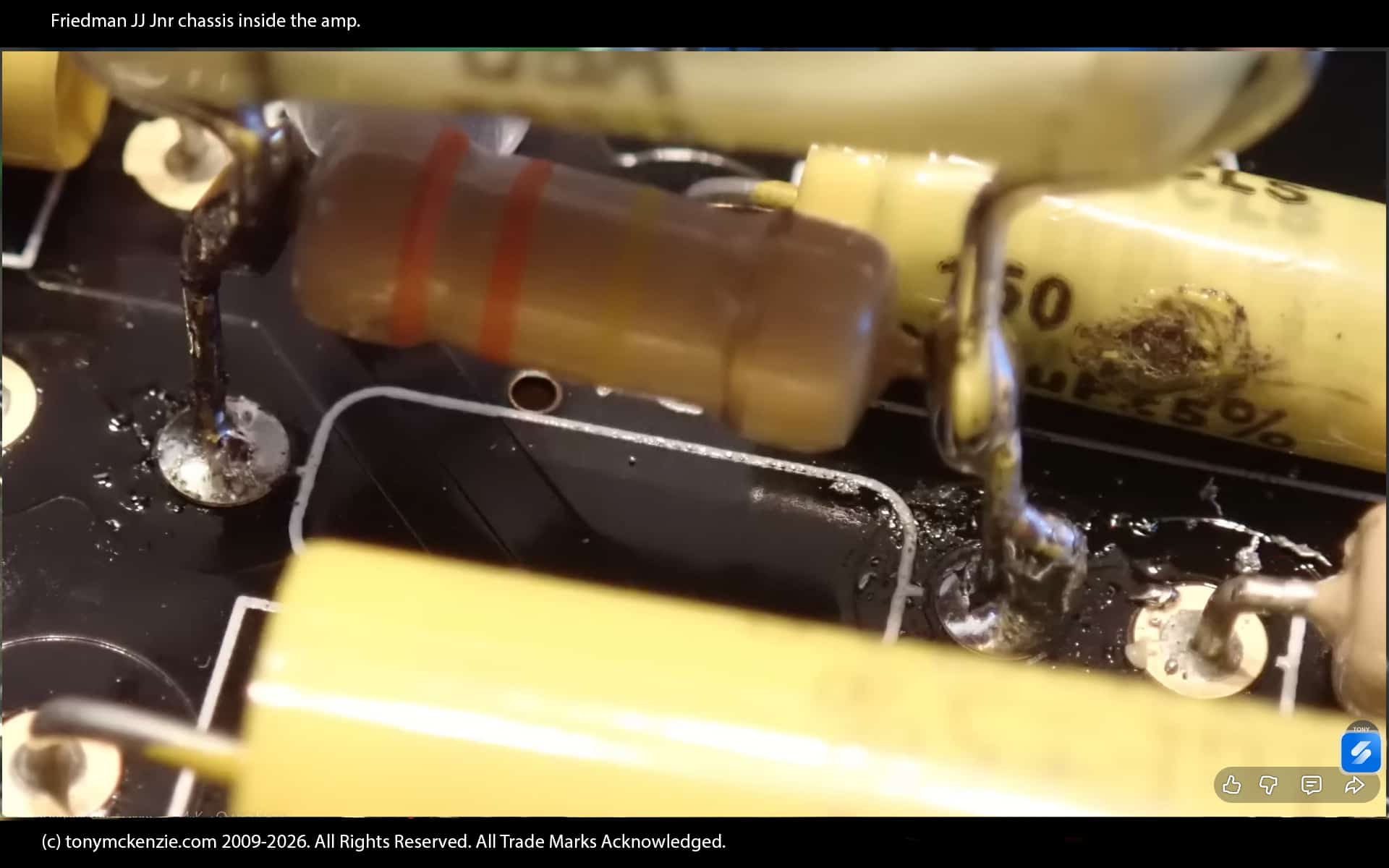
Click for a larger image
It was immediately clear to me that this Friedman JJ Jnr amplifier as supplied from Peach Guitars was far from what I was led to believe I would receive. Its easy to see that background capacitor all burned and damaged by some idiot (whoever it was), and the overall botch to the PCB and surrounding components made me stop in my tracks.
Whether this amp came out of that 'AMS' company, or Friedman, or Mr. Friedman signed the chassis as shown, or whether Peach Guitars had 'fixed' the amp in the UK who knows. But someone really does know. I for one would NEVER accept this amp as a purchase because its completely clear that someone has botched the amp, whether in manufacturing or later I don't care - the result is as bad whatever happened. Of course it could have happened anywhere... there are a number of scenarios that spring to mind, but my opinion here is guess work. But no matter how you cut it, the results are the same - the CUSTOMER got ripped off for a sub standard Friedman JJ Jnr guitar amplifier.
I could write my opinions about what happened, but it would serve no purpose as the image says it all. Let's move on and I'll sum this up at the end of the review.
Amp Controls
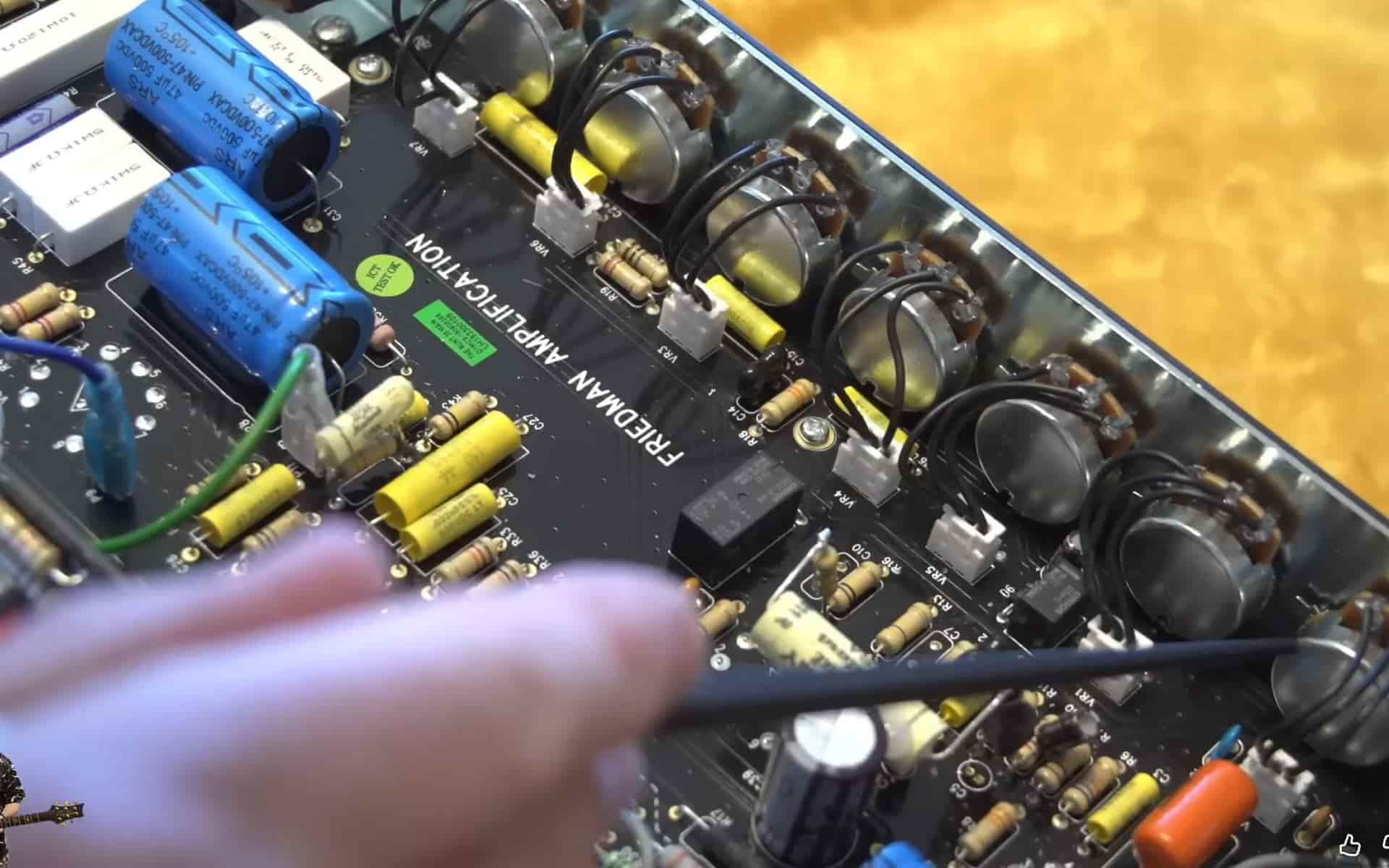
Large image click the picture
As you will see the pots fitted are fitted in a way that you can simply unplug the flying wires and change out the offending pot if there was ever an issue with them. That's a good design and I like to see it. While other amps often have their own answer (like a small PCB for the pot mounting with fly wires) but this particular design I felt was pretty good by any standards. The POTS by the way were all Alpha pots branded.
The I/O and Controls
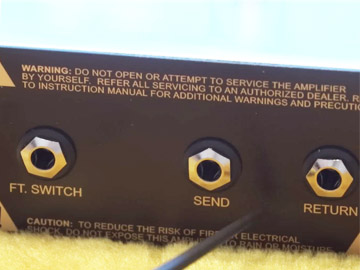
As you can see from the image there is a rear foot switch connector and a send and return for the loop. The loop output can be adjusted inside the amp itself but there is no external adjuster for it. Note that the footswitch IS included with the amp.
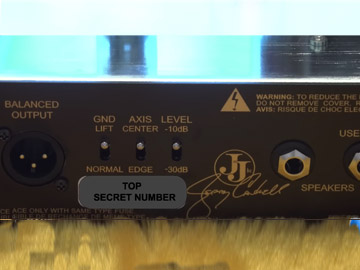
we've got a balanced output that you can whip off to your recording desk I suppose and we've got a few different things going on here that relate to the balanced output there's a ground left, an axis center or edge for where the microphone should be, and a minus 10 or a minus 30 which is a bit of a drop in my opinion but worth knowing about, there's a jerry Cantrell logo but I guess he would not like this amp! Moving on we've got the speakers outputs.
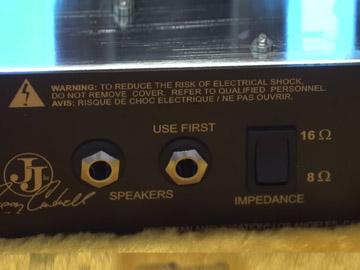
The speaker outputs are really pretty straightforward use first it says, second one and there's a 16 or 8 ohm impedance switch. This switch I guess is one of the switches that was held in place with the silicone. It's probably OK but once you are aware of that then somehow things are not quite the same.
Power Input
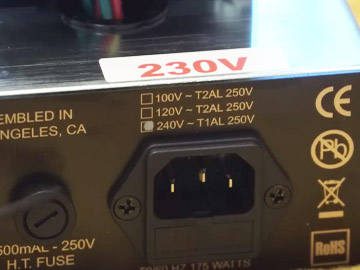
Here is the power input at the back of the amp. Notice the fuse on the left hand side of the image which is a HT fuse. And there's a fuse in the power connector too. The mains connector is fitted well and is clearly marked on the outside of the unit as 240 volts and tells you which fuses to use for each voltage. However, something slightly concerning (and not just with this company) you can see a 230 volt sticker? So which power input is it? 230V or 240V? You might baulk at this as some do that are not familiar with approvals. I have seen a EVH 5250III similarly wired for 230 volts too, as well as others. The problem is, if the amp expects 230 volts as an input to the PT, then you actually input 240 volts, then on the output side of the PT the voltages will all be higher, and in some cases over voltage for the particular components! Longer term failure may occur. The Fender EVH 5150 III can be switched to correct this, but what's the situation with this amp? is it 230 or 240v?
Front Controls
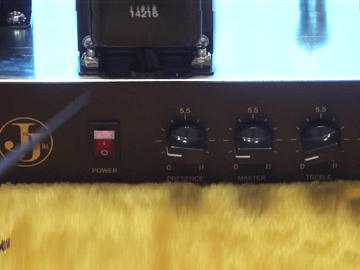
The front of the amp is pretty straight forward as you can see. Firstly there's the JJ logo on the left, then we have an on and off switch. I showed how that was mounted earlier in the review. Next is the Presence, the Mater and the Treble controls... all pretty standard stuff. Controls are mounted OK.
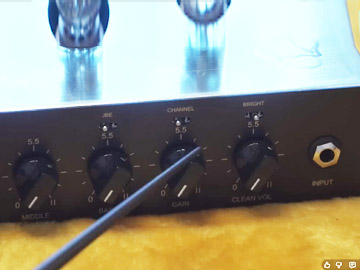
Lastly across this image are the middle, bass, gain and clean volume. All standard stuff. But along the top above those controls are more important ones - some might say... there's the 'JBE', the channel switch and the bright switch. My guess is that readers will be familiar with the front controls except that 'JBE' switch. This selects between the BE (Brown Eye - standard) and JBE (Jerry Brown Eye - modded) modes as supplied for the gain channel. Engaging the JBE mode adds significantly more gain, saturation, and compression for a thicker, more modern tone, though it may result in a perceived volume drop.
And here is the second issue that I had. While certainly the switch was there, the above description had no association with reality when it came down to this amp. It actually might not as well been there! Peach Guitars said 'it only has a slight difference' or words to that effect when I complained. Personally I did not accept that comment as making sense really, the switch was useless on this exact amplifier. Perhaps the botch in this amp affected the ability of the JBE switch to carry out what it was supposed to? or not?
CE Certification and Safety
Anyone familiar with CE approvals etc. will be aware that the information on the device for power etc. forms part of the CE approval. So it's a little perplexing that this amp has a presentation of 230 volts AND 240 volts. In that situation would it pass a CE laboratory check? You might tell me it would... but having seen CE testing in action maybe not. There is no exact certificate to download or presented to the owner that I could see, so who knows about the certification for CE. I have personally seen goods arrive in the UK and be seized by trading standards for what they call 'unsafe' equipment. They confiscate the gear and then tell you to 'get your money back' from the seller. For countries outside the EU and that certainly includes China and the CE certification and testing they treat it like a joke - falsifying the CE approvals with 'similar' CE logos for example. I am NOT inferring that this amp is not approved or is falsified in any way, but to be clear you could ask for the CE lab test just to be sure.
Other Observations
I noted that the amplifier is marked up as 'Assembled in Los Angeles CA'. Well that's good if it's true and less good if it's not. However 'AMS' at the time appeared to be based in California, so my guess is that it's correct. And of course what does 'assembled' mean? From looking at this amplifier if this is the overall quality of what someone could expect from 'Assembled in Los Angeles CA' then I'm pretty sure other than the fan boys few would opt to own this exact amp.
The manual says it's got a 'limited lifetime warranty' on everything except the tubes! Those tubes are 90 days I'm afraid and why am I surprised? With JJ tubes I'm not surprised in the least and that brand is the ONLY brand I have ever had fail in use! If you like them great, but hey when the tube fails and takes out your amp remember I said it. Buy quality tubes like Tube Amp Doctor tubes that are tried and tested and selected to be the best tubes you can buy... they even sell JJ tubes - and those won't fail like the 'every day ones' you might buy.
I like the quality of the amp box that's nice, it's good from the outside but i don't like the feet too much they're a bit like furniture feet. Overall when you buy the amp it looks fine, but does it look fine inside? It's one thing I have learned from this review. NEVER trust a dealers words, NEVER trust the 'fan boys' on the internet, and NEVER judge an amp by its cover!
Final Thoughts
I set out to buy a tube amp from what some claimed was 'the best' maker of the time, but what I actually got was a joke. The dealer or the maker or both of them really are responsible for this Friedman JJ Jnr amp and frankly I don't care which. Ultimately I returned this amp as soon as I saw the mess inside and can you imagine finding that inside your amp later down the road, especially if it failed because of the botch.
Honestly, don't assume that what you are buying is what they claim from ANY company, and then later you won't be as sad when you realize that the hype and fan comments and those paid for reviews that told you it was the best thing since sliced bread were really just selling machines for the music business.
Thanks for spending the time to read this very in depth review - and expect another 20 or so on other equipment - some great, some not quite so, but all really worth watching and hopefully you will learn from my experiences and through genuine real reviews of equipment I have bought personally. Thanks.
© A B McKenzie 1997-2026. All Rights Reserved. All Trade Marks Acknowledged.