
Headrush Core is a powerful effects unit below the Prime... But does the Headrush Core reign superior or is it an also ran pedal?
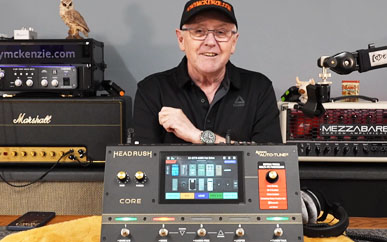
Headrush Core Seems a good idea... but how good is it?
Introduction and Preamble
Before I got to this Headrush Core, I had bought and reviewed the Headrush Prime - and before that one of their 'little' pedals. While it was all interesting the Prime had problems that I often see on many of these types of modelers or amp simulators or effects pedals I'll call them and it's one of a rush to market. What do you mean Tony? Well you see these companies (Line 6, Fender, Headrush and others launching products that don't actually include what they say at launch, or the item they launch simply does not work well. It's true that later when they 'get their act together' that firmware updates generally make it work, and start to add features that were claimed at launch, with mouthwatering reviews by paid reviewers, but those never turn in to reality from the start when you get your unit.
My guess is that if you knew what you were letting yourself in to when the gear is first launched that most guitarists would simply not buy it, and wait until 'others' say it now works. But that CANNOT be the case for someone like me! Why? Truthfully, when I buy anything that includes firmware and/or software and is new I have always believed in showing exactly how it was for me in the hope of education guys so they can make a more informed decision about what I was reviewing.
I agree that things do move on, and no more so than in this crazy amp sim or modeler marketplace where it almost seems the norm to launch as 'fast as possible'. There are some exceptions - I would cite Roland Boss, simply because often their gear works, and rarely is there some software problem (although I have seen that too).
So here is the Headrush Core launch edition and how I found it under review the good, the bad and the tones and everything else. You might be surprised that this unit worked better than the Prime (also a version with earliest firmware in it) and my guess is they solved the rubbish on the prime, cut back the firmware to work on the core and hey presto... its what the Prime should have been at launch.
This is a totally unsponsored review and I actually paid retail for the unit under review, as I did for the Prime also, so my view is entirely based on what was supplied at the time.
Also bear in mind this review is at a time when Headrush had no real editing software, but today things have changed and maybe I'll cover that at the end of the review. So let's look at the Headrush Core.
First Impressions
Once I unboxed this core it did impress me right off the cuff. Somehow everything provided was looking good, and unlike the Prime this device simply connected to my network, whereas the Prime was a total nightmare to the exact same gear? What I will say is that I think they solved the connectivity issue of the prime by this time and the core was great. But it should be - this unit cost me near enough £750.00 (that's probably $975.00 at today's exchange rates in 2026). The Prime of course cost more!
You WILL need that internet connection as much as possible for the Headrush core - it likes to be on the internet in to their cloud.
The Core is from what I can see initially a well put together device but I'll take a closer look I think.
Inside the Headrush Core Amp Sim Modeler
I can never understand why anyone would want to buy a product, but they don't care about what's inside? For those 'Pro's' out there they are prepared to use something that could be riddled with agro inside, but they 'just don't care' seems strange. But the more ordinary guys like me and you, well I think it's worth knowing about any prospective device. There really is some rubbish out there and not looking inside, well you would never know about quality or even obsolete parts used to make the thing. So inside matters!
Outer Case
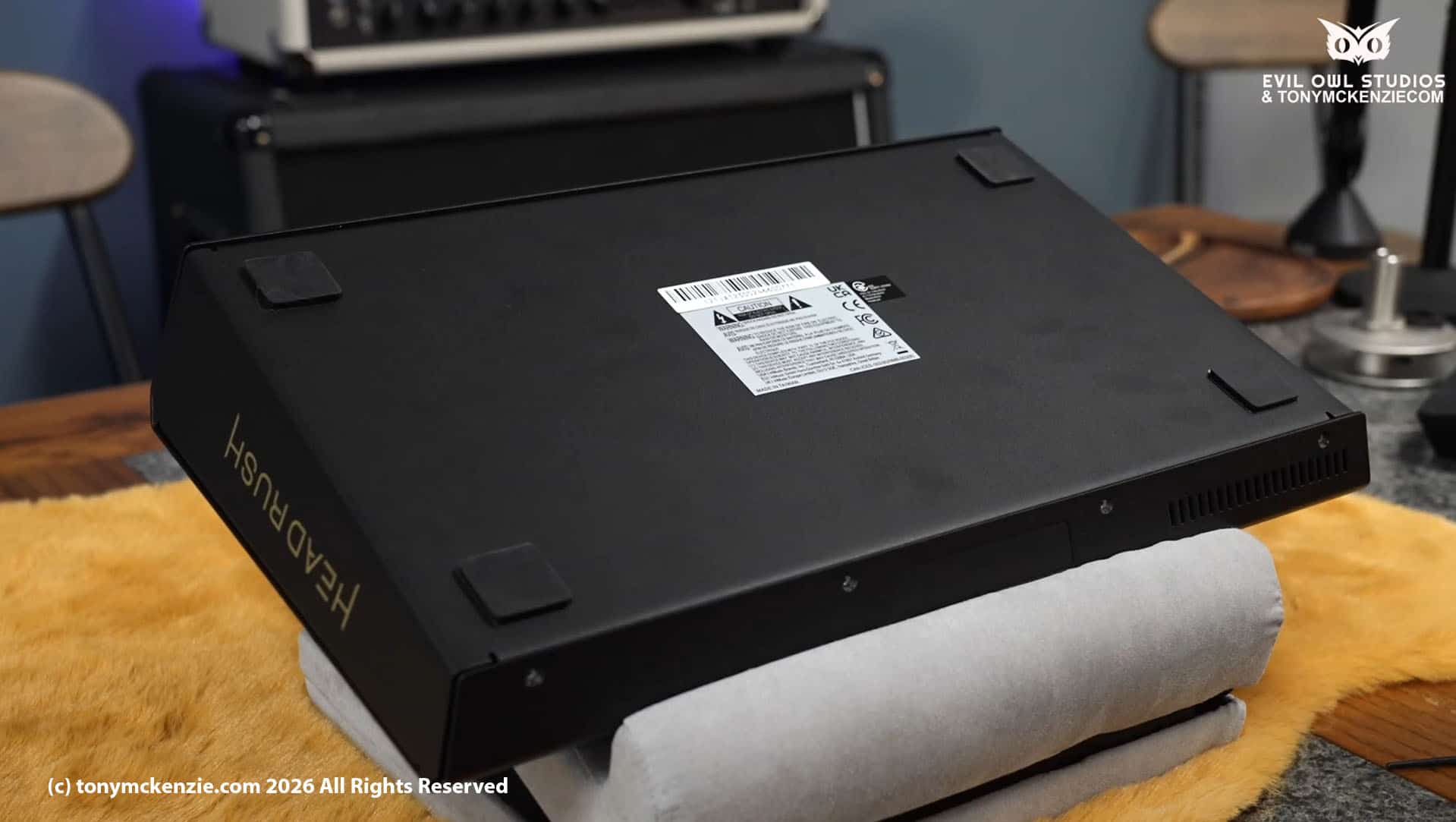
The bottom case is made from a sort of pressed steel and screwed on very securely. It's finished in a sort of (maybe) powder coated type of thing and is a mat paint job - but it does feel 'cheaper' than some brands I could mention.
Overview of Inside the Headrush Core
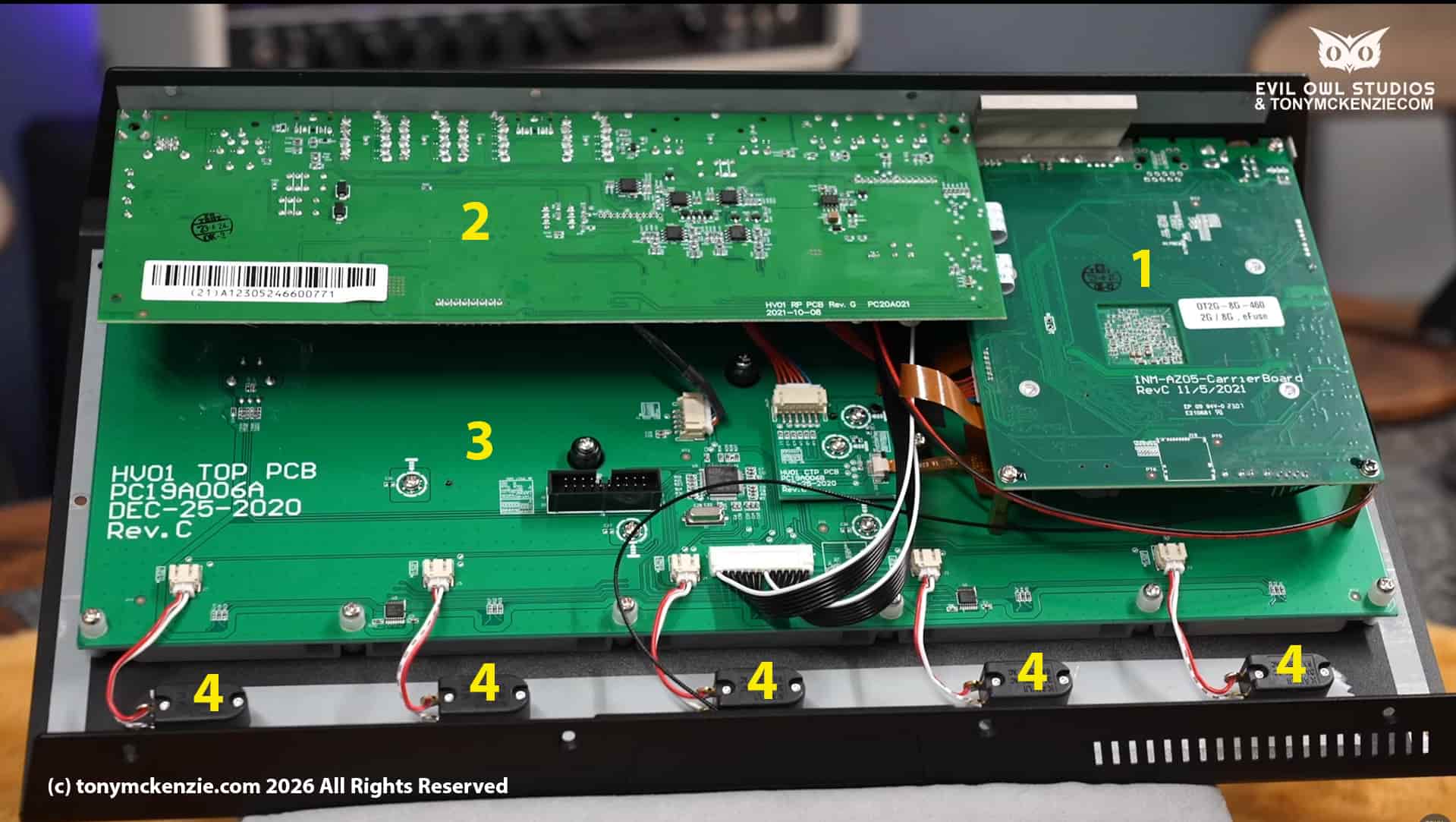
There are a number of boards as you can see and I have numbered them so I can discuss them here. Click the image and you will see:
- 1. This is the main processing board in my opinion and you will see the underside of the processor in that square cutout. More about the processor later
- 2. This board has a load of I/O attached to it and to the back of the case assembly, and connections to other boards.
- 3. The very large board at the bottom (its really at the top of the unit, houses the controls, that screen and maybe those scribble strips near the switches
- 4. There are 5 foot switches clearly mounted on the top of the chassis and really well engineered in place. I like this type as YOU can buy them on the open market.
So overall so far so good and those boards are clearly built on a flow solder machine, but likely presently I'll take a closer look at those and the components that are so critical for longevity and for operation. Notice the board designs are dated and some go back as far as 2020! Ah so you thought you were buying the latest 'cutting edge' technology huh! In any case its good that the overall unit is broken down in to these sub boards.
Processor Board
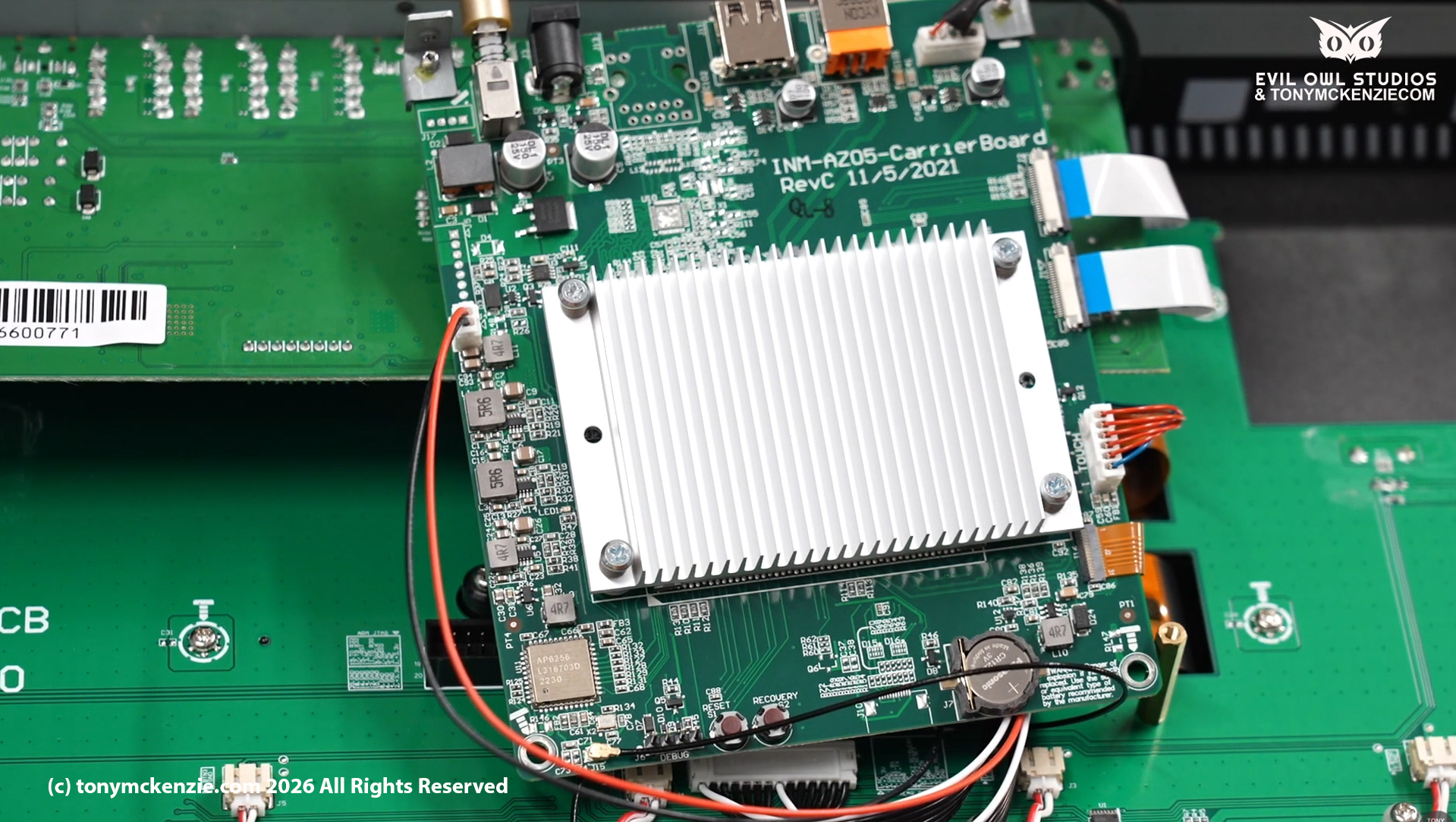
It's certainly a big heat sink and under there will be the components that make or break the Headrush Core as an amp simulator and effects pedal. The wrong processor(s) or limited memory, and the unit will certainly feel particularly slow in operation. In any case I'll look at the components further down in this section. This is a very well made board and from what is presented to me there is little or nothing so far that is concerning.
Notice that down at the bottom of the processor board is a 'Penny' battery a CR1220 type that I bet you did not know was there. At some stage this will fail and you (lucky you for reading so far) will just flip off the back and replace it! :)
Processor Components
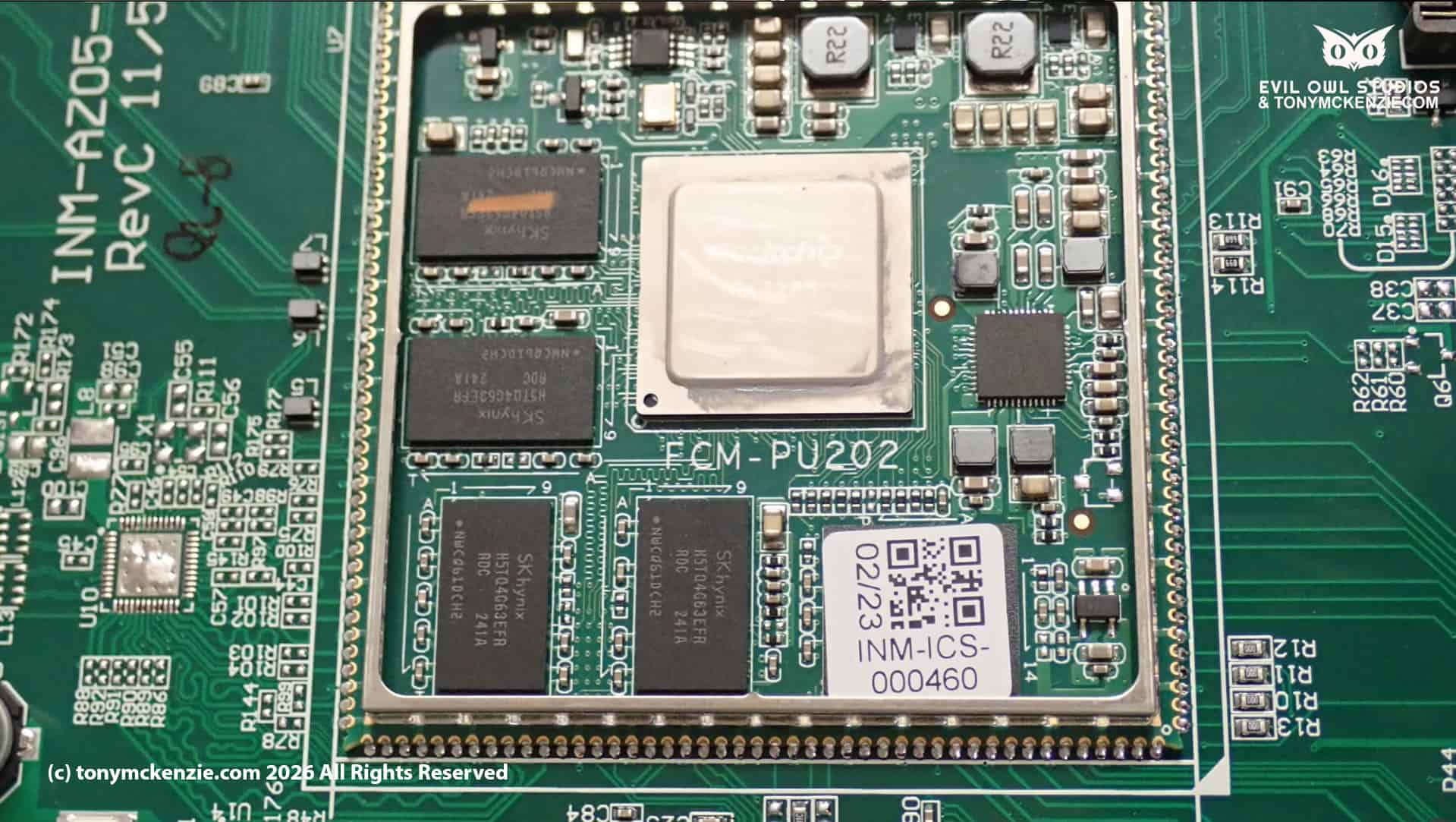
Just a first view of under that heat sink - and I'll be coming back to that later. You can see the processor, the memory chips and another important chip all assembled on that board and the quality is perfect.
The I/O Board
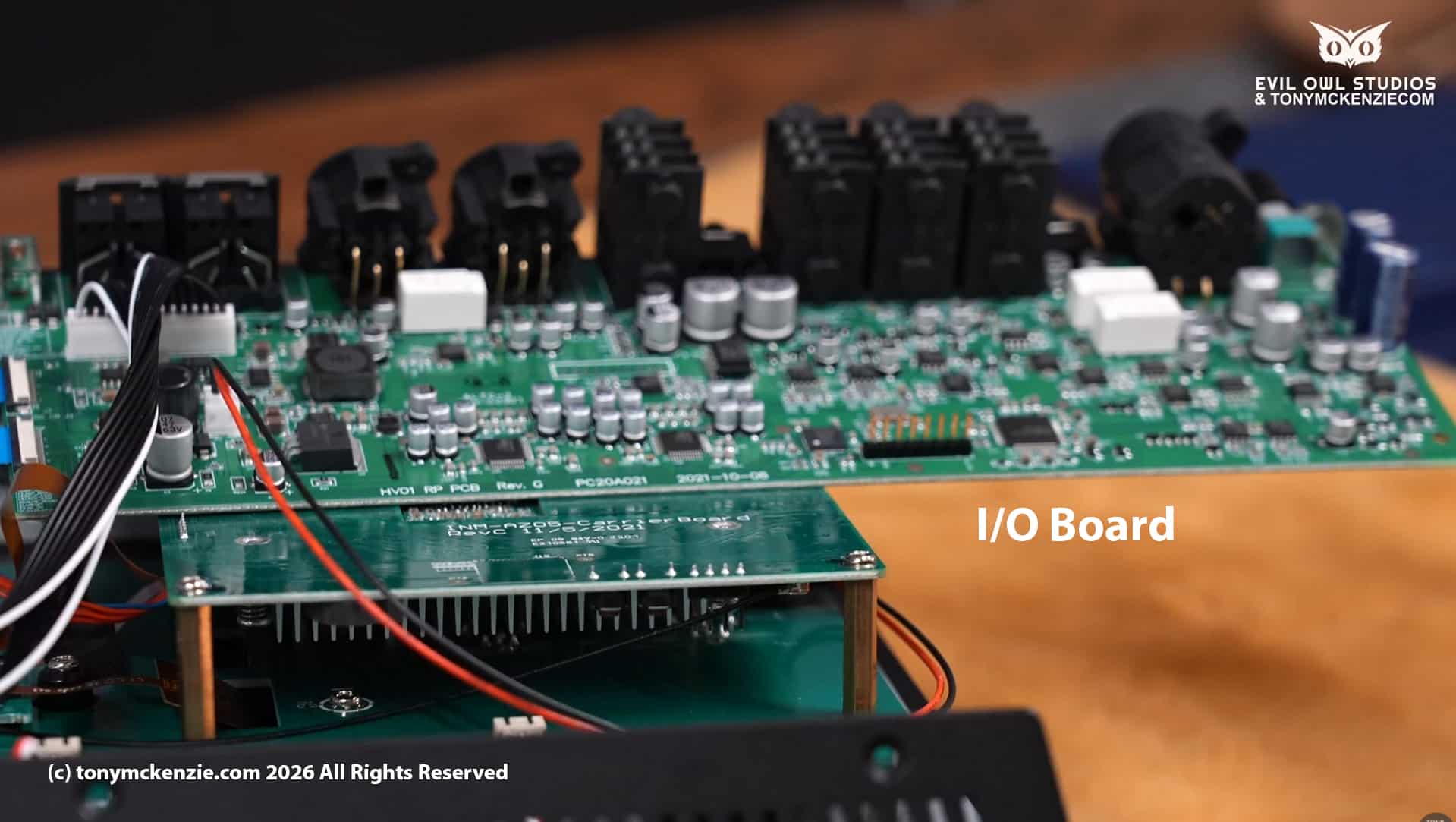
Open the larger image and review those in this section and you will see many plastic I/O connectors mounted directly on the I/O board. This is not the best way of doing things in my opinion, but at least they are on a separate board than the rest of the components. Look closely at these other images and ask yourself if these IO plugs, sockets etc. could get damaged over time through being used on a stage constantly? For me its no problem, a studio environment is so different really. But remember this won't you? Many of the I/O is mounted with plastic nuts too as well as some screws so its not all bad.
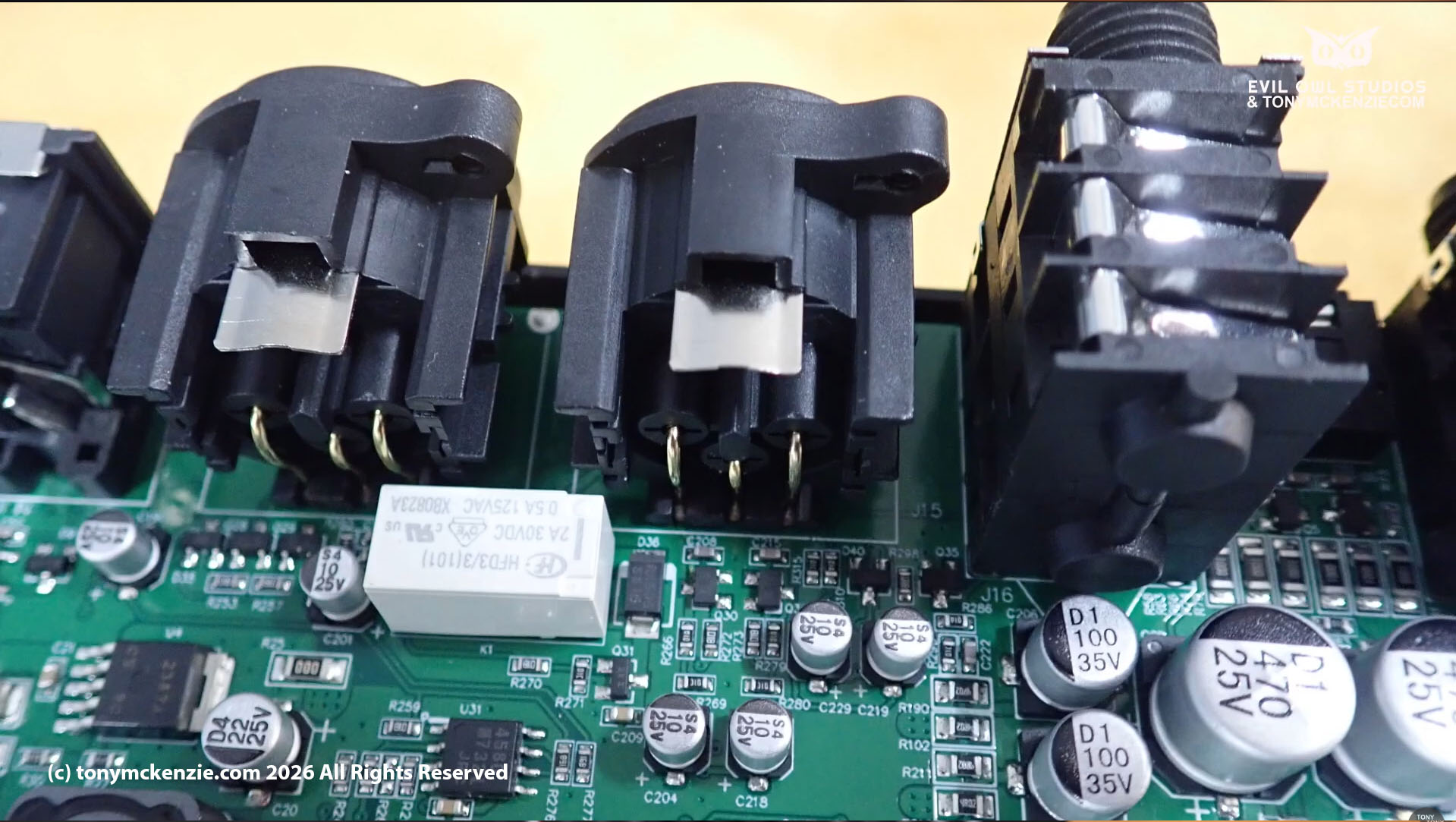
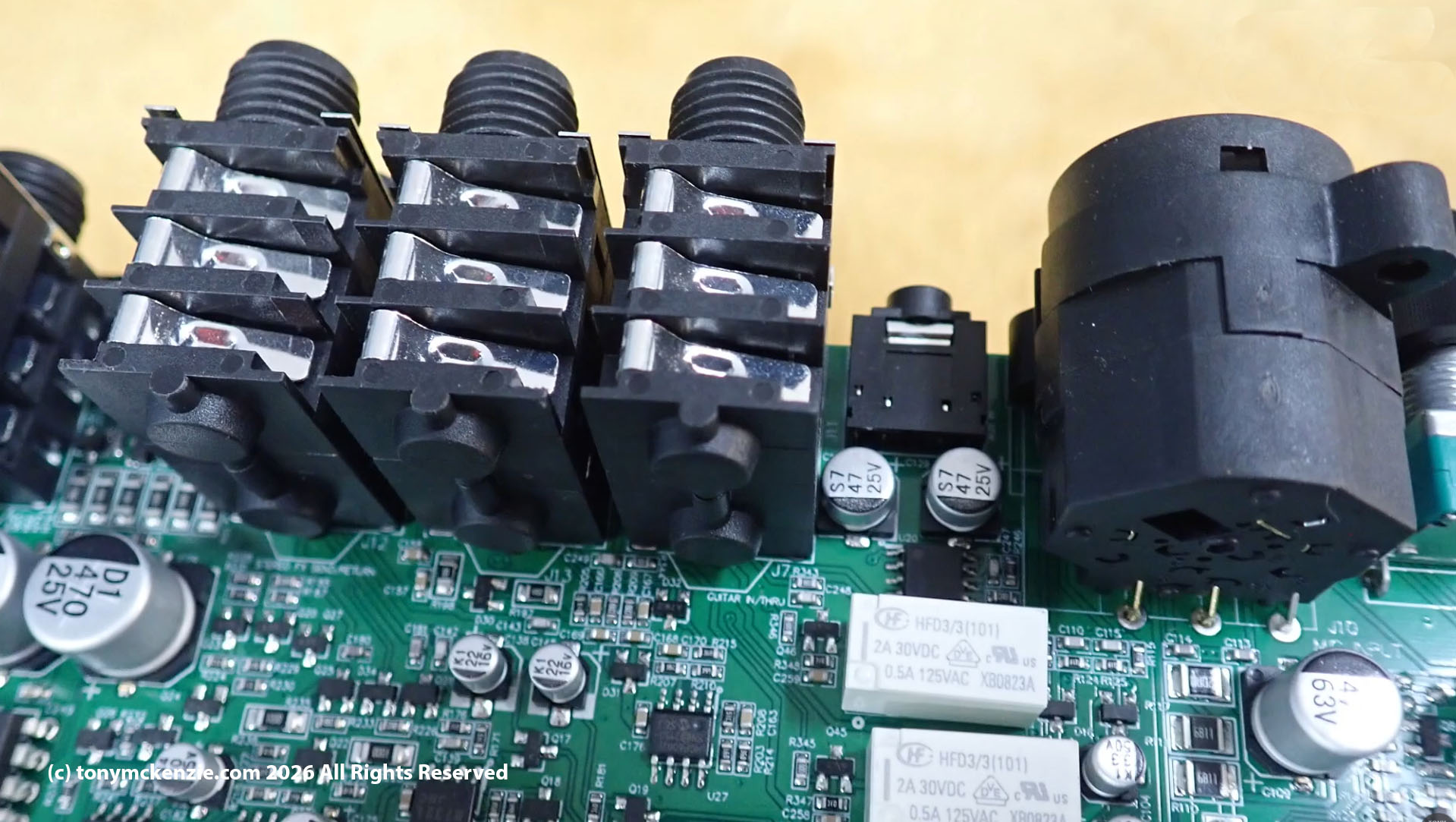
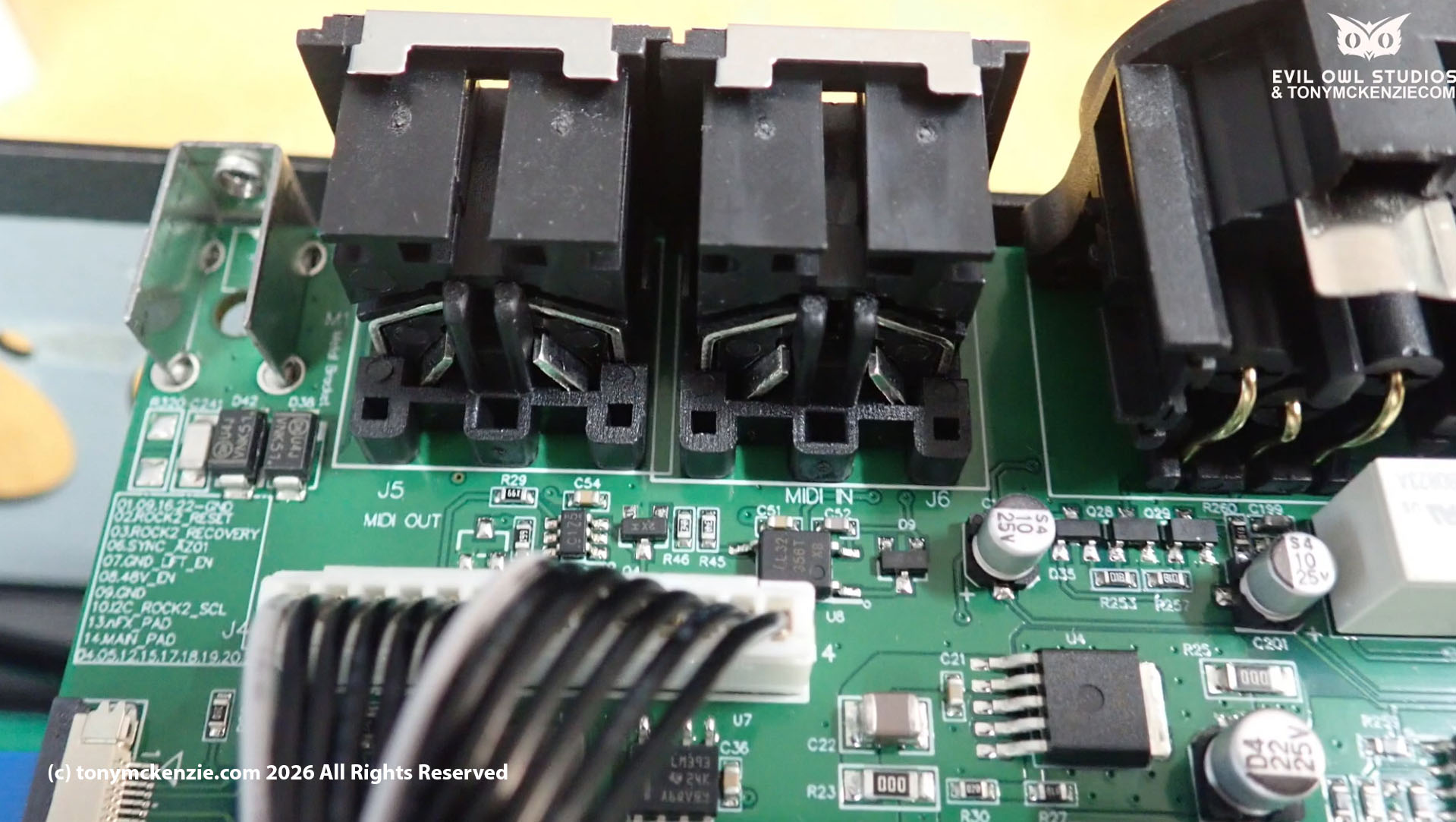
I hope you took a look at the I/O and just for clarity, there are many of this type of device that is similarly created.
The I/O Components
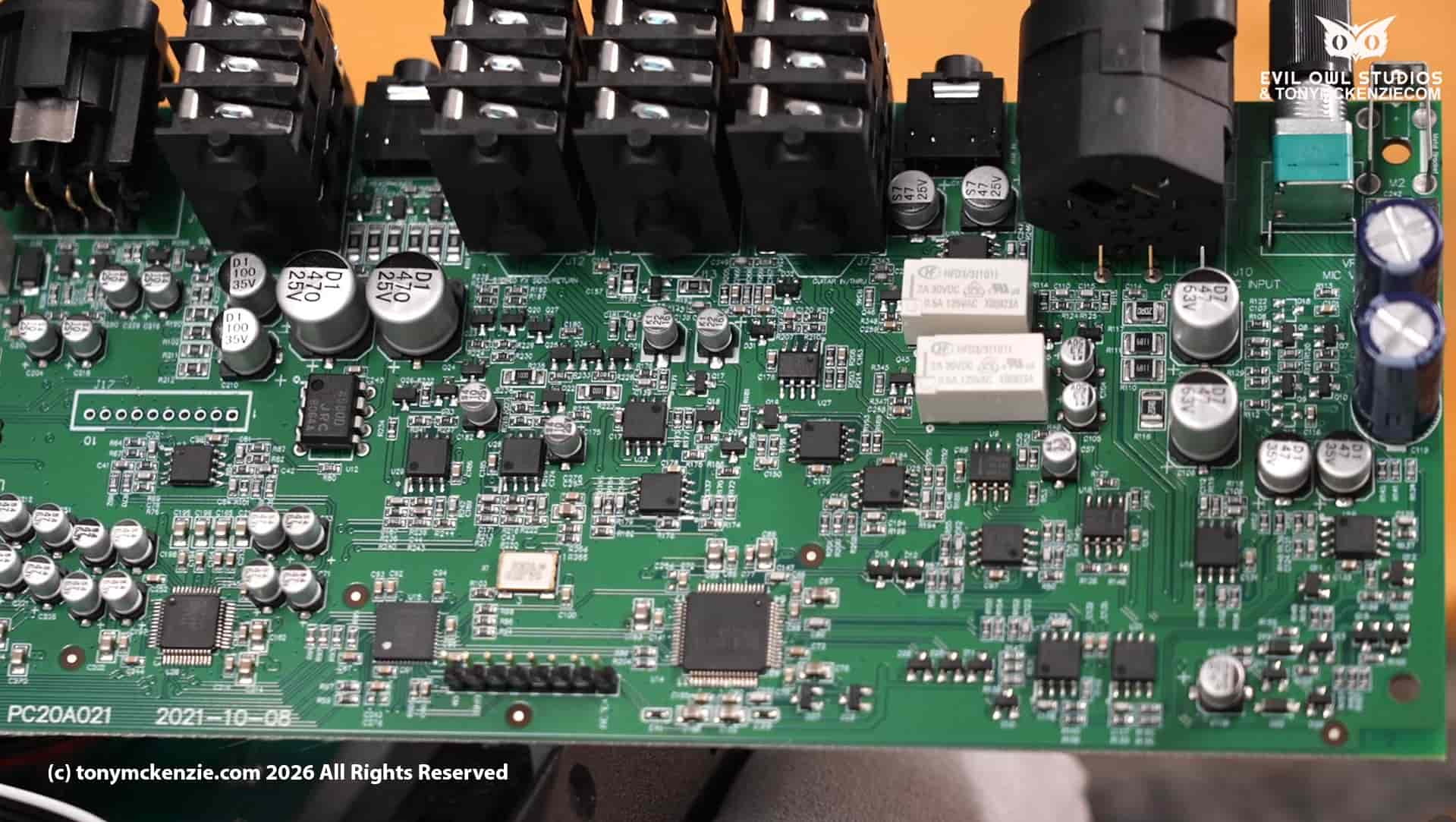
This is a very high quality board again and it has at least 4 chips installed on this board that are more important than the other sort of basic logic chips etc. But there is no denying its pretty cool and all so good so far. Those chips are probably A2D and D2A which are so common in these devices (Ha essential!) and there's a few other things like what might be regulators etc. And there are a few relays (look like white blocks) that are fitted. Also note the electrolytic capacitors at the right hand end of this board, because over time they generally fail and will need changing - but some years away.
ARM1 Chip
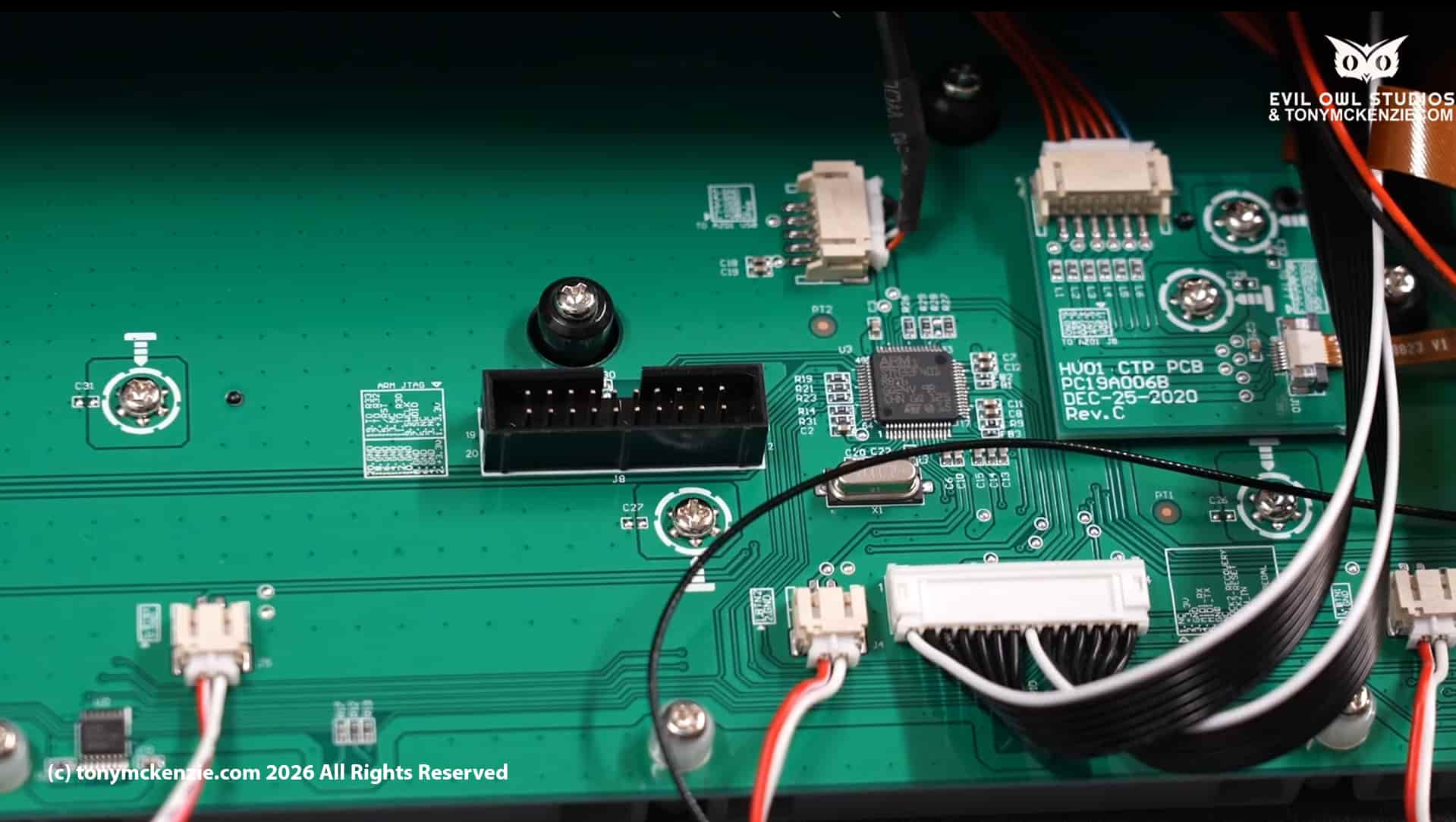
This chip as you will see in the larger view, is an ARM 1 chip. STN32F401RBT6 is its name. I might look at this later or not depending on what I find about it.
The Chips Used in The Headrush Core
I always take a closer look at the chips used in these type of devices. They can often tell you a lot about the unit itself, when it might have been designed and a whole lot more... so let's take a quick look and explanation of them.
Memory Chips
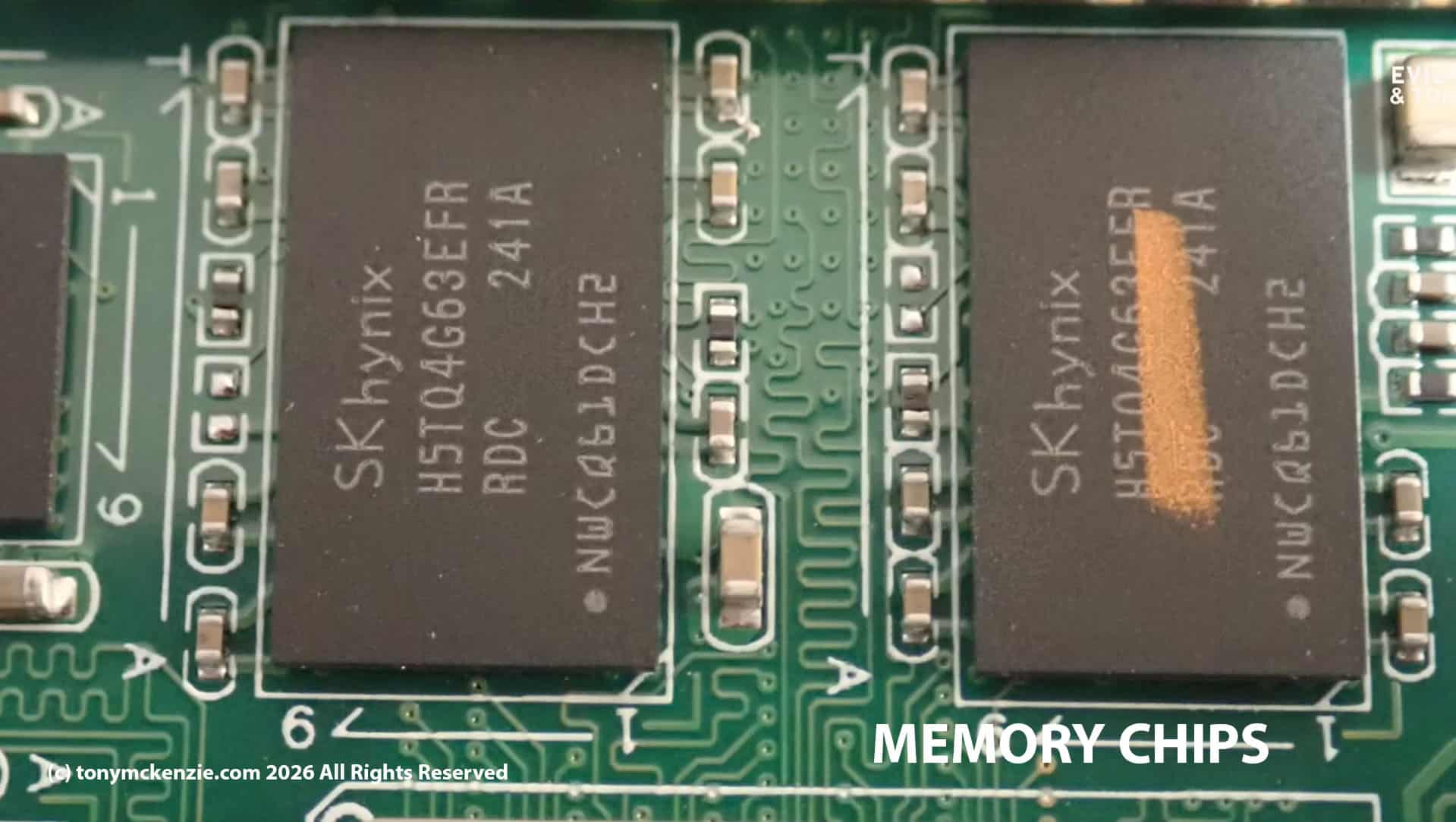
These memory chips are pretty much typical and similar devices are found often. These are on the processor board under the heat sink. They are: HSTQ4G63EFR 4Gb DDR3 (yes the old stuff!) I show two here but in fact there are four installed - better than some I can name. But Ha DDR3 that tech is a bit old isn't it - I guess it's OK but see what I mean once you start to look at the technology underlying the nice shiny device called the Headrush Core then DDR3 well... its so yesterday even though it is relatively new.
Power Management Chip
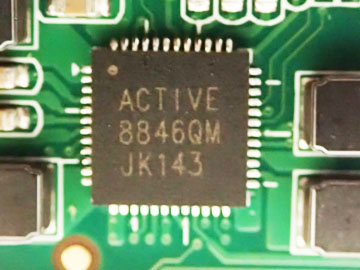
This is a highly efficient PMU or power management chip. This chip is handling lots of the power management, not much more to say, but now I'll look at the main processor :)
Main Processor
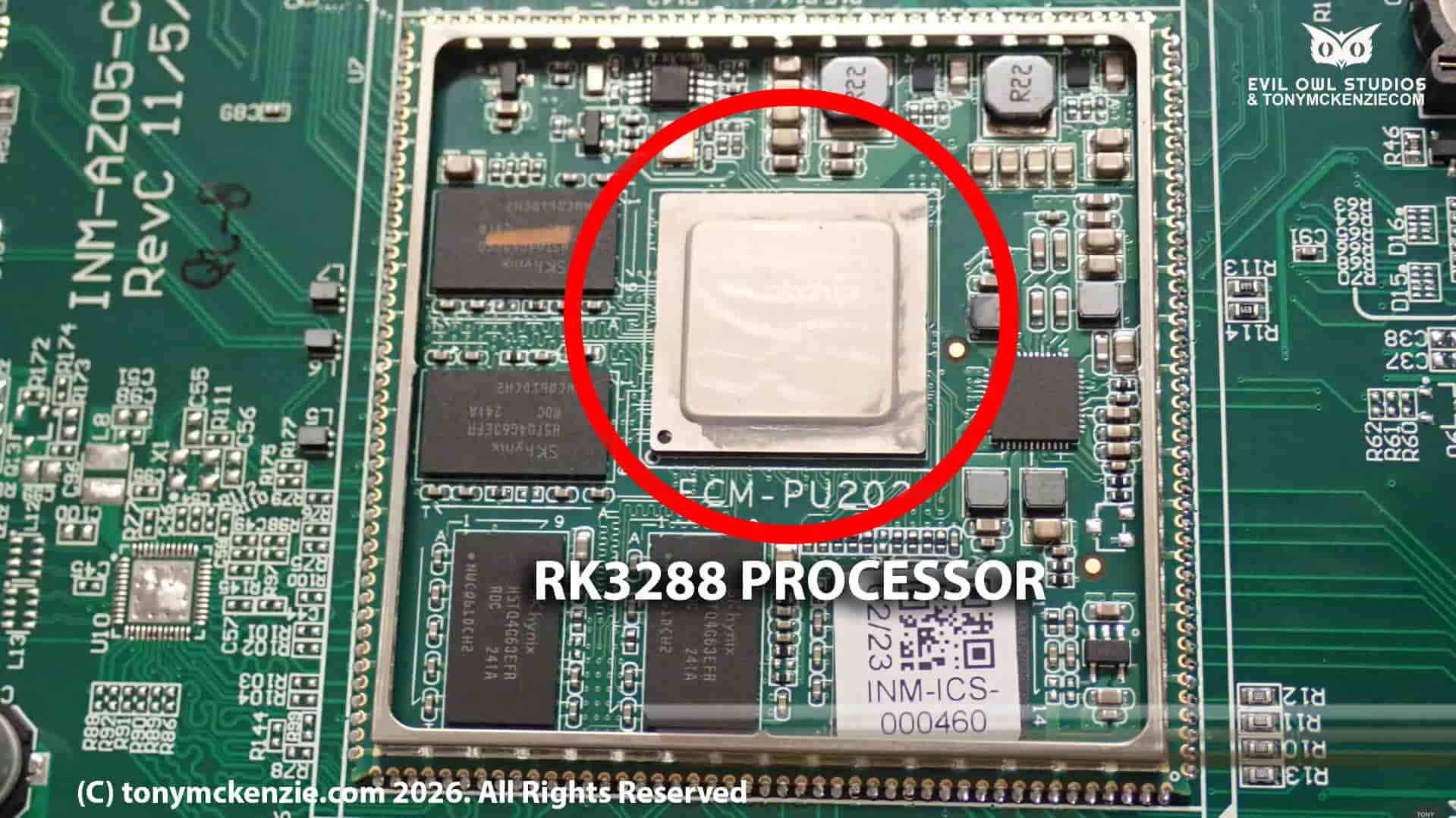
This is the Rock Chip RK3288 as its known. Interestingly this chip is EXACTLY the same main processor as in the Headrush PRIME! is this a bargain? is the Prime under powered? is the Core over powered? Well you have to decide yourself which is the case, but I tend to think that the core is a sort of 'cut down' version of the Prime... but then again looking at this image and knowing the processor for the Prime it could be a little confusing!
This is a low power, high performance processor for many devices including mobile phones, and other digital media applications they say. It integrates a Quad Cortex A17 with a separate 'Neon' co-processor. There's an 8265 encoder that's 2160p @60FPS and H264... which seems sort of screen related... it has an embedded 3D GPU that's compatible with Open GL, there's also a special 2D engine with hardware - again relating to the display performance.
This chip interfaces with those DDR3 chips from internal architecture (hence the DDR3 I guess), it has a cached application processor, and to be frank the specs go on and on - read the RK3288 specs yourself.
Other Chips
There are many other chips included in the Core like the 4580D from JRC, and other small chips. But on the IO board there were many more important chips and I'll list a few now:
- Analogue to Digital ADC - PCM4204 (Texas Instruments) check the specs out - it's a high performance 24bit, 216Khz sampling, 4 channel A to D chip. Its applications include digital recorders, mixing desks, effects units, broadcast studio gear and so much more so don't assume this is a rubbish chip - it's not.
- Digital to Analogue - DAC - PCM4104 also from Texas Instruments and check specs.
This really pairs with the PCM4204 and they both work very well indeed. The two of them are not what I would call rubbish, in fact that's far from the truth and show the Core as being ready and able in the A to D and D to A stakes. To look at of course they look insignificant on that IO board, but don't be fooled... these are cool stuff to include.
There are also a few relays in the unit, who knows what for, but clearly for switching one thing or another!
An ARM chip makes itself known on that IO board too! It's an ARM STM32F401 processor check the specs - well fancy that and I recommend you check the specs in blue here!
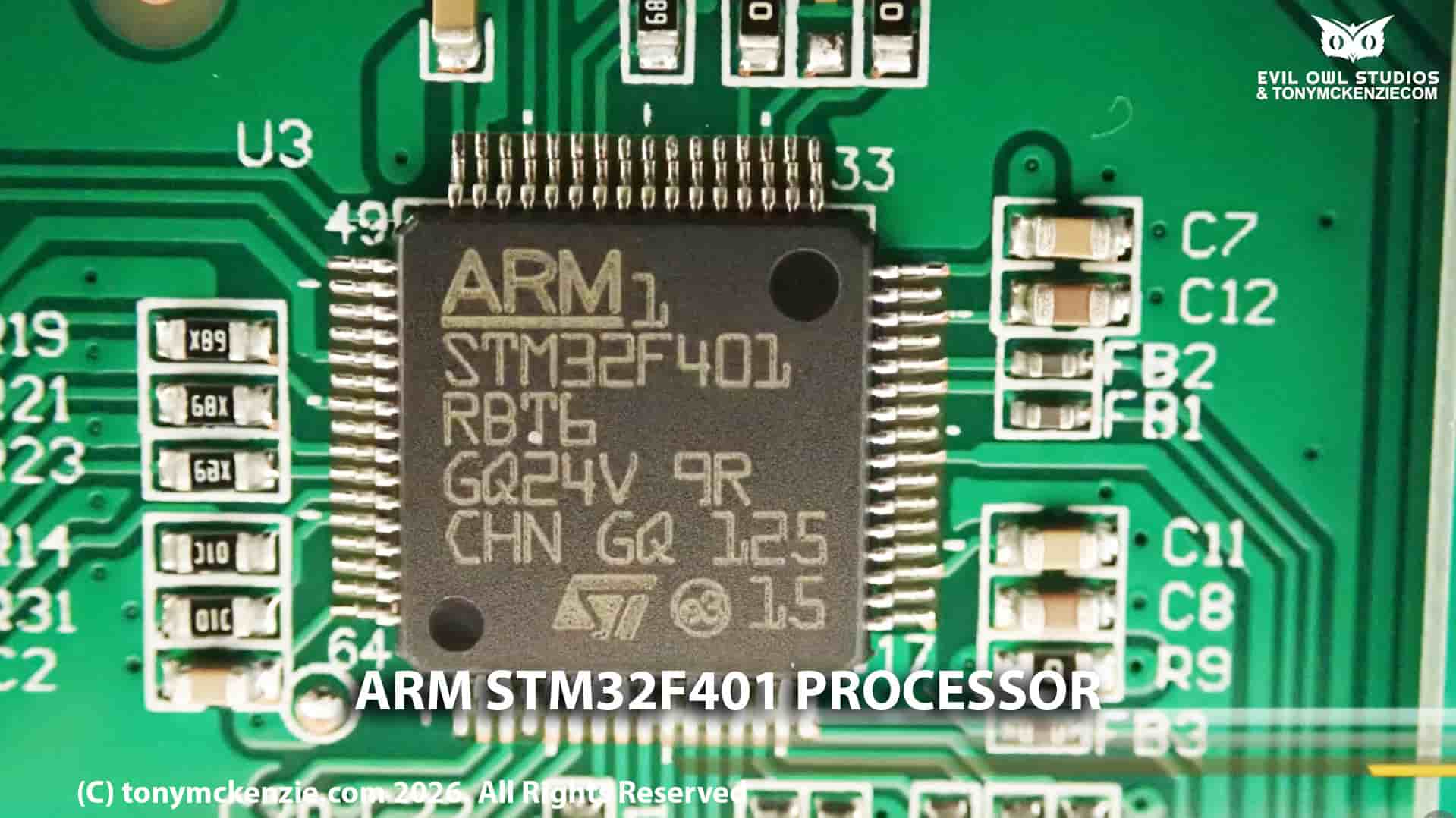
Arm® Cortex®-M4 32-bit MCU+FPU, 105 DMIPS, 256KB Flash / 64KB RAM, 11 TIMs, 1 ADC, 11 comm. interfaces.
In case you did not know this, the ARM chips were developed here in the UK by Acorn Computers (really!) two guys involved if I remember correctly, Herman Hauser and Chris Curry which is somewhat surprising but true. They also had their hand in one or two other technologies too - all back in the day of course. I first learned about those guys when I bought an Acorn Atom computer kit and assembled it in about 1981 or thereabouts. In fact that blue link here shows a typical kit. Amazingly, back in those days I never knew much about technology and it was all very mystical, but I got in to this because I wanted to learn how to create 'Space Invaders' from about 1978. I went on at that time to create a software company selling software games, but by 1983 I flipped to the hardware, and by 1985 I was selling full blown IBM 8086 compatibles :)
Power Supply
Just to mention that the included power supply is a switched mode power supply rather like you might get with a laptop (for example) and it looks OK for the approvals and that sort of thing. Often on 'dodgy' power supplies they give themselves away when they have spelling mistakes on the labels (because the label is part of the approvals!). In this case I'm happy to say the Power Supply looks great. Its difficult to read on the text on the unit, but it certainly has all those important approvals and RoHS etc. down ok. It's a 12v 3Amp and positive centre.. which rules out any Roland power supply so remember to use theirs won't you?
Summing Up
As you can see I have shown just a few chips inside this Core device, but if you really take the time to check them out, you will realize that for the cost these are pretty cool chips and offer lots of specifications compared to some of this type of pedal I have checked over recent times. Headrush are actually offering a fair bit of technology for a fair price I think and what's not to like? Well some might not like the sound, or the OS, or... well you'll get the picture - its really all subjective until you come and look at the hardware right? And some will insist that the hardware 'does not matter' but they are so far away from the truth someone needs to tell them, before their gear fails at a major gig and they are left with 'egg on their faces'.
And remember this device is not hyper cheap (I paid in the UK about £750.00at the time and currently its $699.00 but remember my cost includes 20% tax and the USA one does not). The Headrush Prime in the USA today as I write its $999 plus tax. In the UK its currently around £850 discounted so its not a million miles between these two. I have to say that my experience with the Core was substantially better than the Headrush Prime and my review shows that as you would see. And for the difference in that price, do you want a Prime that has the same basic chips? And the large footprint also can be an issue. There are lots of things to consider and this inside and out review is only just starting!
Headrush Core Controls
It's time to check out the top of the Headrush Core for controls and that screen etc. so let's dive in deeper.
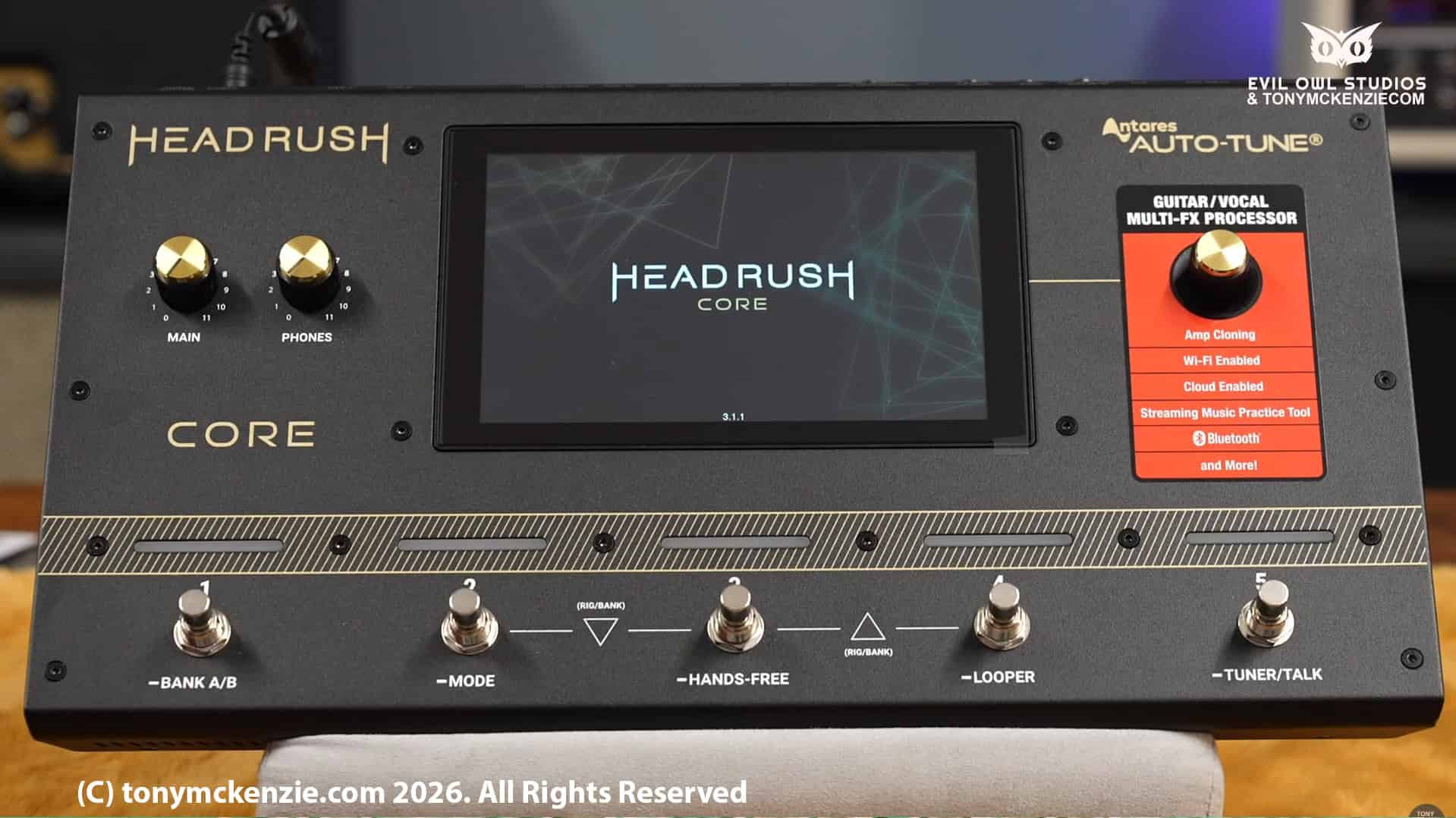
This Core device is really a neat and simple device (as far as these modeler types go) and I guess its as far away from a Fractal Audio Axe FX III as you can get. Some might say you're right this core is 'junk' in comparison, but in reality I think the truth is a little different than the fan boys of the Axe FX III would have us believe. But you have to step back a little and consider this:
- Do you want to sit around all day learning how to drive a computer for some months?
- Do you really want to spend (in the UK) up to three times the cost of the Headrush Core for that complexity and tones you might hear not that much difference in at home?
- Do you really want a rack device?
I could continue to make a list as long as the arm on an Orangutan! But this time I trust I get the point across - difficulty is a critical aspect of buying any piece of gear. What is the point if you don't understand the thing in the first place. There is no point.
Most buyers of the Core will be retail customers - I'm one, you're one and in many ways were all on the same street or level if you will. I like to play guitar and don't like to sit in front of a computer all day (that's what all these devices really are). Then there's the tones. Think about this, even if you gig with a Headrush Core at the local bar, pub or whatever you will... ask yourself first would the audience even care about what you use to play? I can tell you that they don't give a flying fig for what gear you are using. As long as YOU like it nothing else matters. After all, you are the artist. So getting a simple device matters.
I'm using version 3.1.1 firmware on this device, so please understand that this will have newer firmware that could substantially enhance the Core unit (it has of course changed since then). The unit, when started and already connected to the internet, will update everything that needs updating and its amazing to watch how good and simple that is. There's little or no input from you.
The controls on the top of the unit - well compared to many other competitors there are far less - and I think that's a good thing.
Screen
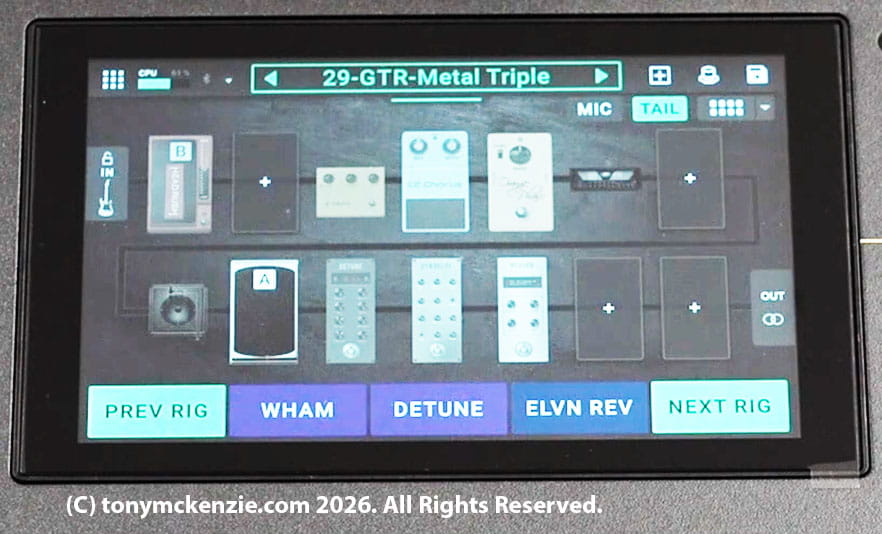
The main screen appears high resolution colour of course and is a touch screen. Its a 7 inch display (18cm for the rest!) and is as good as any screen I have ever looked at of this type. Of course there are all sorts of adjustments for brightness, contrast etc. so because this screen is important that will matter when you're using it all the time. Across the bottom of the screen where other gear has knobs, this has a number of touch buttons and in this case shown they include previous rig, wham. detune, elvn reverb and next rig, although these change depending on what preset you have loaded. All touchable so what you see is what you get.
The graphics on this screen are also sort of like the pedals they show. Its a typical screen of this type audio path comes in top left and exits bottom right on the preset shown. Simply by touching 'what you see' the parameter can be changed - for example that's a guitar shown as the input, but you could have something else, And those empty spaces shown as a rectangle with a + sign in there can easily be populated from all the effects etc. that are available (more on that later).
Large Encoder Knob
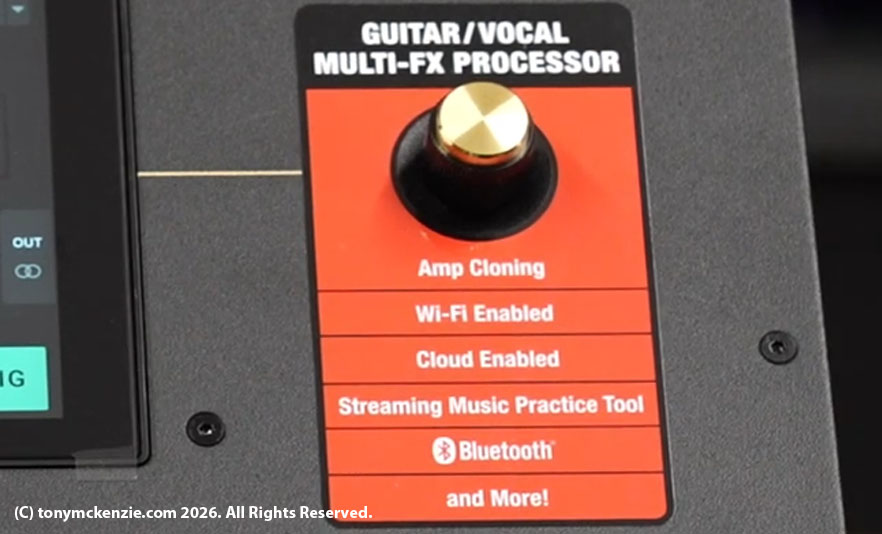
This large encoder knob can be pushed to select something, but it can be different things depending on what you are selecting really. Its a main control encoder so you can use this and/or touch the screen also. Its simple but very neat and easy to use. Just what the doctor ordered.
Foot Controls

Typical of these types of unit, the foot controls are solid and are laid out well, but note that there are only 5 foot controls on the device, which is better than some I could name with just three available. At least with five switches it will not be as bad as those other minimalist foot switches from others. So there is a bank A/B, mode, hands-free, looper and tuner/talk. This unit is a bit different than some insomuch as it has an audio input for guitar (of course) but also vocals that is built in as does the Prime device also. Instead of scribble strips that some devices have, this Core has lights that are on or off so to speak.
Other Top Controls
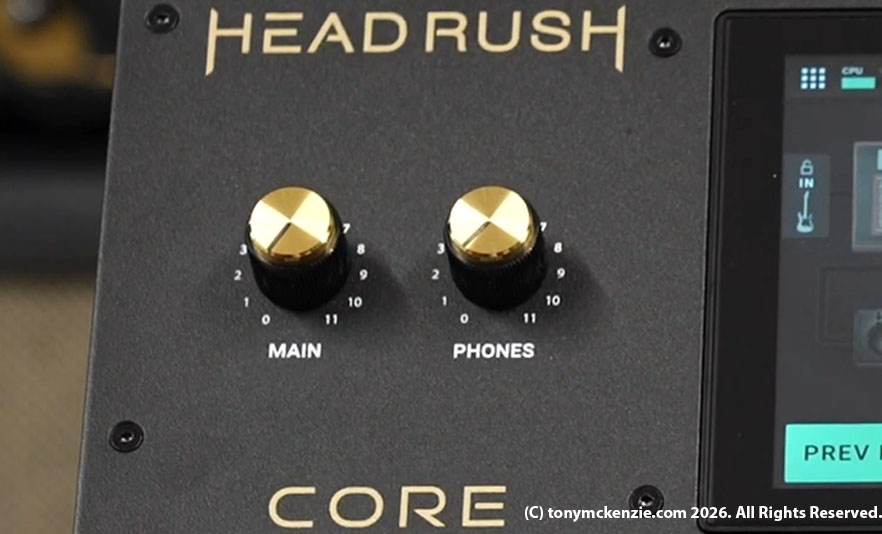
These last two controls are pretty much self explanatory, the phones knob controls the volume of the headphones, and the main knob controls the output volume.
So I want to show you the I/O on the Headrush Core as it can be critical for some guys, but this unit I doubt will be inferior to other similarly priced equipment for guitarists.
The Rear I/O Section
It's always interesting to see what companies include on the I/O (or not!) so I'll check this out now...
Rear I/O Connectors

Check the I/O by clicking the above image - there is lot's to see! There really is a lot of I/O included for this price and level of amp modeler or amp simulator or even effects unit if you will and its good to see it on there. It takes the Core up a little in my opinion even if some of it is plastic! So I'll zoom in a few sections and we can discuss what's there - sounds like a plan.
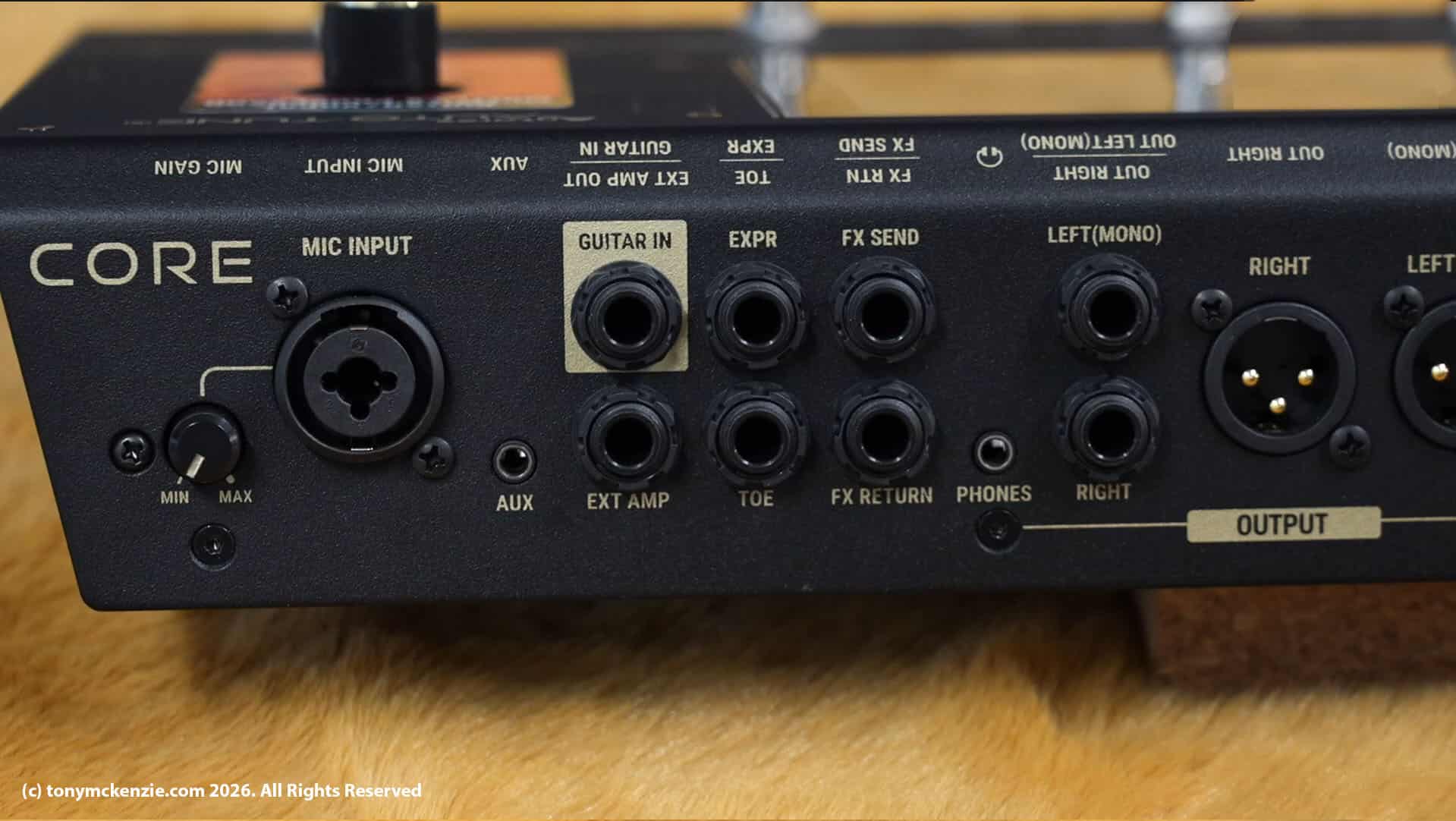
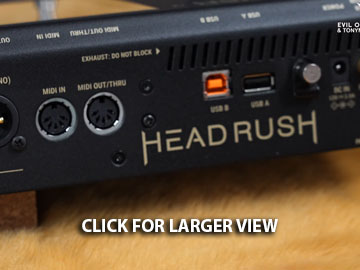
Actually most of the I/O is self explanatory so check with the above images and here is the list of the I/O:
- A microphone input with input control to the left. While using the Mic tap the input block on the screen and see if it's clipping... adjust accordingly with that input level here. There is also a 48V phantom power that you can turn on or off depending on the Microphone under global settings on the top screen. And note this connector is one of those XLR or 1/4 inch (6.3mm) connector which I have to say is handy.
- There's an AUX input next up that you can feed audio in to but sadly its a tiny 1/8 inch or 3.5mm connector and those can be easily broken.
- The next up is guitar in - and what more can I say except its 1/4 inch (6.3mm)
- Amp control. I'll call it amp control and remember that relay earlier? Well it's likely used for this control. If you have a 2 channel amp (for example) you can flip the amp from clean to crunch/lead with this connector. Use 'short to sleeve' to use this and it again is controlled on that screen.
- There's an external expression in so you can plug one in and set it up on the screen. And the next is interesting, if you have an expression pedal with an on/off switch connect the switch out to the 'toe' connector both 1/4 jacks. I did make one of these expression/switchers and you can watch how I did it.
- Next there is a send and return FX loop... again controllable from the screen.
- The Phones out again is one of those hopeless 1/8 inch or 3.5mm stereo jacks and at best it might well give you trouble when it snaps - it will!
- Next up is a standard left and right outputs 1/4 inch (6.3mm) outputs.
- Thankfully there are Left and Right XLR outputs too as you can see.
- There is a MIDI in and a MIDI OUT/Through connector standard 5 pin DIN (great to see) and those will last a while notice the metal connectors!
- There is a USB type B port - used for backup and restore, updating and a host of other things.
- The USB type A . This supports backing tracks and other data so could be useful. It can be used also for external MIDI control over USB.
- There's also an on/off switch as well as the power in connector I mentioned earlier. Good for you Headrush in adding a 'proper' switch.
This concludes the I/O at the back of the Headrush Core and as you can see its very comprehensive and probably very little that you might otherwise want. For me, I have plugged the XLR's in to the desk and it all works pretty great with no issues I could see.
The Role of the Screen
So let's take a closer look at the screen and it's controls and features...
Audio Routing
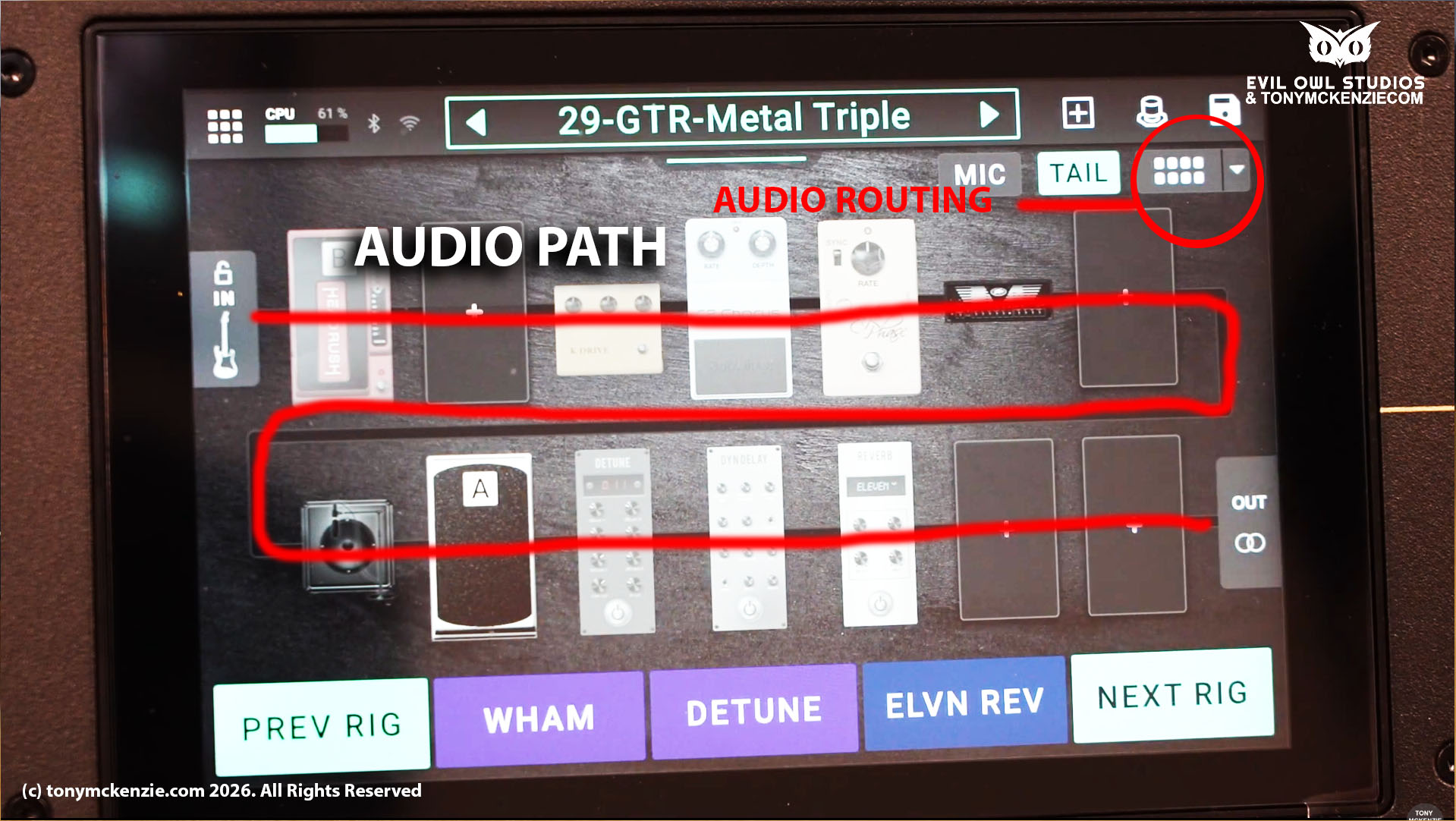
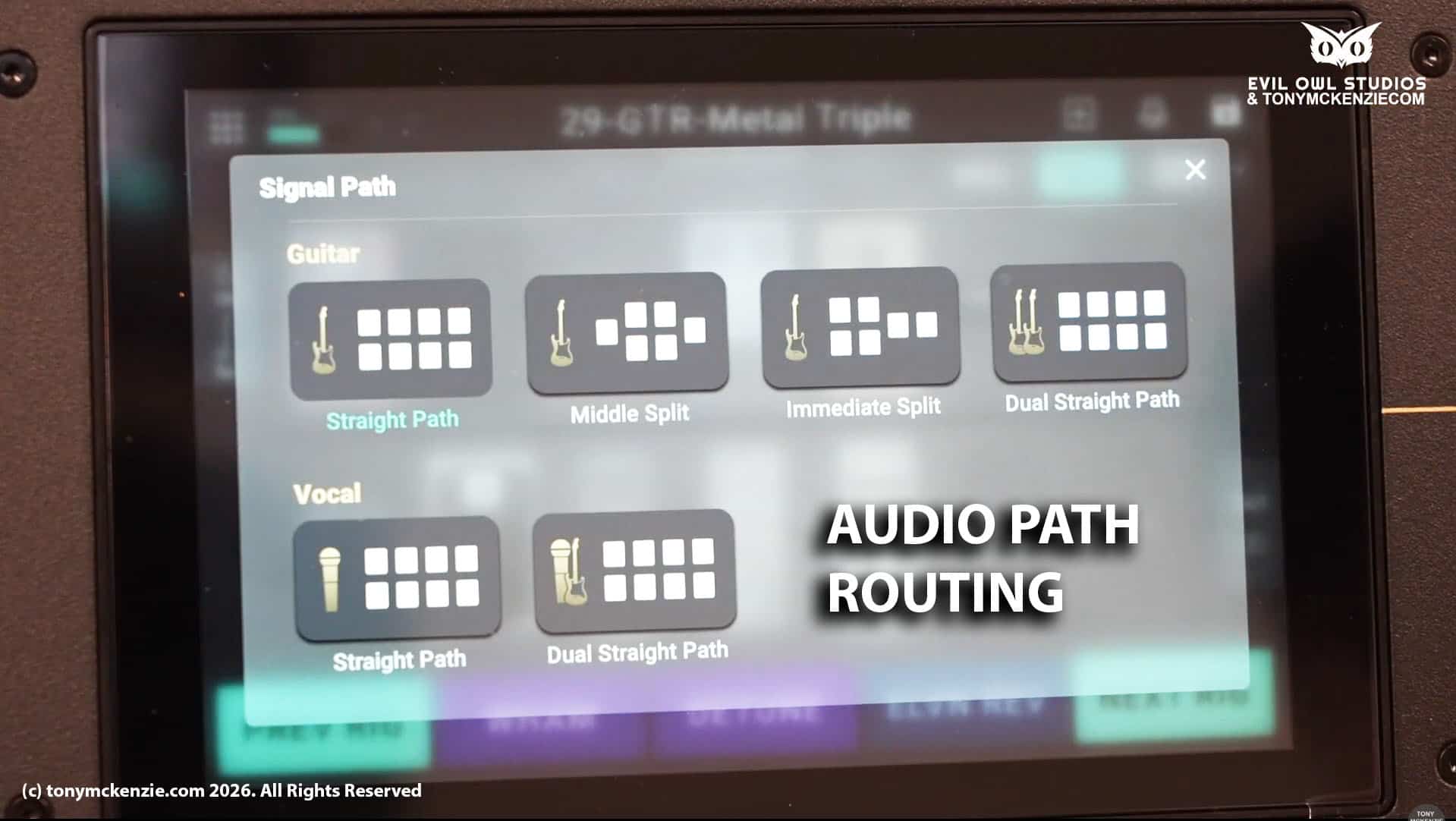
Check the image for seeing the audio path and the control for the audio routing. This device has a pretty good section for the routing with many predefined ideas already there and I think it helps ordinary guys incredibly especially if you are not familiar with this sort of thing, here's a shot of the routing screen:
As you see in the audio routing screen above you are presented with a number of options already to go and I like tom see that. Here's some of them listed:
- Straight Path
- Middle Split
- Immediate Split
- Dual Straight Path
- Straight Path
- Dual Straight Path
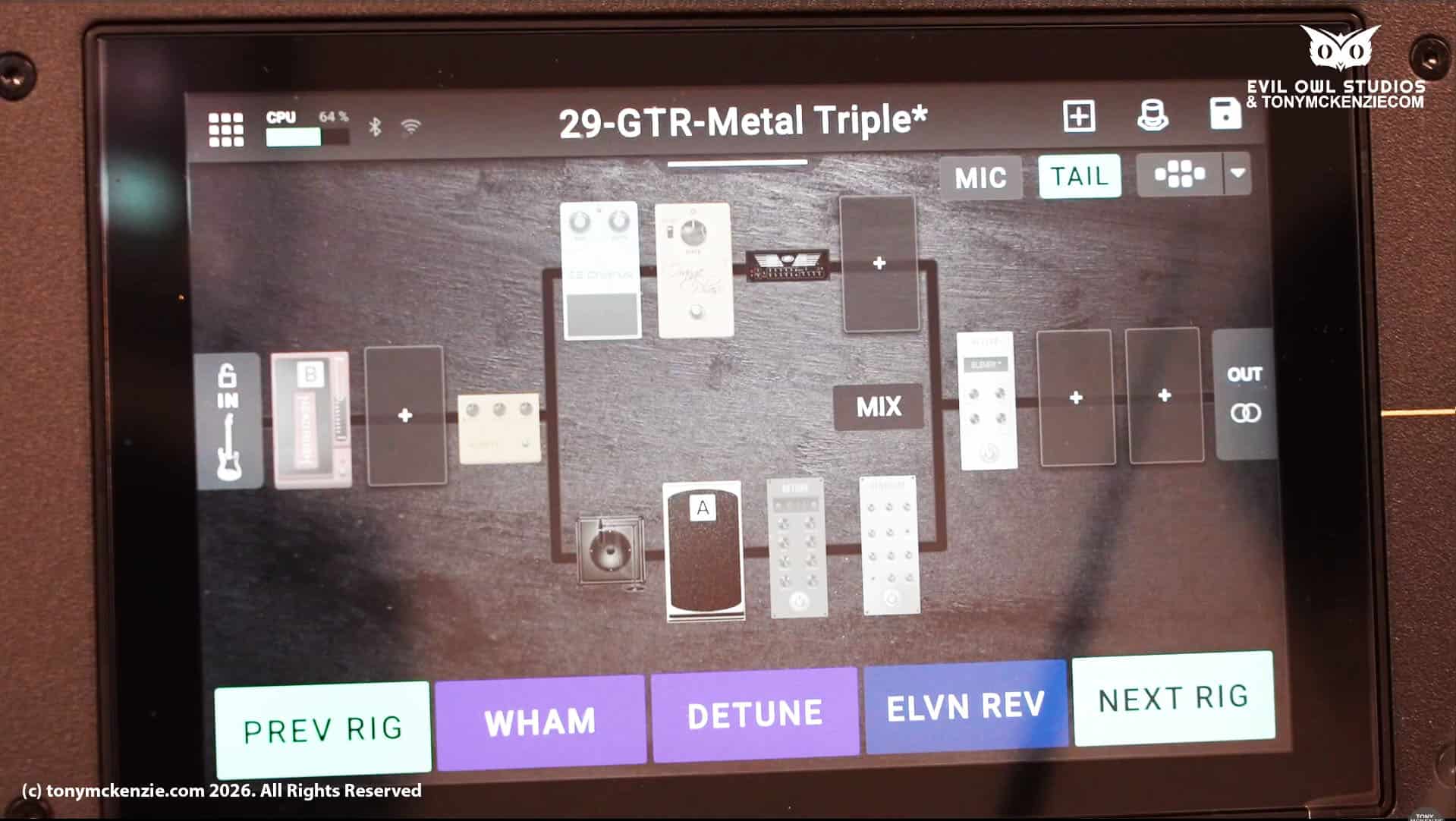
In image three above, the result is from choosing the 'Middle Split' can be seen compared to the image in picture 1. Indeed a great feature that will save you loads of time, so you can be playing!
Tails Control
Tails are the fade outs when you choose another preset. Basically you can set them (from that little tails menu on the screen) to continue and fade out nice, or have them as an instant change where they get 'cut off' so to speak. Me? well I usually have mine so they fade out after a change of preset. There is also a 'Mic' drop down too that can change various microphone settings but I'll leave it at that.
Redirect Output
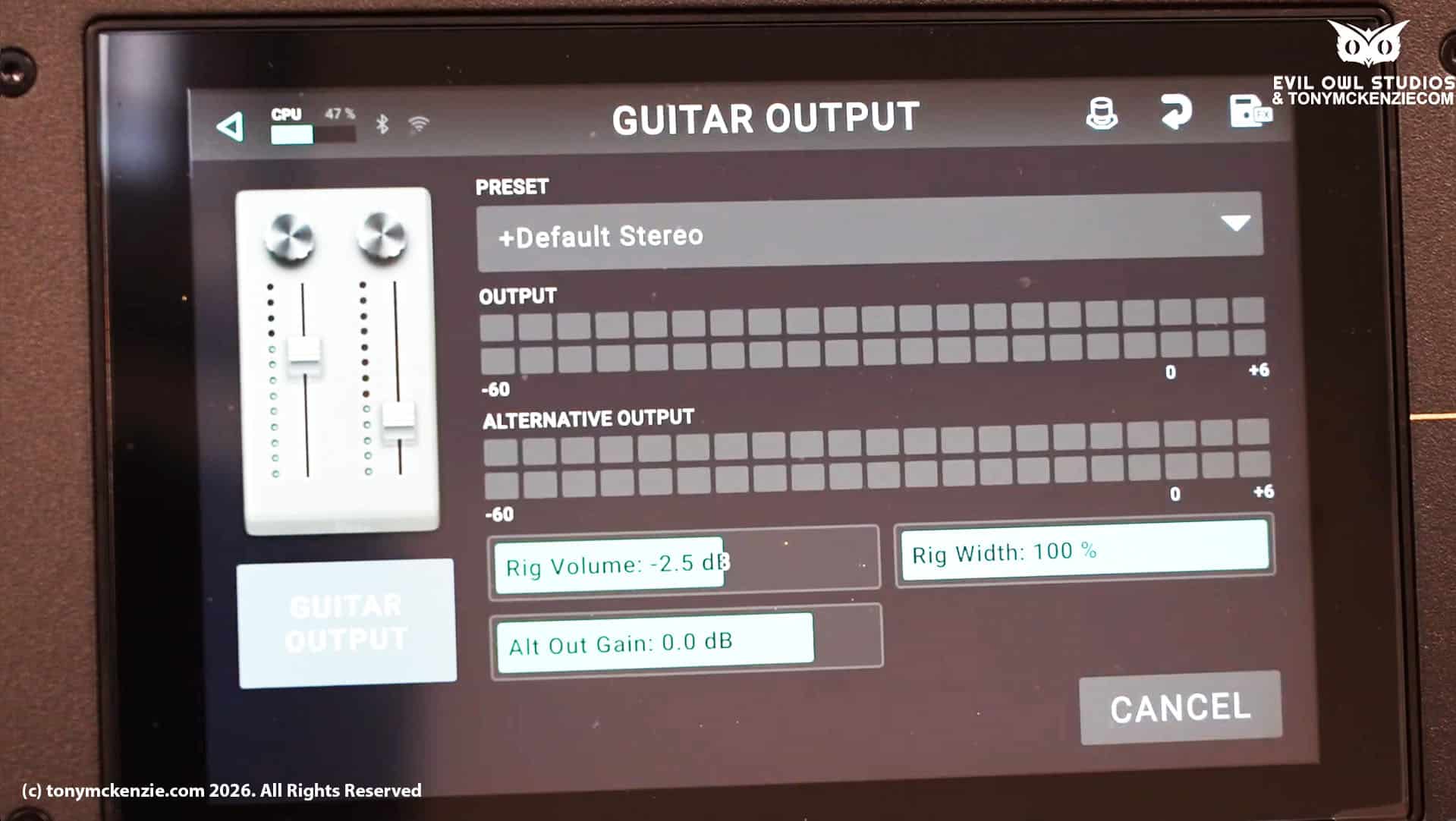
A simple tap on screen where the output is shown will allow you to change where it all goes - honestly its that easy, and these settings and changing things in this way are really brilliant especially if you don't want to faff around all day!
Control of Pedals Onscreen
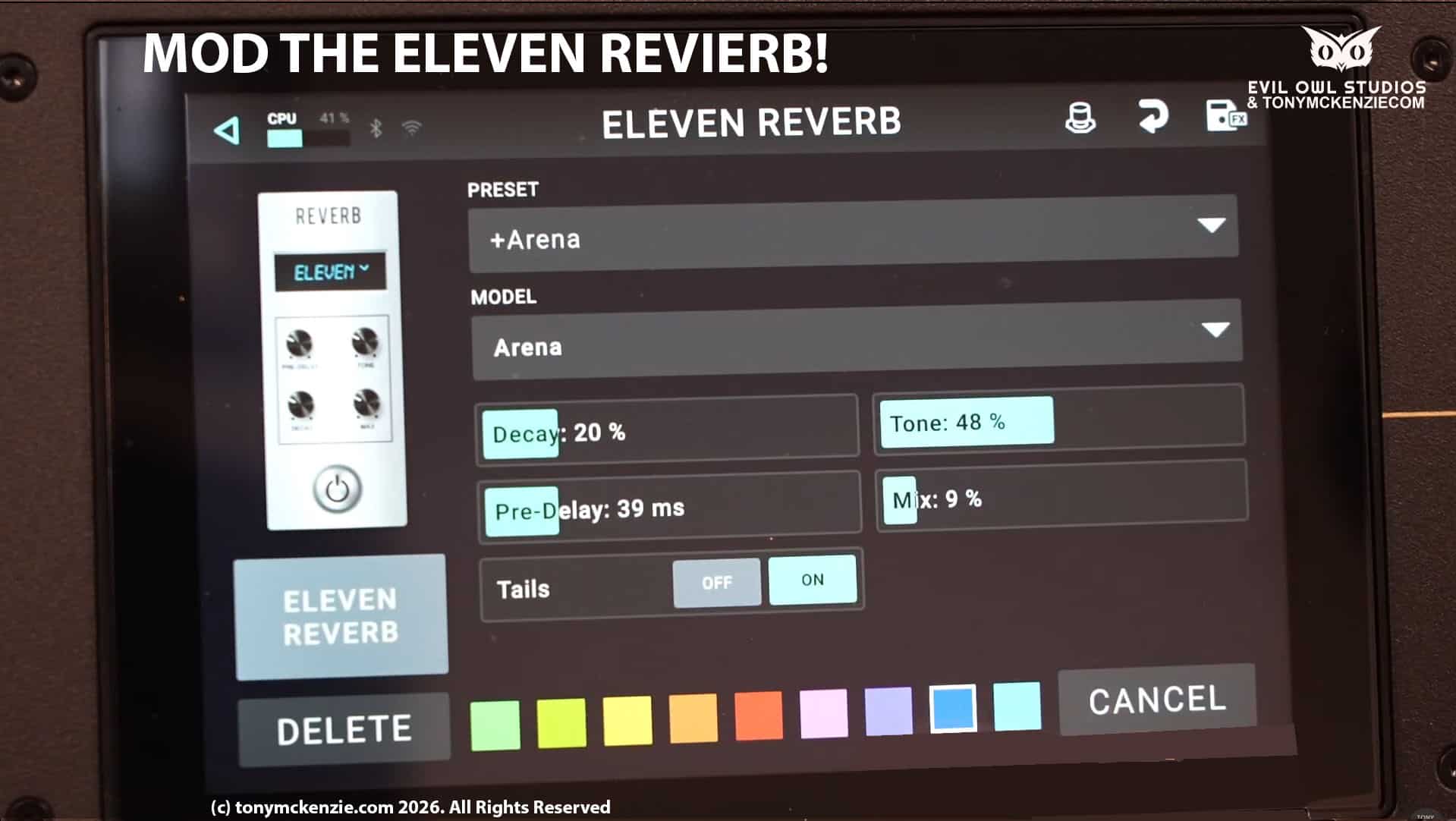
When you click an effect - I clicked the Eleven Reverb in the above screen, you can then change the settings easily and as far as you like - honestly its that simple and it applies to all effects and many other things too.
Pedal Setting
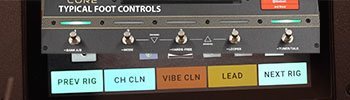
Remember these foot switches, well here on the top screen those software buttons represent the foot pedals as shown, you can simply change them to whatever you need.
Lastly, you can move pedal locations on the screen simply by dragging them to the new position you want.
So this concludes the section on the screen, its true I really could create a longer review, but this should give you a really good flavor of the Headrush Core as I see it myself. Honestly there are so many features still to cover that this is a very long review but should be very thorough about the Core pedal.
Quick Sum Up So Far
I was thinking about this Core pedal as I write and there are not really many things that are concerning, but there remains an 'Elephant' in the room really. Last night I watched a discussion between Tony Iommi and Lyndon Laney. Now Tony Iommi has to be recognised as one of the guys behind heavy metal and that sort of stuff for sure, and Lyndon Laney (RIP) just passed away in the end of May 2026 and he was the innovator behind Iommi's amps. Iommi and Laney sat together in this recent interview and discussed all the things they had done since before Sabbath, right through to today. And along the way Tony Iommi talked about those Laney tube amplifiers and how they changed what they went on to and did until today.
It was an amazing interview to watch and I recommend you watch it. One thing that Tony Iommi said was that he used Laney tube amps etc. and at one stage recently he used a Kemper Amp - and it did not have the 'feel' of the Laney tube amps (or any time amp really). Tony Iommi expressly commented that the tube amp had that 'feel' that is generally lacking from the simulators and modelers etc. and to be honest I can agree with that statement. The computer based gear is close for the sound, but seemingly not close for the feel. And the feel, is an inspiring thing that allows an artist to develop so much unique music. Evert time I bought a tube amp it always inspired me to write some music - its a weird thought, but its completely true.
That does NOT mean that this Headrush Core is 'rubbish' oh no nothing of the sort. It clearly has a place and I can still recommend it because let's face it, everyone is not a Tony Iommi and probably never will be. We all have different needs, and sometimes a breathing 100 watt tube amp on full tilt can't be the answer. In any case Lyndon Laney RIP sir and you made some wonderful amps - I still have some here.
By the way, why not check out the Headrush Prime video review I completed. You certainly don't want to compare them... hint: I thought the Core is better!
Some More Important Features
There are so many features - and I'll cover some of them here, but for this review there has to be a limit! So let's take a quick look at some
The Prime Processor
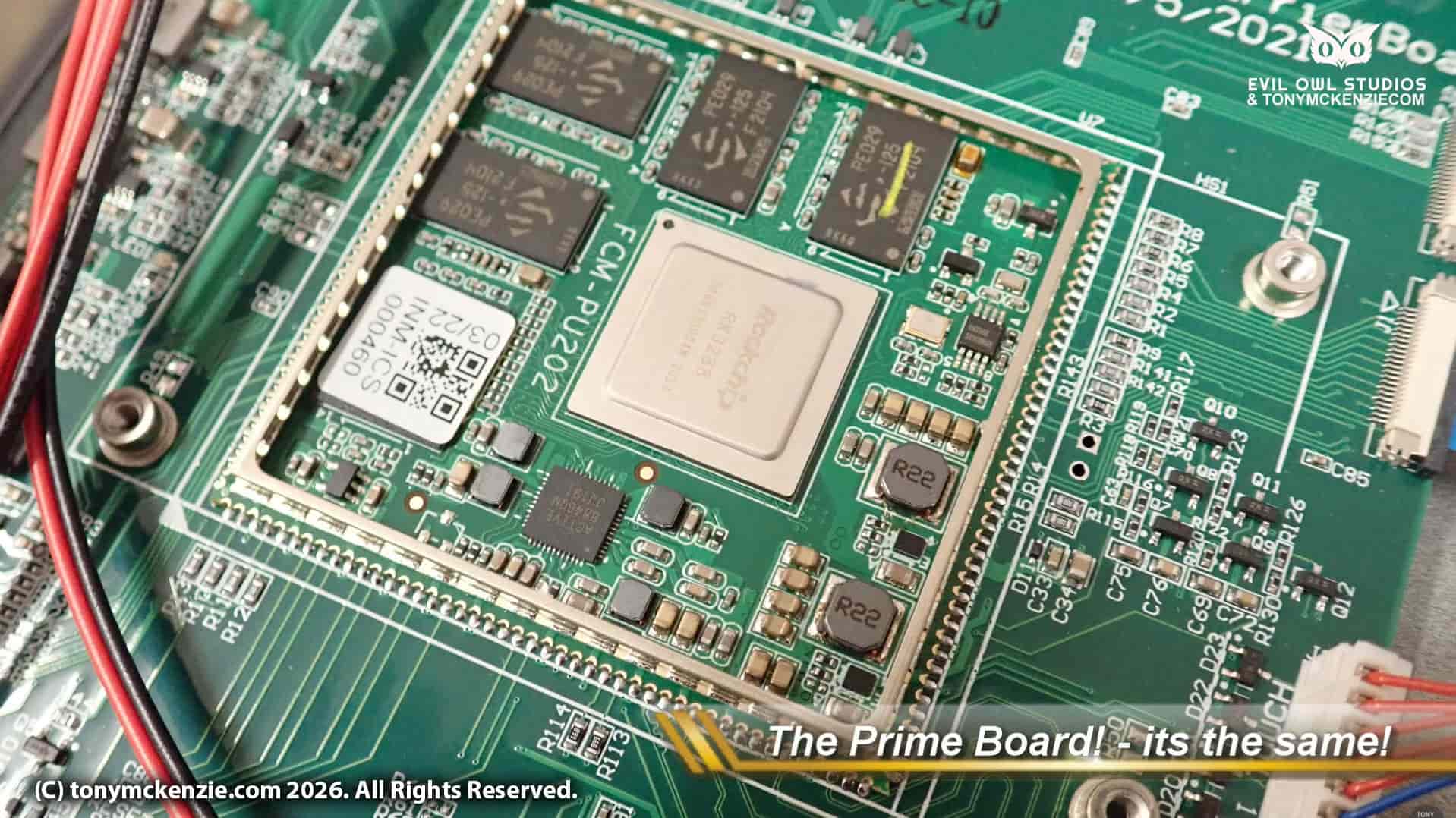
Just to make things as clear as possible... the Headrush Prime has exactly the same processor board as the Core! At least that's my conclusion to it all. And scarily the I/O board looks pretty much the same too.
Chop Tones IR's
Yes they have the Chop Tones IR's and inside the Core there are 350 available. A Manageable number in my opinion. And these IR's are around in many other devices - seems to me they strike a deal up with a maker to include them - and that's not a bad thing really. I did mention that in my video review about how if many were using the same Chop Tones IR's then will they sound all the same? You might want to think about that.
Amp Cloning
Like in many of these types of devices these days (including Tonex) there is an amp cloner so you can go and 'suck out' the last life of the tube amp makers (some might say) and capture those unique tones forever. Of course my first foray with capturing was with a Kemper in about January 2012 and it was so good back then. Today of course everyone and their dog can capture these amp tones sadly. But this cloner can capture the cabs, effects as well as the amp at the very least - but many also do that now. But it is included and it does work so why not I say.
Cloud Storage
Indeed, like so many other companies (I could list them for an hour!) The Headrush boys have set up a 'cloud' service (Ha it might be on Amazon but likely they don't tell you) so that you can share your cloned components, amps, speakers etc. with everyone else. It's a good idea of course, but Kemper at last check had 22,000+ profiles online in their cloud stuff so there might be a bit of time before Headrush catch up. Bear in mind that one way or another the internet connectivity has to be there!
Music Streaming
It's possible with the Core to stream audio in to the unit from your mobile or cell phone. And I can tell you it works pretty good too. Its Bluetooth of course just in case you did not know. Want to practice, put some cans on, play the audio in to the Core, crank the guitar and its all very good for silent practice if you need that. Obviously with it being streamed there can be sometimes a slight hiccup but they were pretty rare when I checked it out. There is an app if I remember correctly so download and have a go. But also remember that USB type A Memory stick that you could load up audio and play to that, which might be backing tracks, or BT for your own music etc. the features are right there and worth a go.
The Looper
Now it does sport a looper. I don't personally use them but its whatever is good for you. This one supports just 5 minutes of loop, but it also supports those important overdubs x 20 altogether which is a bit of a feat really.
Output Assigns
One of the interesting things is being able to 'relocate' outputs to different things. For example take the two 1/4 inch outs and maybe send those to the PA, and take the XLR connectors and send out of there DIFFERENT outputs to somewhere else. Its easy enough to do and I'll leave you to think how you could use that feature.
Core or Prime?
I won't spend much time on this, but the prime has things on it in a slightly different way. More knobs, an attached pedal, and a host of other things, but I have to say so far the Core for me was the better device. Bear in mind that the Prime had early firmware and was not great. It's improved now. Read the rest of the review and make your mind up yourself. Indeed you might even decide to look at something else! BTW the Headrush Core today is firmware 5.0.1 so be prepared for even better things! On the prime its firmware version 5.0.1 also! And that says a lot too don't you think.
Technical Specifications
- 5 footswitches with colour LED
- 7 inch full colour screen touch display
- 3 knobs on the top surface -main volume, headphones volume (300 degree) and one 360 degree navigator control
- 1/4” (6.35 mm) TS input (guitar)
- XLR / 1/4" (6.35 mm) input (microphone)
- 1/4” (6.35 mm) TRS input (expression pedal)
- 1/4” (6.35 mm) TS input (expression pedal toe switch) 1/8” (3.5 mm) stereo input (auxiliary device)
- 1/4” (6.35 mm) TRS output (external amp footswitch) 1/4” (6.35 mm) stereo pair outputs
- XLR stereo pair outputs
- 1/8” (3.5 mm) stereo headphone output
- 1/4” (6.35 mm) TRS input (FX send)
- 1/4” (6.35 mm) TRS output (FX return)
- (1) 5-pin MIDI input
- (1) 5-pin MIDI output
- USB Type-A port
- USB Type-B port
- Power adaptor supplied
Weight: 8.37 lbs. / 3.80 kg Dimensions: Width: 16.08" x depth: 9.24" x height: 2.64" inches Width: 40.84 x depth: 23.46 x height: 6.70 cm
Software?
Editors, Live Sets, you name it? But is there any?
Well clearly when I was looking I found none and have not particularly found much software like an editor. I could be wrong and have not looked really this year (2026) but the phone seemed to be pretty cool and the Core worked flawlessly so do I even need all that software that takes sometimes months to learn, or is buggy and does not work, or... well you fill out here what you think... Me? I did not find or use software but I have heard there is some these days... I just have not looked further currently./
I did in my video review mention the Fender Tone Master Pro. That device at launch (no matter what the paid reviewers said) was so bad I stopped the review! Later (in fact a year later) I reviewed the Tone Master Pro again and it was very good. It just shows what firmware can do.
What is the Warranty Like?
Ah warranty, that thing we don't need? Right?
So warranty does not matter some might say, but mark my words when this thing fails (like most of them today) if its out of warranty then you will be getting your money out! I think it has a 1 year warranty, unless you buy it form a company that offers 3 years as standard like Thomann. In any case buy from where the warranty is the longest and its a trusted supplier. Also in the UK, Gear4Music.com offered it with 3 years in the UK.
Summing Up the Headrush Core
The Likes, Dislikes, Score and that sort of thing.
Likes
Sop what did I like about the Core?
- Rear I/O excellent
- 7 inch screen that actually works proper in touch mode
- Easy to understand and use
- The Flash drive facility
- The Bluetooth and streaming was great
- Wireless worked perfect 1st time and the auto upgrades are incredible
- Same or similar hardware boards as the Prime
- It's good value
- It has a 60 page downloadable manual
Dislikes
- Software? where is it
The Score?
With a device like this Core, honestly it has to be given a score. I have looked it over and over, used the unit, listened to the tones and played it and done most things with tis device. And I have to say I really do like it. It's reasonable cost, it works first time, everything is cool, especially with that internet operational too. So my core for the Headrush Core is:
10/10
So there it is, a perfect score for what is really a very good device even at launch.
Final thoughts
This Headrush Core they say is sort of based on those old Eleven Rack's that used to be about. No they are dreaming. That Eleven Rack was rubbish at the time and ha today well its a door stop. I owned one and really disliked it.
But you know what, I like the sounds on the Core too. While they are NOT in my opinion to the level of Kemper amps for example or indeed the Line 6 Helix Stadium I reviewed also that does not matter because those devices are bordering on twice the price really for something that you might think is better - or not! Sound IS subjective and the only real way is to have a go yourself with YOUR music. There have been many times I've had gear thinking it will be 'great' and in reality it was basically not for me. So I urge you to try both of these units yourself. There may (have been) updates to this unit re Firmware etc. and it can only really be BETTER than I showed here.
In any case the playing is coming up in the links section below and thanks for taking the time to read this review. This one piece has taken me a week to complete!
A Real Review
I bought this Headrush Core to use personally in my studio and I found it to be very useful. But take note that there is no sponsorship of this written review whatsoever. My written comments are what I found AS A CUSTOMER who bought one. Always remember that and my reviews will always show you what others never do.
This review is 1 of 21 reviews I am writing currently and they will be on my site tonymckenzie.com presently. Enjoy.
The Music from the Headrush Core
Links:
Fender Tone Master Pro Final Review
Check here for other new 2026 reviews
© A B McKenzie 1997-2026. All Rights Reserved. All Trade Marks Acknowledged.