
Marshall 1987x reissue tube amplifier with 5881 tubes. But do those tubes make this 50 watt Marshall amp a Go or a No?
Marshall 1987x 5881 Tube Amplifier Inside and Out Review
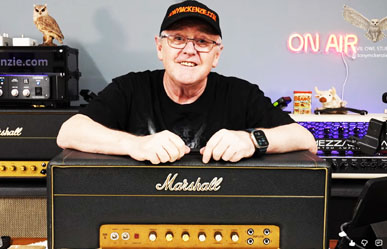
Marshall's 1987x is a reissue, but is it worth the effort?
Introduction and Preamble
Over the years I have had so many Marshall guitar amplifiers I could not even count them all. And this 1987x valve amp is an earlier one with a few different things than you might otherwise expect. I have reviewed a 1987x historically and they are great amplifiers fir guitarists there's no doubt about that, but this one under this inside and out review honestly readers should be a little enthusiastic at seeing this amp. All to often these earlier amps are changed or dare I say 'butchered' beyond what they were meant to be and that's a trend that has continued for years. Indeed some companies make near enough Marshall amps and then mod them accordingly - and even Marshall these days (2025-26) with modified amps of their own. You could say they're 'all at it!'
Remember the 'x' in 1987x denotes that this is a reissue amp as I have confirmed, but this earlier model has a few interesting points many guitarists will still be interested in even in these days of amp simulators. Consider whether this version of the amp is better? or worse? than the later amp and if you think so, then why not post your opinion on my YouTube channel for the video review - that would be interesting, and while you're there subscribe - PLEASE! and thanks for that.
The Marshall 1987x 5851 Amp Chassis
So I'll take the amp out of its Marshall case and lets have a closer look at what we have here.
The Chassis
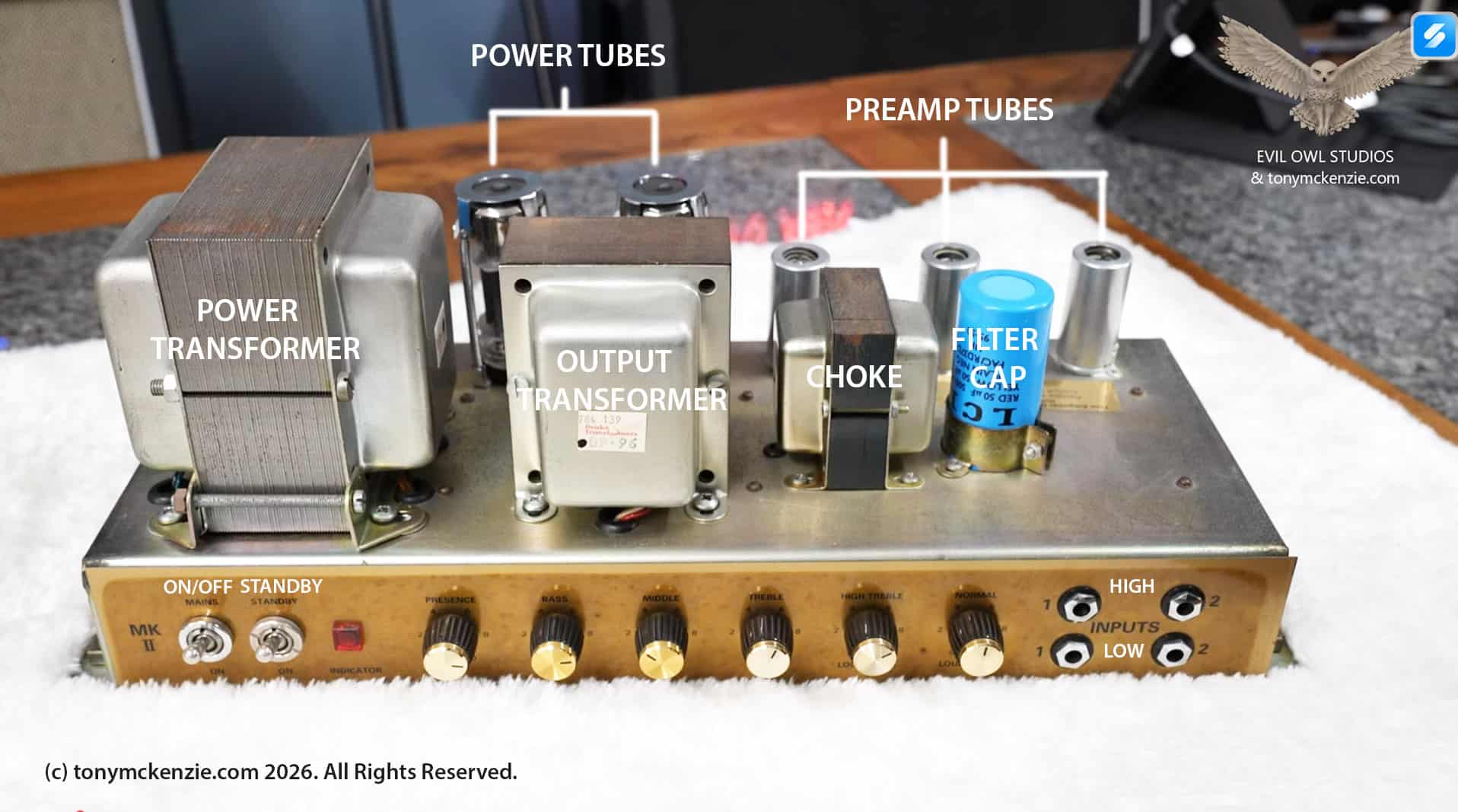
Take a look at the large image and I have identified the things you can see on the chassis as follows:
- Power Transformer
- Output Transformer
- Choke
- Preamp Tubes (there's only 3)
- Power Tubes (two)
- One Filter Capacitor - there are more
- on/off Switch
- Standby Switch
- High Inputs
- Low Inputs
- The Chassis Itself
And of course there are the tone and volume knobs on the front of the amp. It all looks pretty normal? Right? Well maybe not. This is a 1996 version from what I see and there is certain to be things different than on the later version where things change a little.
The Power Transformer as you can see is a big but well made unit made in 'the old way' that Marshall had made for them. It's a Drake transformer as supplied for many years and it's number is '1202-324' as a designation and that from what I see was made in week 37 of 1995.
Next up is the Output Transformer, and as you see its smaller, but it will certainly 'do the job' for this 50 watt amplifier. Again its made by our friends Drake transformers and part number '784-139' and it was made by Drake in September 1996. So maybe the amp was assembled a little after that 1995 assumption of manufacture but I doubt much after and certainly I would date the amp not really newer than the end of 1996.
The choke is a large one really - I could not see the detail, but its likely made by Drake transformers too and is very much up to the job!
Looking at the filter capacitors - there are three - two behind the PT and one that you can see. Marked as FAC/C RD37D - these are all made by LCR Filter Capacitors EU Ltd and these are typically dated week 50 of 1995 also.
By the way, the power tubes are still 5881's and there's a story to those - but they have been changed for a different pair and what's in there currently certainly works as I have tested and used the amp a little since I bought it.
The amp has had a master volume fitted (the type that's easy to remove later if you want :) and certainly while it needed taming re the playing volume, I would have preferred maybe the Roland Boss TAE that I also recently reviewed to calm this amp a little. I'm not in the least concerned about that mod, as you will see its been done very professionally and could be removed in 1/2 hour or so, but for now I'll leave it in there.
I don't want to bore you with the front tone and volume controls, who has not seen them? and the on/off and standby is like the other Marshall amps out there. As is the high and low inputs basically the same as a 1959 Plexi from Marshall. They can be linked between the high and low if you want and I tend to think of this amp as a sort of 'baby' 50 watt Plexi, whether I'm right or not is pretty irrelevant really, but you get the idea.
The Rear of the Chassis
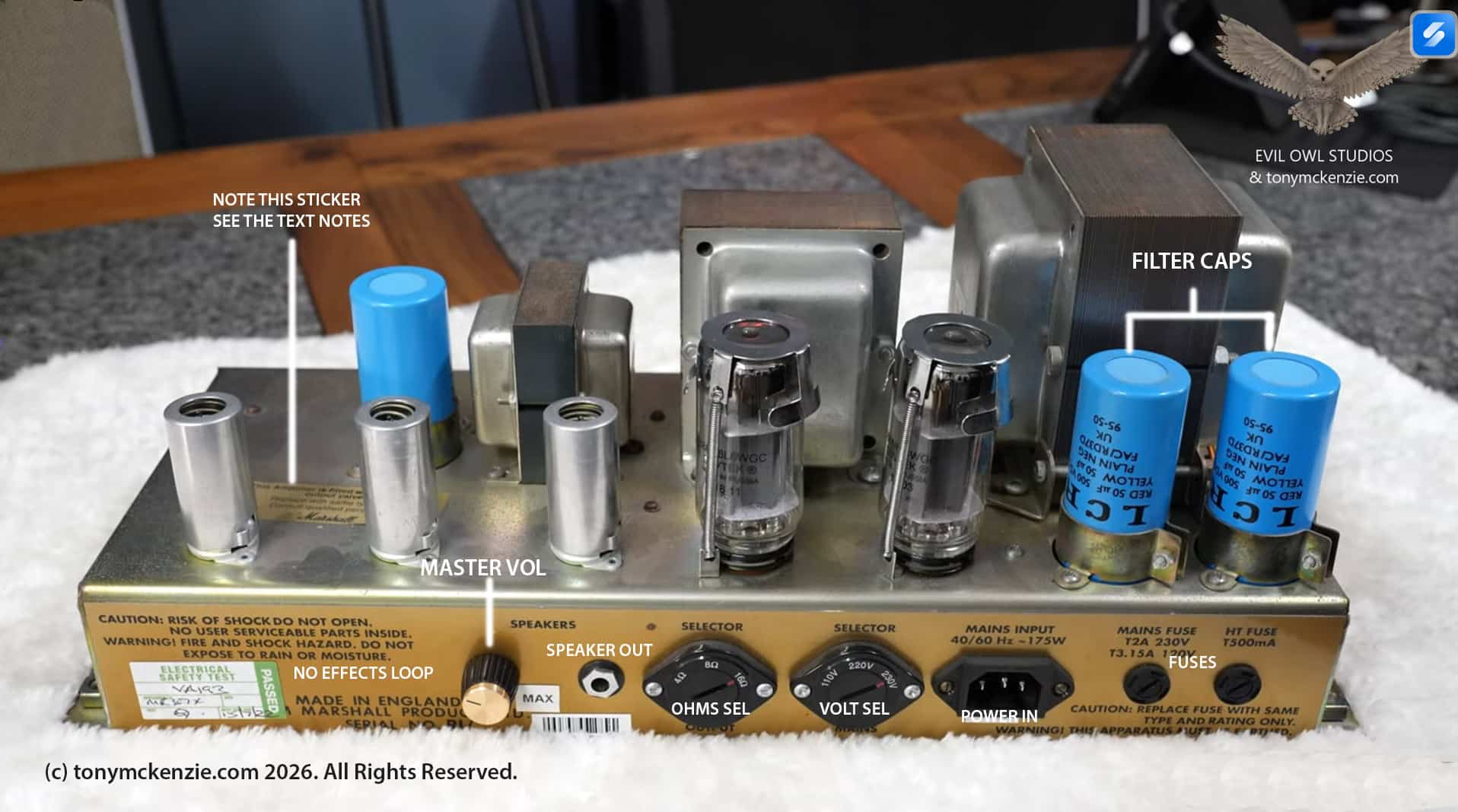
From the large image note those other two LCR filter capacitors, both dated similar to the one we saw around the front of the amp chassis.
The tubes as I said are replaced with SOVTEK 5881/6L6WGC tubes and those look not very old from what I can see. There's an '18-11' on them so they could be week 18 2011 but I think maybe week 11 of 2018 as the amplifier has been well looked after by a professional player - more on that later along with the story of the 5881 tubes.
The preamp tubes I did not really mention are actually TUNGSOL tubes - 12AX7's and have a date code of '19-01'. In my opinion these are week 1 of 2019 which sort of matches up with the power tubes dating. Of course I could be wrong but that's my opinion. The preamp tubes also look in great condition too.
On this amp you don't have the usual sticker on the amp from Marshall on the top of the chassis either, the sticker I mentioned I'll cover soon, but there is a serial number on the back of the amp as you can see here:
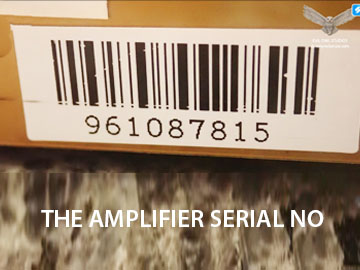
So let's break down the serial number a little. The first two letter are 96 which equals 1996 and the second two 10 tells me it was serialized at week 10 1996. So now we have it all dated. Just as a reference on much newer amps if your serial starts with an M then that amp was made for the UK.
About the 5881 Tubes
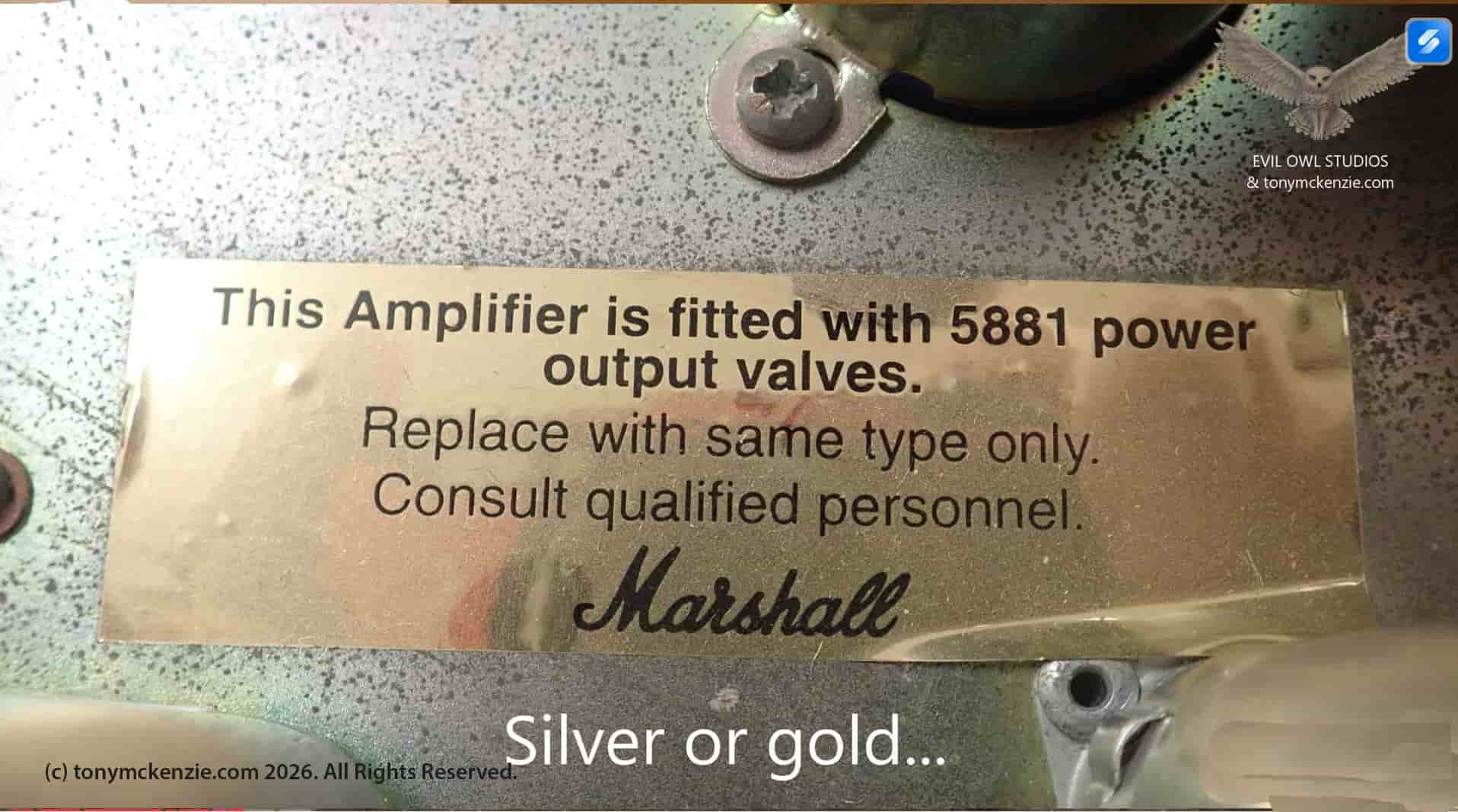
OK well it's time to discuss those 'elephant in the room' 5881 tubes. I can hear you screaming at me now, hey Marshall have for the most part EL34 tubes Tony. Well, firstly that is not true, Marshall HAVE used a number of different tubes in their amps going back from 1962 onwards. Before this amp in the early 70's the tubes were 6550's. Download a pdf of 6550 specs from tubeampdoctor.com. The 6550 is a beam pentode tube and was popular for (among other reasons) that two 6550's could output the same as four EL34's or 6L6 tubes. But in this time period of 1995/6 and around there (maybe a bit earlier to a bit later) there was a severe shortage of power tubes in the world. Marshall, in the 1987 50 watt amps had EL34, that's true. But imagine making this amp and one day the EL34 tubes basically just dry up! That's exactly what happened.
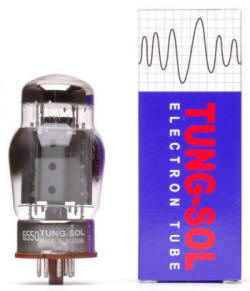
(c) Tube Amp Doctor.
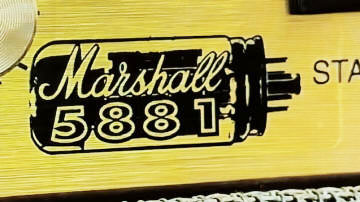
So Marshall, rather than stopping the production, reworked the 1987x to take 5881 tubes so they could carry on in business. And I remember a number of Marshall amps using those 5881's are around those times. Many of those amps of the period had a tube sticker on the front face plate with a tube and '5881' written inside the tube.
It's all a bit weird really, Many said that Marshall design came from Fender (I think it might be disputed by some) and Fender amps were of the 6L6 type of tubes certainly more than EL34. Marshall, when they created their amps in the early 60's chose EL34's as their basis for tone, and we all know that with a few mods etc. was the birth of not only the Marshall brand, but of the Marshall tone too.
But here they are, back in 1996 being literally forced to fit 5881 tubes (also known as 6L6WGC in this case I think) that were sort of a Fender tone base.
The question of course must be, does this Marshall 1987x sound like a Fender amp? You'll have to wait for the answer later in the review :)
As for that sticker I show above on the chassis it was actually a gold one and that told you that you could NOT just install EL34's in this amp. You can of course, but there are some modifications that should be carried out before you do that inside the amp.
The Effects Loop
OOPS! Have Marshall forgotten to fit a component or two? Where is the effects loop... where have they put it? In reality they did not put it anywhere, it simply has no effects loop so if you like effects in this amp then likely they will come in via the front of the amp. But that's not the right place for some effects I hear you say. And that's true. Its one reason why you see these earlier 1987x amplifiers modified so much with effects loops added. Now that does not mean that added effects loops sound bad, they certainly do not - and Head First Amps of Australia makes a very good effects loop that I could fit in to this amp. But then, would I have an amp that Marshall created? And bear in mind that this tube amp is now at least 30 years old? And then there's a question today, after take overs and other things, how long will Marshall continue with making amplifiers, BT speakers are one thing, but real tube amps is an entirely different thing. So this amplifier is basically part of a Marshall legacy in my opinion and should not really be tampered with.
Having said that, there has been a 'master volume' fitted to the back of the amp, but that (as far as I'm concerned' is simple to get the amp back to factory condition easily. So what's your view about this? Is this amp just some 'old relic' (like me some say) or should it be protected for future musicians and long in to the future to show exactly what Marshall made in that time period? Its an interesting question.
The Main Board Inside the 1987x
At last here I am going to show the main electronics and board in the 1996 1987x tube amp from Marshall. Let's do it!
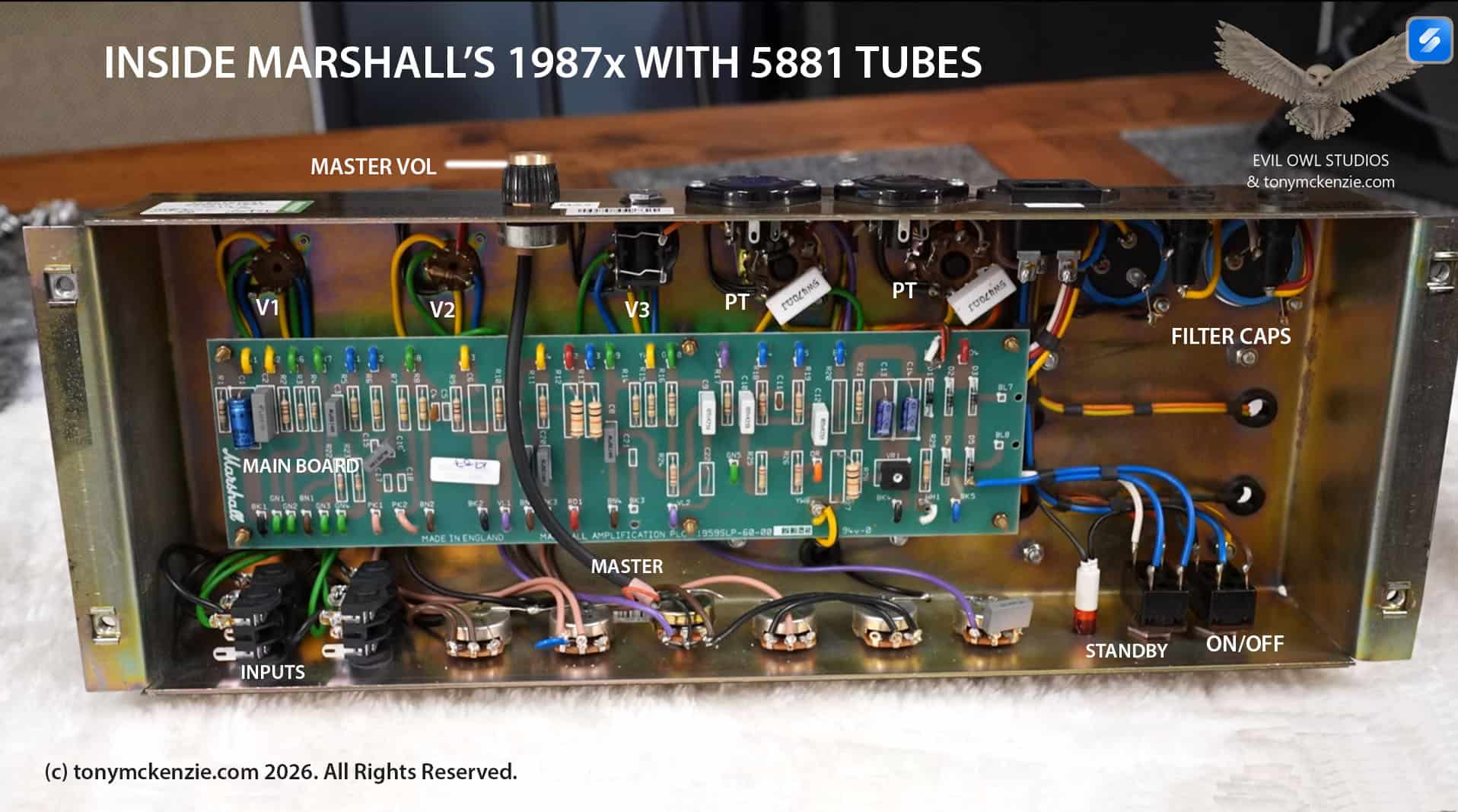
The main board is very reminiscent of many Marshall amps dating back to the early 70's I believe. I have seen so many Marshall amps actually butchered and botched together by what appears to be 'engineers' that don't give a flying fig for almost anything. I had a 1973 1959 type amp and it was really so bad I sold it when I saw the mess inside. That had the inimitable ST1 board if I remember correctly, but honestly it had been through the wars.
LOOK CLOSELY AT THE LARGE PCB IMAGE - and you will see that the main board actually says it's a 1959SLP main board! Hmm I wonder how many of you guys have seen that before? Maybe you have, but I don't remember seeing that exact association with the actual 1959SLP board before although clearly the ST1 of those earlier years had many configurations.
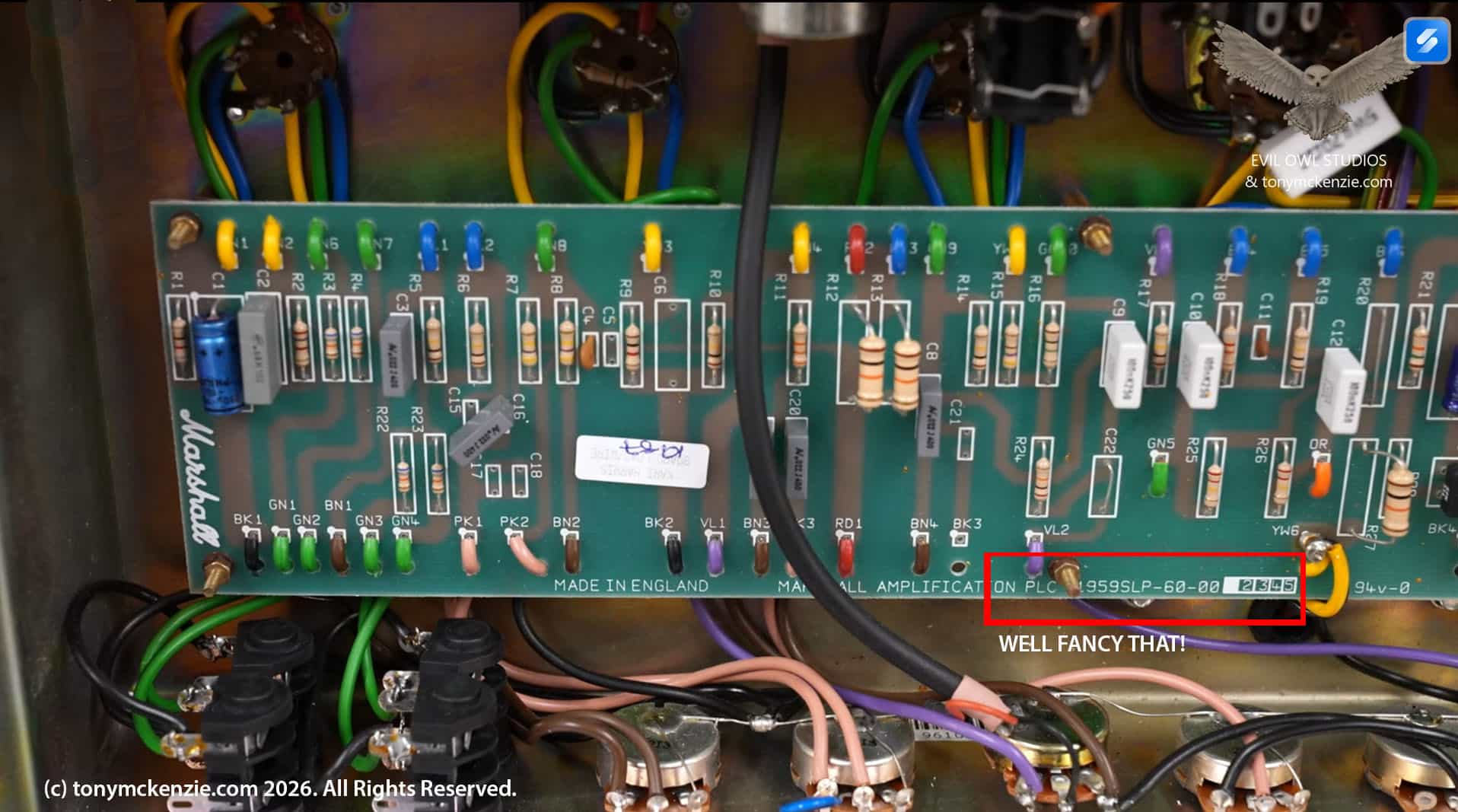
Looking at a close up of this PCB, you will see that while there are some of the more modern capacitors etc. than the older amps, its a tidy enough job and one that really has had very little or nothing done to it other than that master volume. And the master volume mod is interesting. There are three or four different mods that can be applied to Marshall amps, some better than others, The @Guitologist did a video on those and showed the originals in a book I also have here, so try and find that video it was worth watching. Lets see the other part of the PCB.
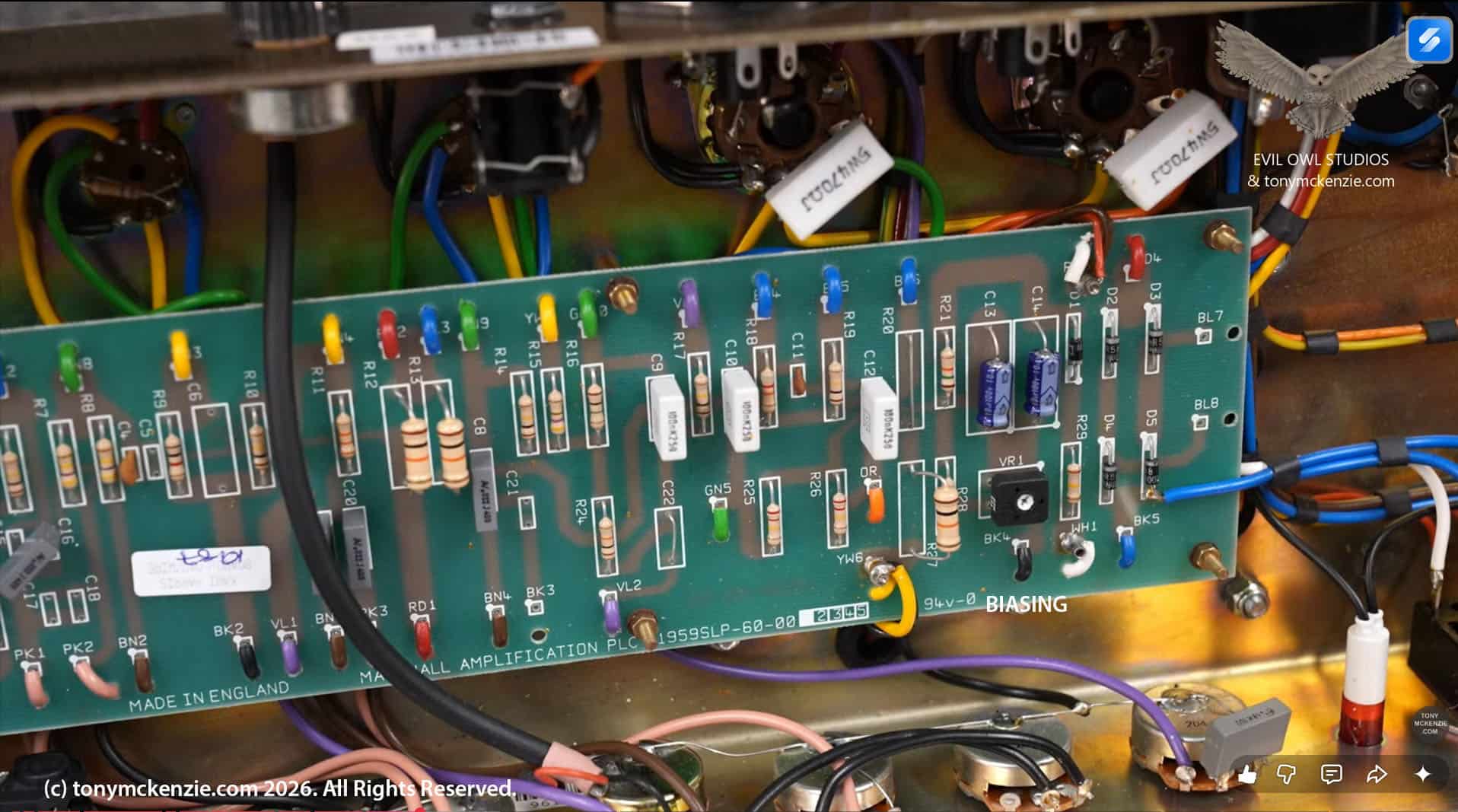
And looking at this side of the PCB you can still see that master volume mod, as well as the bias adjuster and those two blue capacitors that typically fail over many years and allow the biasing to 'run away' causing untold damage sometimes. Note there's no heater balancing control as found on later Marshall amps so if there's that noise on here then its here. I guess you can reduce it, but the balancing mod that came later I thought was great. This amp IS quiet by the way.
What I would say about this amplifier build, is that the switches are mounted properly, the resistors that get hot are 'off the board', there are no 'botches' on this amp board and overall its a brilliant amp for a great cost (I paid around £950 ($1100) for it.
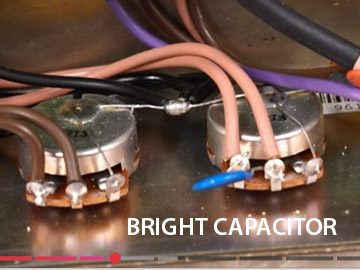
I threw this pic in 'for fun' and it shows the 'bright capacitor' as fitted to this amp. It 'might' have been played with but you make your mind up about that...
Thoughts so far
So what do I think of this amp so far?
There I am... so depending on your point of view, is this amp worthy of being called a 'real' tube amp?
My opinion? Well I can hear you now, howling at the screen :) telling me that it can't be a 'real' tube amp for a number of reasons and I'll list them now:
- It's got a printed circuit board in it
- Those tubes are not 'right' for a Marshall
- Those capacitors are cr*p
- It's got an X in it's name designation
- That's not a 'real' Marshall
- It's got no effects loop
- Put your reasoning here...
You see, it's a subjective when it comes down to some of those things I just mentioned, but make no mistake some readers will be serious when they say those things. For me, however, I think this really goes a long way to capturing some of the Marshall story and their history. Personally I think the build is exceptional and you might well be hard pressed today to find an tube amp that comes close to this build especially in these rapidly rising times of costs for everything.
I don't mid the master volume and neither do I mind the 'missing' effects loop because I'll add those post recording in the DAW, which is frankly a far better way of recording your guitar tone than trying to embellish it with any old effects at the time of recording. Ha it's one reason I guess why they harp on so much about 're-amping' - something I just don't do!
Then the question posing now is: Does the older turret board and hand wiring affect the tone. For me I have to say, while that's nicer to look at when the right person built the amplifier, honestly I don't get 'hung up' about that, and I think the tone of most tube amps can vary a little. Whether its down to the turret board, the hand building, the resistors and capacitors well maybe my ears are more 'shot' than yours? But however I look at it, this amp still sounds really great to me.
For the guys that dislike this board intensely, you can go the Head First Amps website and buy a replacement board! I'm not sponsored in any way by them, but they do make some really nice main boards where you could add features all day. Let's move on from this section.
The History of this particular Amp
Yes this amp does have some history to it and I'll quickly tell you about that for anyone interested.
This amp does have a little bit of history that I was advised when I bought it a while ago in 2019 which I found interesting really. The seller 'Neil' had the amp for sale and he told me that he had bought the amp from 'Vintage and Rare' in Bath in the UK. They told Neil that the previous owner was Innes Sibun, a really great blues and rock guitarist. But also Innes had been playing in Robert Plant's band, and he decided to sell it because the other band members wanted him to have something that was not as loud! The guy in the shop went on that Innes loved the amp but it had to go. So what a thing... well for me that's all interesting to know and I'm sure it would interest many guitarists. You can learn more about Innes Sibun and his band here and I hope you viewers will enjoy his work - I did.
By the way I bought this amp from Neil, the last owner on Reverb and a great guy he is, very helpful and the kind of guy that everyone should be like!
General Conclusion
Looking over the amp as we have I think its really in a pretty good place regarding the condition. The filter capacitors all look fine to me (I did check them also) and the overall condition is excellent. And if you were someone that wanted to make some modifications to the amp (some do sadly) then the world is your oyster really. The master volume mod was carried out and I don't mind that, but there could be many more mods thankfully not carried out, but here's a few:
- A Cascade Mod
- The One Wire Mod
- The Master Mod
- The Loop Mod
- Main Board Mod
- Power Tube Conversion
And I'm sure the 'modders' out there could fill this page. Let's face it, Friedman made a living modding the circuitry!
But with a TS808 or similar you really can sound like the most famous players that there has ever been. I won't name them because you know them all already. To get that authentic tone (that many guitar players have never experienced in these days of simulator amps) from Marshall you could say is an acquired taste, but with an amp like the 1987x today you CAN use one almost anywhere if you're prepared to lug it a bit. Wimp's need not apply. For a studio of course its perfect for my needs, and one reason that I also have the inimitable 1959HW head and a 4x12 or two in the studio. Simulations are one thing, but anyone contemplating buying one of these Marshall's knows the difference between these tube amps and the software equivalents. Its one reason that while tube amps have surely slowed, they are far from being dead, and guitarists still hanker for those tones. Never tried one? Well you should and maybe you would never go back!
Other things maybe of interest, include the case assembly as its the 'old' design and those can get rather beat up around the corners of the amp often, and all over if the thing has been gigged over substantial time. On this one there were a few corner issues with the tolex, but nothing that a bit of superglue could not fix.
And also underneath there are the original type of feet, seemingly originally made of 'Bakelite' but probably at this time of plastic. Internally there is a spring for each foot, all held in place by a cover with two screws. It's very 1959 Plexi style for sure, and when you place the amp on these it can sort of move around a little on those springs. The later releases of this type of foot are entirely rubbery material and constructed so its all in one piece - basically a cheap way of creating what looks like the original feet but certainly is not. It's nice these are on this amp.
What About That Volume?
I should say that playing the 1987x without some sort of volume is a problem as it can be really loud. You will know that this amp has a 'master volume' fitted, but in reality as @guitologist said in his video there are actually 4 different master volume designs as follows as Ken Fischer described in the 'Trainwreck' pages in 'A desktop reference of hip vintage guitar amps by Gerald Weber. Mr. Weber has written a number of books about amps but here are the 'master volume' types:
- Uses a double 1Meg as used in Marshall amps let's call this type 1
- Uses a double 100k linear pot for type 2
- Uses a single 1 Meg audio taper pot for type 3
- Uses an additional preamp stage for type 4
I recommend you go and buy the Gerald Weber book available from Amazon as it is a wealth of knowledge, but also Gerald Weber's other books like 'All About Vacuum Tube Guitar Amplifiers' and 'Tube Amp Talk For The Guitarist And Tech' as all these books I also own and are really informative. Mr. Weber is one of the great's.
I just wanted to show that there ARE many mods for master volumes available and they can be applied to various amp designs.
Now if you really don't want to modify the amp then maybe look to the Roland Boss TAE Core which is a unit costing (in 2026) about £620 in the UK currently. Note that I have a video review of the TAE core on YouTube and a newly written review on this website of the TAE core here. So if you want to learn about the TAE core and I show everything about it in that review.
In reality, no matter what some might say, the volume is actually a non-issue since many years through one method or another. Look if its good enough for all those guitar heroes then it's really good enough for little old me!
Still on the conclusions point really, whatever the 'latest simulator' and how 'great' they are hyped up to the hilt about how they are 'the same' as a tube amplifier like this, make no mistake they are not quite telling the truth. Even now, go and watch Yngwie Malmsteen, or Michael Schenker etc. any of them and you'll still see those tube amps right there on stage. While clearly there are pro musicians that do use the simulators (whatever flavor you want to choose - and I know some) the actual 'feel' is not actually as inspiring as it is with the likes of this 1987x or indeed the 1959HW and many other tube amps (not just Marshall). Remember that won't you.
It seems if you go to buy a new 1987x in 2026 that you will be asked to pay £1599 British Pounds, and check pricing of the Marshall 1987x currently when I checked. So they remain a bit expensive and if you can find an unmolested on that's the best route to save some money.
The Overall Score
After a review like this (you won't see one anywhere except from me in other formats) I always get asked about a score and whether I would recommend the amp etc. and you know when looking this close its obvious that I have conclusions about a score and value etc. basically ultimately would I keep the amp or sell it later?
Remember that I did not buy this 1987x to review, I bought it to use for recording music and getting inspired enough to create new music that otherwise I might never had written. So for me the score for this amp has to be a 10/10. And of course I have played it a lot since the original video review.
Even with the 5881 tubes this amp remains at a 10 out of 10. Sincerely I hope Marshall continues to make tube amplifiers long in to the future - its an ability and they have driven the tube amp market arguably since 1962.
The Audio
I recorded the audio with the amp, a1960a cab, an Audio Technica 2040 (I think it was) and in to the desk. On the feed side of things I used my Ibanez RG550LTD guitar in to an SL drive pedal and a wah which was a Jerry Cantrell model. That's it - take the time to listen to it from the links below and I sincerely hope you have liked this long written review which has taken me a week to complete!
This is entirely an unsponsored review and the opinions are my own. You CAN trust this review completely, unlike many that others create that are often paid reviews.
Links:
Playing of the Marshall 1987x Tube Amp
Video Review of the Marshall 1987x Amplifier
Video of Roland Boss TAE Core for Tube Amps
Written Review of Roland Boss TAE Core
I am working on 21 written reviews of all sorts of gear that many guys might find interesting so don't forget to take a look at the latest written reviews on the parent page on tonymckenzie.com
© A B McKenzie 1997-2026. All Rights Reserved. All Trade Marks Acknowledged.