
When Marshall released the JTM Studio ST20 Tube Amp it was widely anticipated. But did that guitar amp really live up to those expectations of guitarists?
Marshall JTM ST20 Studio Inside and Out Review 2026
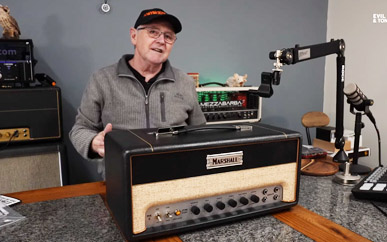
The Marshall JTM Tube Amp - is this a truly great amp?
Introduction and Preamble
In this inside and out review of the Marshall JTM ST20 Studio tube amplifier (an ST20H for this one) I'm going to take the amp apart and show you what you're really getting for the money. Compared to many guitar tube amplifiers in the market in 2026 this JTM is a really good price (at least in the UK typically £749 and check all ST20 Studio Marshalls pricing. The question is have Marshall cut back this amp in some way? or is it really what guitarists have been waiting for literally for years. The Studio series creates 20 watt versions of Marshalls most revered tube amps and I can say that it has been a roaring success overall. Remember though that the JTM Marshall holds a sort of 'king of the castle' in Marshall's history in my opinion so it's really worth looking very close at this amp and it's history a little. In this close up review you will learn more about this amp than any other review ever shows you and it will be easy to see if the JTM really is top of the Marshall Studio designs.
History
The JTM was prototyped back in 1962 and started being sold in earnest in 1963. And I do have a few images of one of the original amps they completed when I visited Marshall Amps over the last couple of years or so - check them out:
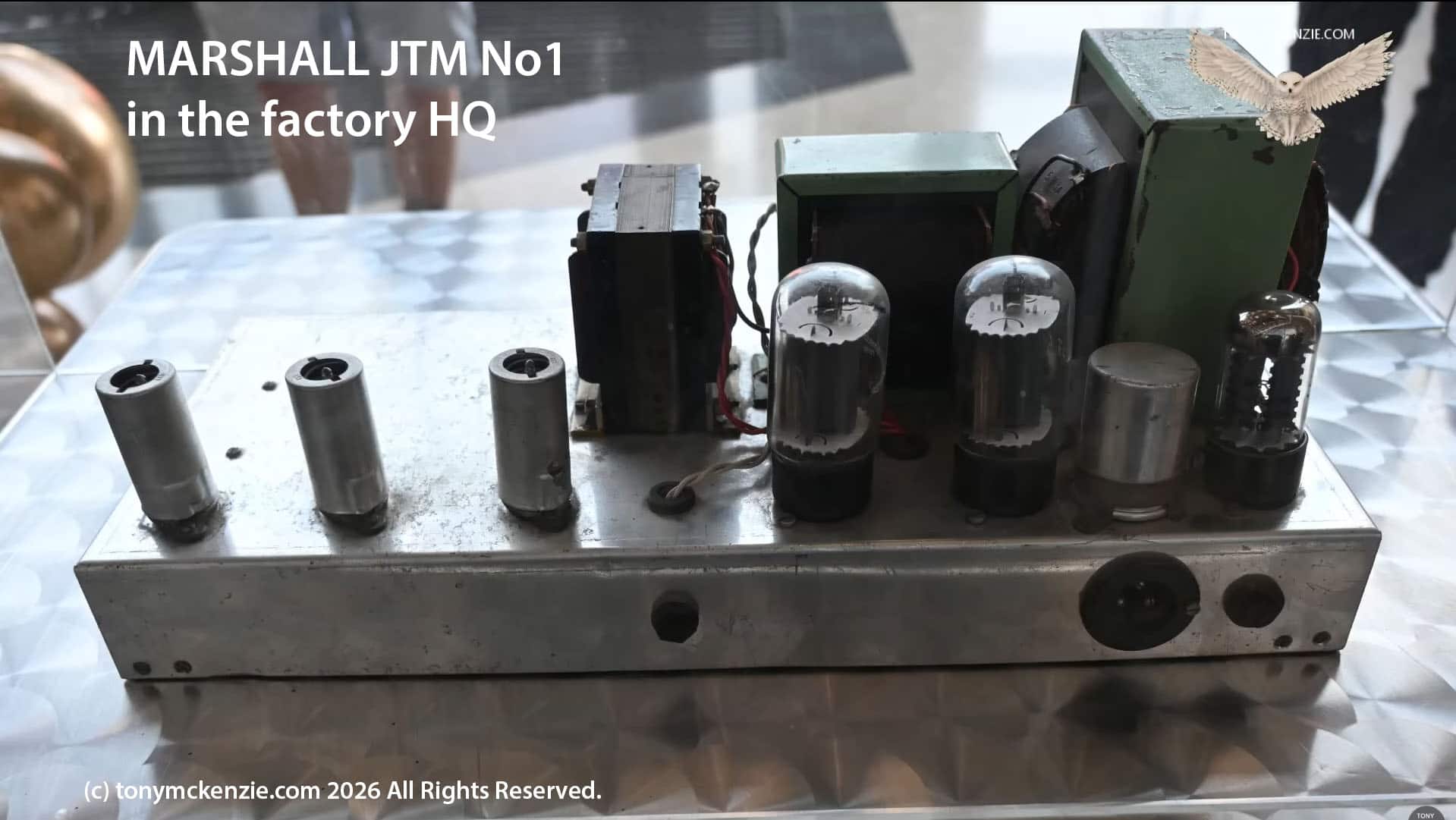
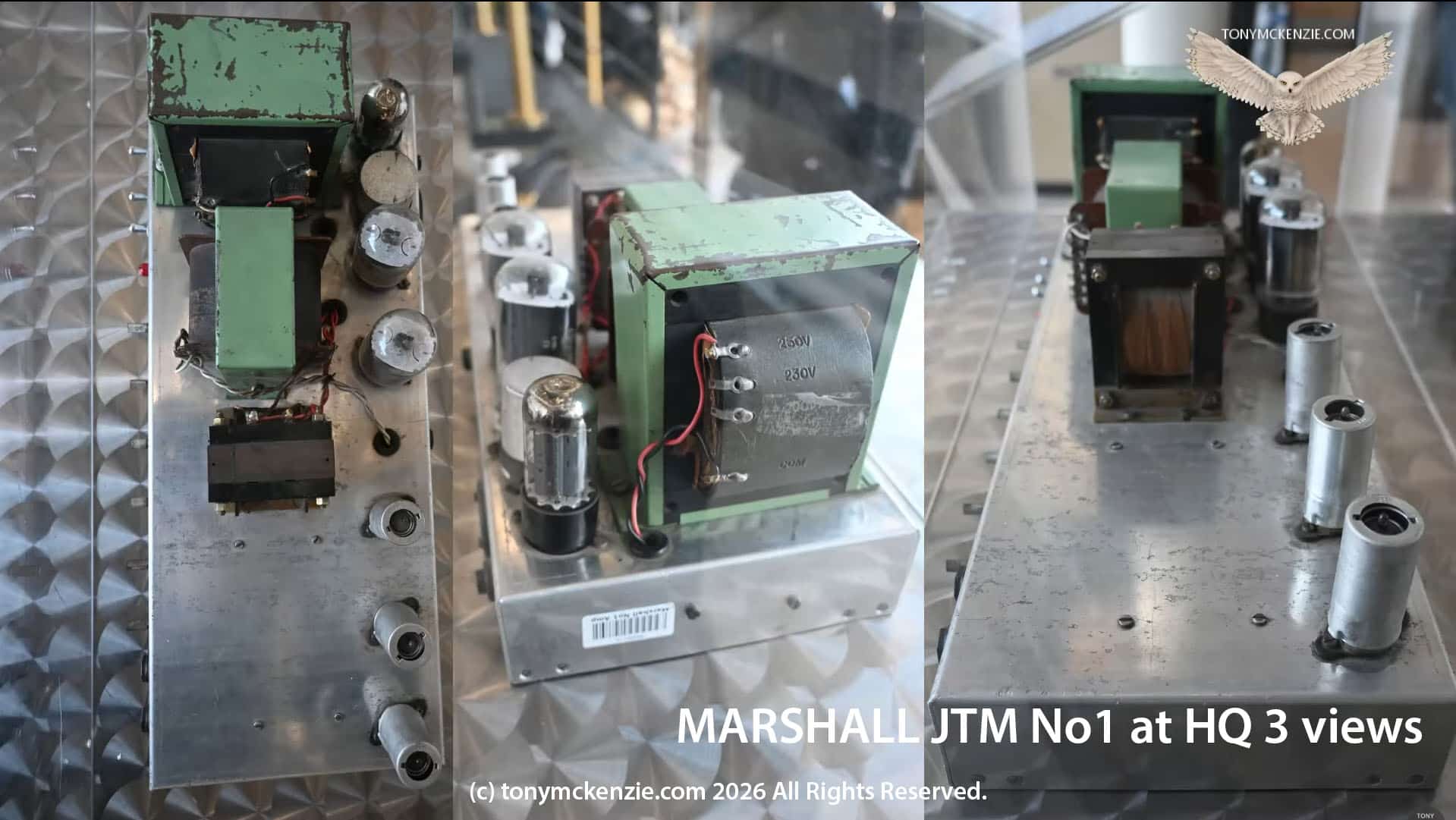
This is the most famous amp that I photographed personally at the factory, classed as amp number 1, but really there were a few of them. Marshall was showing the JTM off to artists that were coming in to the original shop who wanted something much louder than what they could already buy. Notice the green color (those were old service parts hanging around) from the likes of the remnants of the army etc. Of course subsequently the rest of it really is history and the first reason Marshall amps came in to being back in the day was the Marshall JTM amplifier.
That name 'JTM' represented Jim and Terry Marshall (Jims son Terry I interviewed in 2023) and of course Terry did play a part in the development of course and that original design mutated from what some call an offset design to the later amp more as we know it today. BTW my Terry Marshall interview was when the company had just been sold to the Bluetooth company overseas. Terry was confirming they will 'always' continue to make Marshall amplifiers, but I have to say that while they still do in 2026 as I write, honestly I can't be sure of that fact. I hope they do continue to make the Marshall 'sound' (because that's what it is) long in to the future. Note that the Terry Marshall interview link (in blue here) you can hear Terry literally telling you how this JTM amp came in to being, no if's no but's just real straight forward talk from Terry himself! And Ha while Alan Brice is on camera, I'm behind it :) - I don't know, these Bass guys always want the glory on camera? right?
JTM45?
Well many won't have related the original amp as a JTM45 as they know it. Often in the memory of guitarists they might remember something like this:

This mark 2 version (this is one I made) has around 30 watts output and you can drive it flat out if you have the sound proofing etc. and it certainly is NOT the '45' that some think it is.
In any
case the amp under review the Marshall JTM Studio ST20H Marshall
claim its as near to anything you could get to those originals! In
this inside and out review I'll take a very close look and see (and
hear) exactly how true that statement really is. And before I
continue, this review is entirely my own opinion. The JTM45 Studio
under review I bought personally from a music store in the UK (Fair
deal Music) so this review can be completely trusted as my
experience with the JTM45 ST20 guitar amplifier.Inside the Marshall JTM Studio ST20H
So I'm going to take you right through a closeup of this JTM amp and show you
inside. This is not some 'special' amp that was made for the review -
its EXACTLY what you will receive if you buy one... unlike the Friedman
experience this amp is perfect inside and out let's take a look.
The Chassis
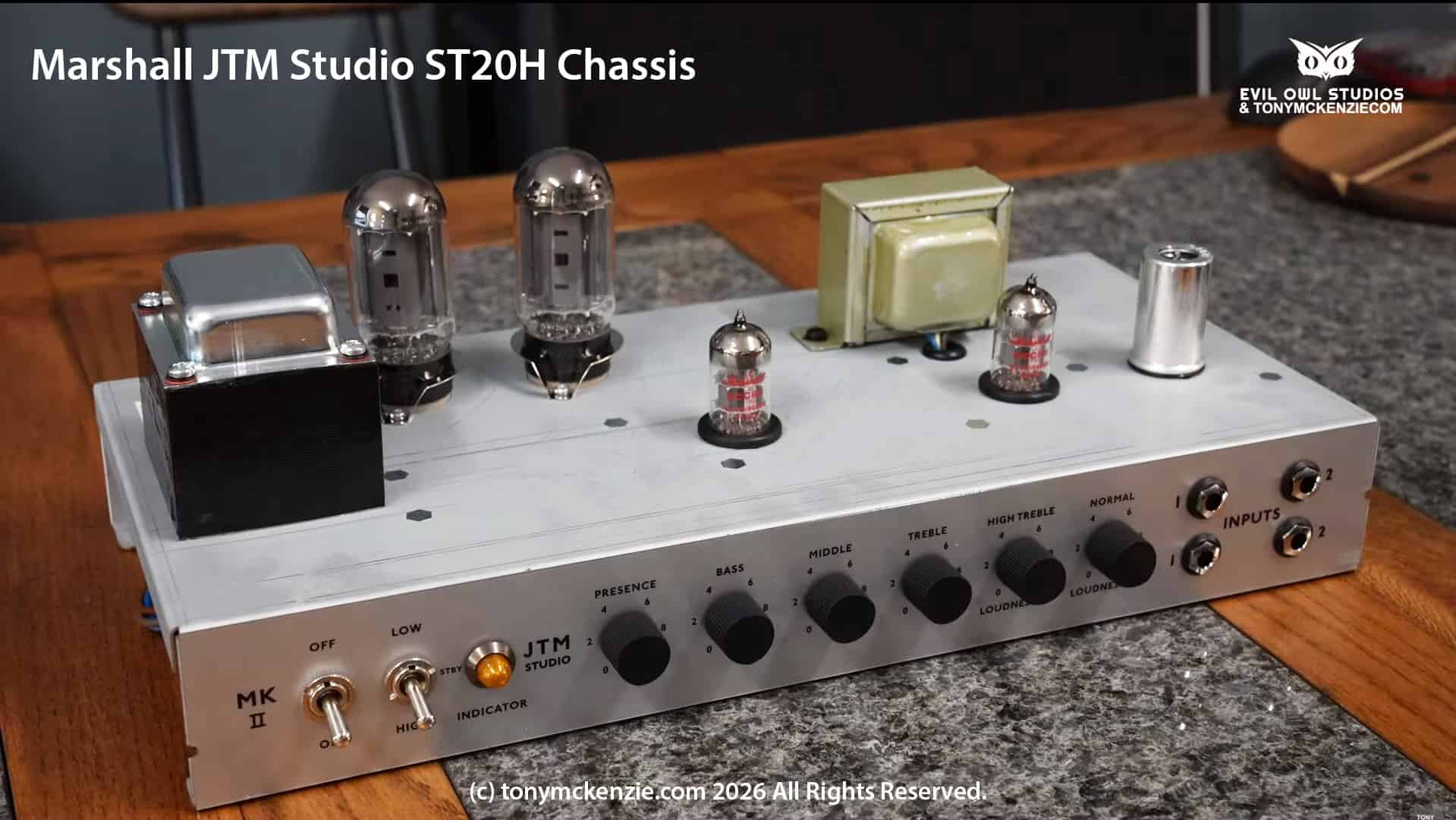
Open the larger image and you will see how simple this JTM amp from Marshall really is. It's also very similar in overall top of chassis design like many of the Studio series I have reviewed over the years. On the left of the chassis you can see the power transformer (TXMA91095), that larger one compared to the output transformer, The main power tubes are a bit different than what you might envisage, these are actually 5881 x 2 tubes (remember my written Marshall 1987X review here) similar to what is fitted to that 1987x earlier version when EL34's were scarce.
Next up is that output transformer (TXOP91014) which does not have to be as big on these 20 watt amps as it is on many of the other Marshall amps, but that's OK. The preamp tubes (including the Pi tube) are all ECC83 and marked in red with the Marshall name on them. I'm informed these are likely JJ manufacture. Note only tube no1 has a shroud on it. And also note that the ends of the chassis are of the 'open' type.
Main PCB Area
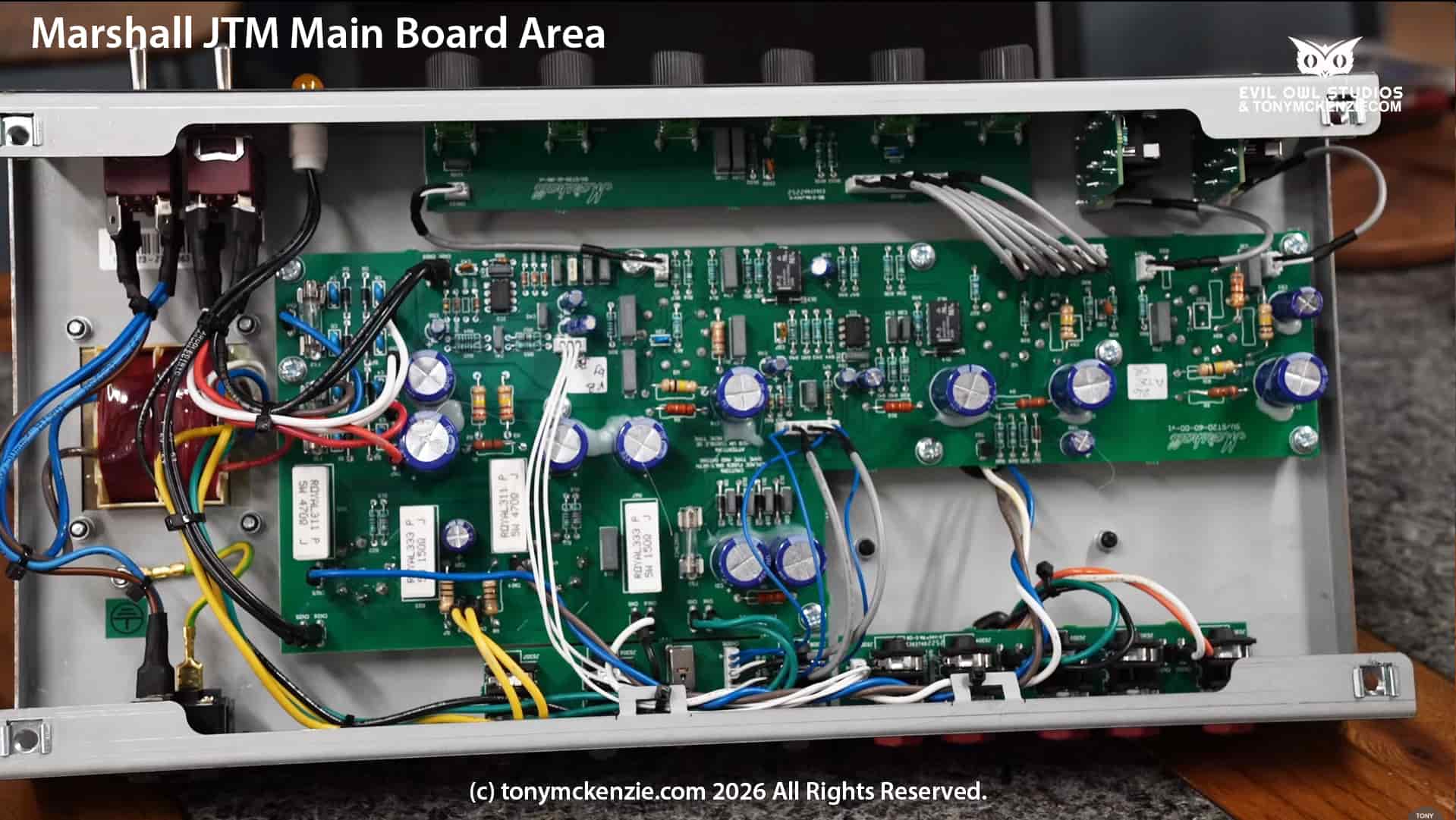
As you can see on the left hand side of the chassis internally, there is the power transformer. What might be important to some, is the ability to change voltages of the amp for different countries, but I'm sorry to say that Marshall has NOT included a multi-voltage power transformer so you can't do that. While it can be done of course by getting a replacement power transformer maybe from tubeampdoctor.com, from my experience though as you will see if you click the link, the price might be prohibitive in changing the PT. There are a few other components you have to change too. The link is NOT for the JTM Studio but just an example. tubeampdoctor.com can literally make the transformer you need and just call Stephan at TAD and tell him Tony sent you! :)

Looking at the standby and on/off switches, these are fitted perfectly and are exactly what you would expect from a decent amp maker. Simply perfect.
Preamp Section
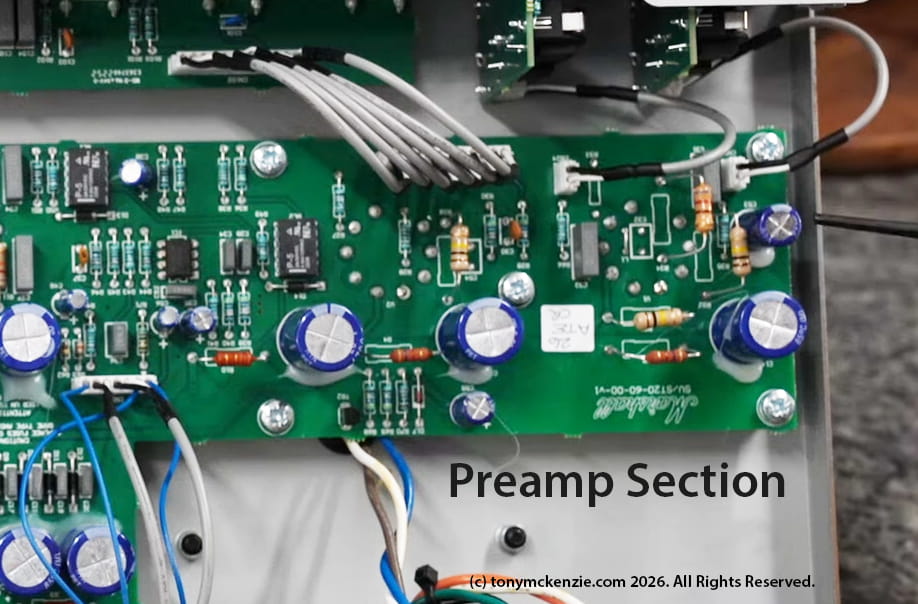
From the right of this section of the main board the audio comes in from those inputs on the front of the amp (and those appear to now use two small daughter boards). Now look close at the build quality, you will see the larger resistors are always lifted off the board and for good reason. You see, the larger the resistor the hotter they get, and remember this, if one should fail, lifted off the board is no issue. But amps that have larger resistors clamped tight on the PCB are asking for trouble. I have seen them overheat and damage the PCB on some amplifiers (but not the studio series for sure), that then have to have PCB repairs. Not recommended - get yourself an amp that will last for years!
Also note that the very small resistors are mounted on the board, but those don't get hot in the same way as the larger ones, so Marshall have fitted them accordingly. These ARE important points that many people don't even know about - at least until their amp stops working! Don't be one of those guys. The electrolytic capacitors are made by SamWha and have been used for years. They seem very reliable and I never saw those fail either.
Looking at the board a little closer - from the right is V1, then V2 and the third tube is the PI tube area of the board.
Power Amp Section
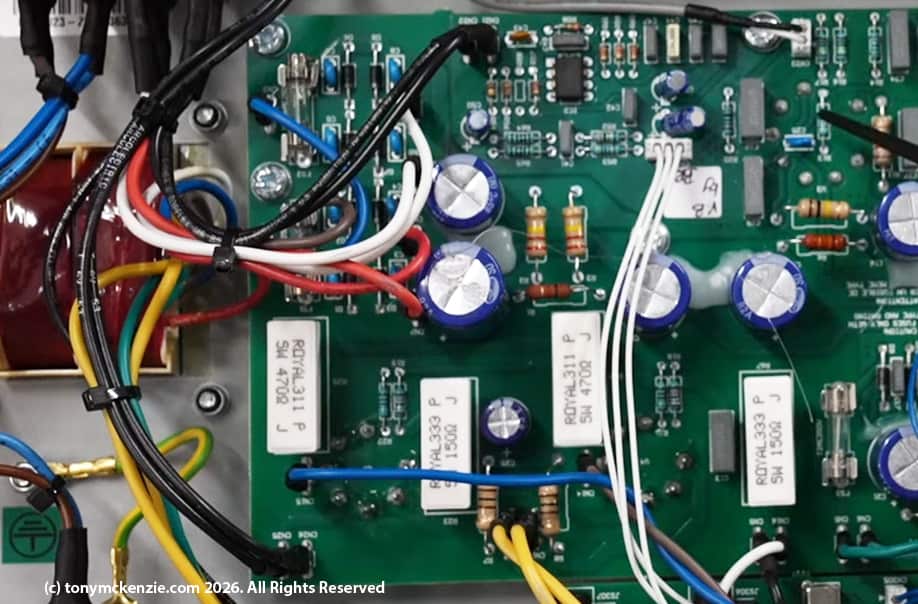
Look close and you will see those 5881 tube sockets on the lower part of the power amp section on the JTM ST20 amplifier. So we're really in to the power amp territory. In the top half of the section shown is the regulation and input power etc. from the PT. Note those fuses inside the amp that can blow sometimes and if you did not know they were there they might prove expensive for an engineer to change them!

And when I look at the main cement resistors that are also mounted in the power supply area you will always note that Marshall have stand-offs to ensure the PCB is not damaged from the substantial heat these can give off. There are many amp brands out there that just pull the cement resistors hard on to the PCB - Friedman is one of them and there are plenty others. Would you be happier with these hard on the board? I think not.
Other PCB Boards
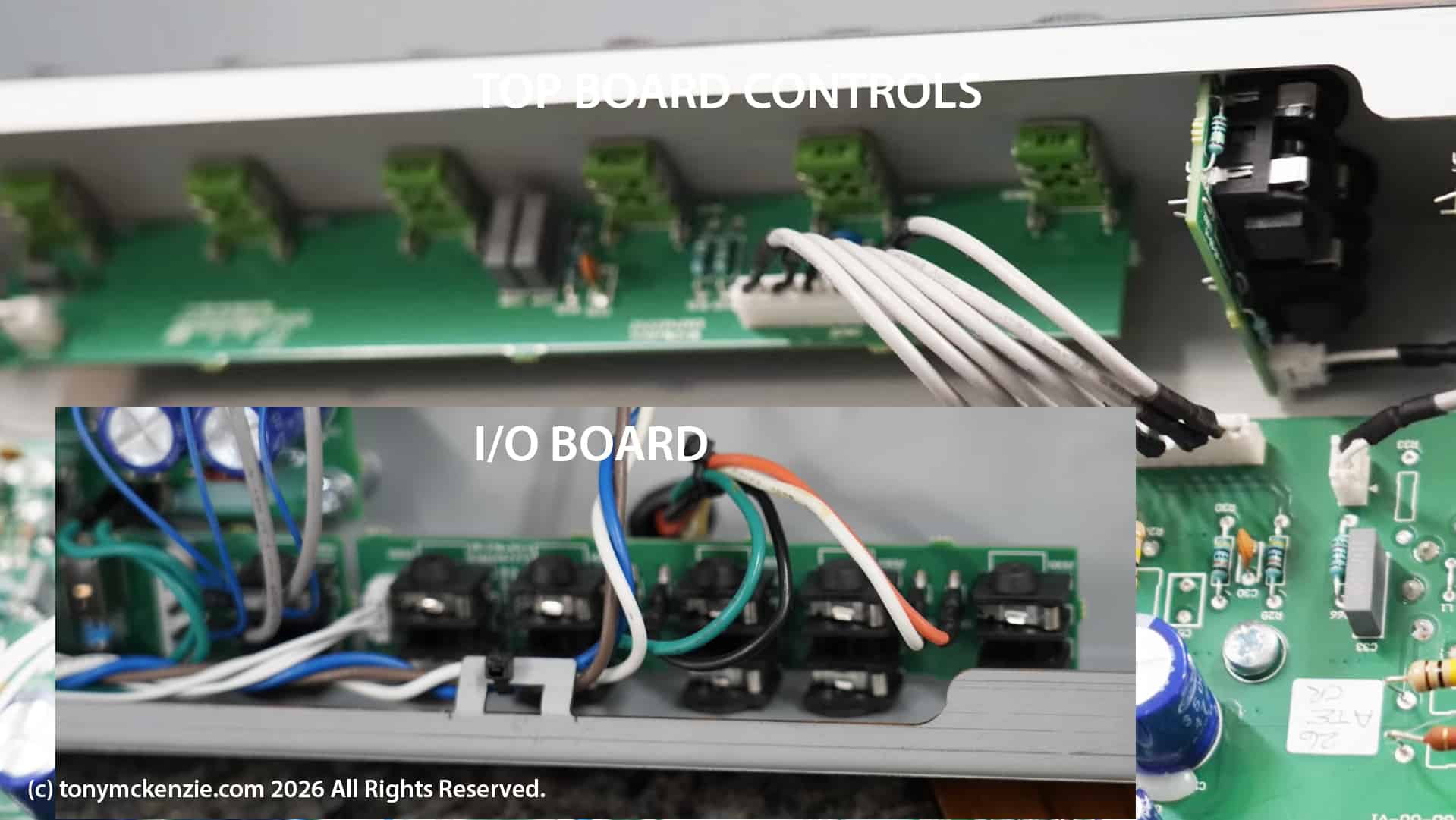
It's nice to know that the inputs, control knobs and rear I/O and even a loop are all mounted on separate little PCB's. Why? Well its simple really, if any one of those gets damaged in some way, then you can get a replacement from Marshall (or the authorized repair guy can) and Marshall will likely have these boards for at least 7 years from end of production which is typical for many manufacturers, but not all!
Conclusions of Inside The Amp
Wherever I look inside this JTM Studio amp everything is nigh on
perfect. There are no botches, no dodgy engineering, no parts
assembled in a way that in years to come the owner will really wish
he had not seen the amp... nada... nothing. The PCB's themselves are
thick enough to matter and while the track thickness is not hyper
thick, its highly likely adequate for the job. I remember the
JCM2000 days of course where the main PCB appeared to have issues of
a number of things, but here and generally in the Studio series
where all the PCB's are similar I don't have anything nasty to
report.
Front and Rear I/O on Marshall JTM ST20H
Let's take a quick look at the front
controls and rear I/O of this JTM ST20H and see if there's anything
different... I doubt it!
The Rear I/O

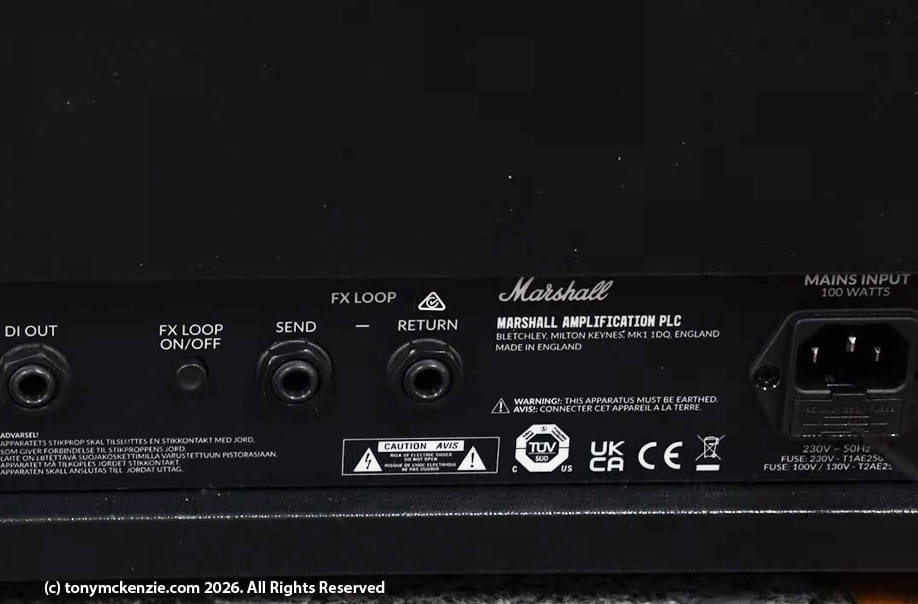
First things first... here's my serial number: M-2023-27-0363-1
The M denotes that this amplifier is made in the UK and for the UK market I believe, the 2023 is when the amp was actually made, I think 27 denotes it was week 27 in the year from January. I'm not sure of the last couple of numbers (If I did know ha I forgot!) so it's easy to tell when your amp was made.
There's the loud speaker outs in red that cover near enough all the Ohms ranges you might want from 1x16 Ohms, 1x8 or 2x16 Ohms, 1x4 or 2x8 Ohms connectors. Next along is a DI output so you can record from the amp.
There's a effects loop on this amp that is a serial loop in and out and it can be turned off so its completely out of the circuit.
From there on, there is the approvals that I believe Marshall actually carry out themselves (at least they did when I visited Marshall and went around with Phil Wells). On this amp is the CE, UKCA, WEEE and RoHS as well as other stuff. Also note that Marshall has where the unit is made - this one is MADE IN ENGLAND proudly emblazoned on there, as well as Marshall's address that should be on the unit for approvals.
Lastly there is a mains input IEC connector with a fuse at the bottom of it - don't forget to check that and only replace with the same thing if yours blows. It blew again? Get your amp checked by a professional engineer.
The Front Controls
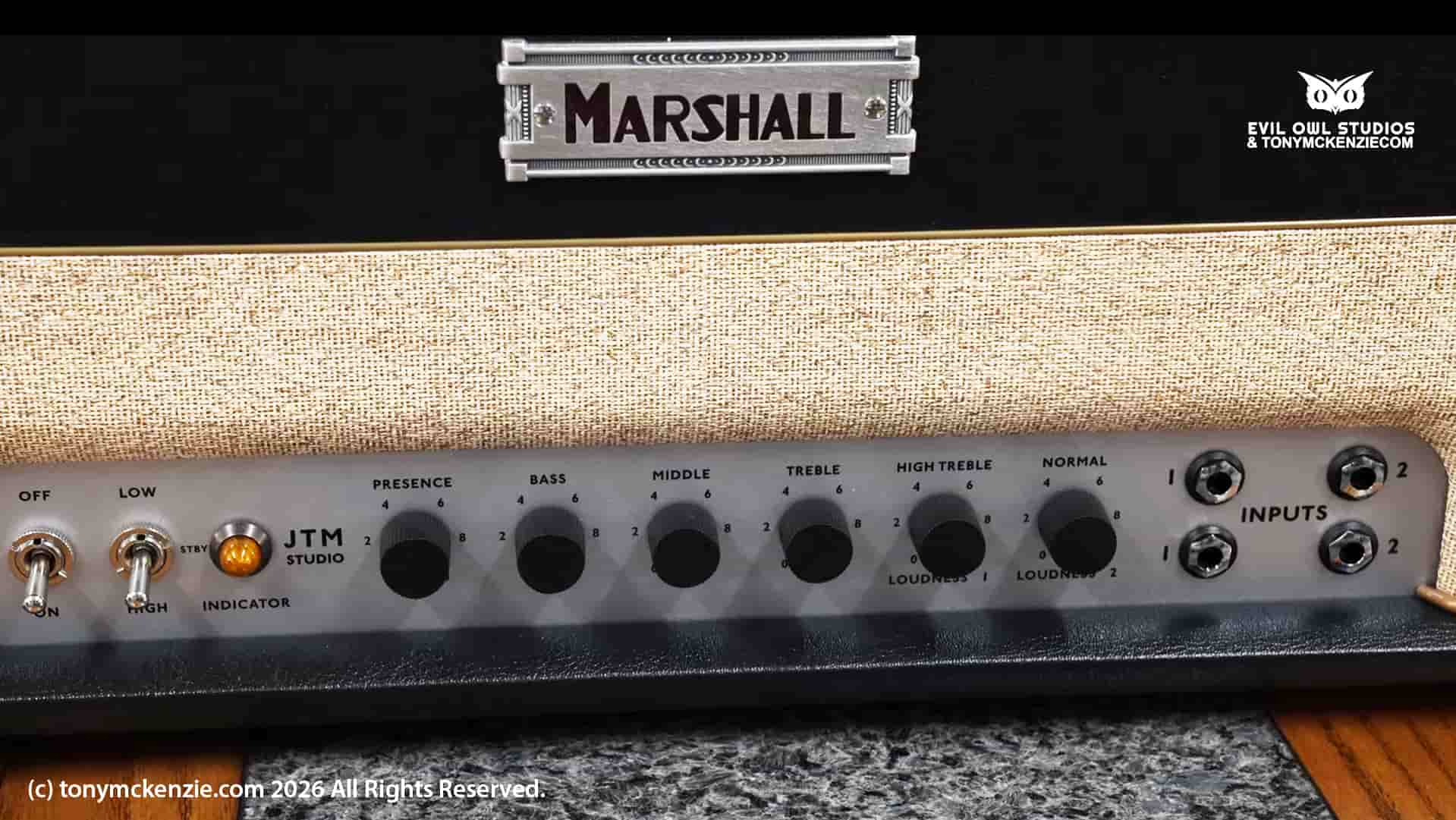
I know, we have seen these controls for so long, even on the later amps they are basically the same even if the knobs changed and the 'pre' plexi front is different. But that's OK, who would not want to play the worlds most famous tube amp brand! What do you mean Fender! :)
So a really quick run across these:
- Old style steel on/off switch
- A standby switch in the middle, low power up (5 watts) and high power (20 watts) down (Ha not on original)
- There's Presence, Bass Middle, Treble, High Treble and Normal volumes.
- High Treble (Loudness 1 is channel 1 and Normal Loudness 2 is channel 2) I'll call them channels but really they are not quite channels.
It IS possible to join the inputs as you would on a Plexi amp to get a better tone and a smidgeon more drive from the amp.
And that's really it for the controls, But do note the MARSHALL BADGE that some call the 'coffin' plate and I can see why.. hey I wonder if Marshall actually went to an undertaker and bought a few? I doubt it, but I could guess there are stranger facts out there.
Start Manual
Basically its a sort of quick start guide and if you really are not familiar with the Marshall amp and its layout you should read that. There is a complete manual for the Marshall JTM ST20H and you can of course go and download it at the Marshall website.
The Warranty on the Marshall JTM ST20H
Marshall have excelled themselves here -
check the warranty out.

Its possible you don't know about the Marshall warranty? Is it just a year? Nope... is it two years? Nope its a full THREE YEAR WARRANTY from Marshall amps. Now remember that you do have to 'fill in the registration form' online to get this extended three years warranty from them. But its not a hard price to pay is it? Some companies with their marketing go for an all out 'lifetime warranty' but you know what, those warranties are not quite the same. Just take the time to read their terms and conditions, and its a wonder there's ANY warranty on those sort of products. But Marshall has offered this full three years and you know what, its exactly what it says on the tin - it covers defects in materials and workmanship for the full three years. Excellent warranty and full marks Marshall.
One thing though, I cannot guarantee that this 3 year warranty is
worldwide so do check with the seller.
My Opinion of the Tones of the Marshall JTM ST20H
The JTM make no mistake is it's own master
and don't assume anything else!
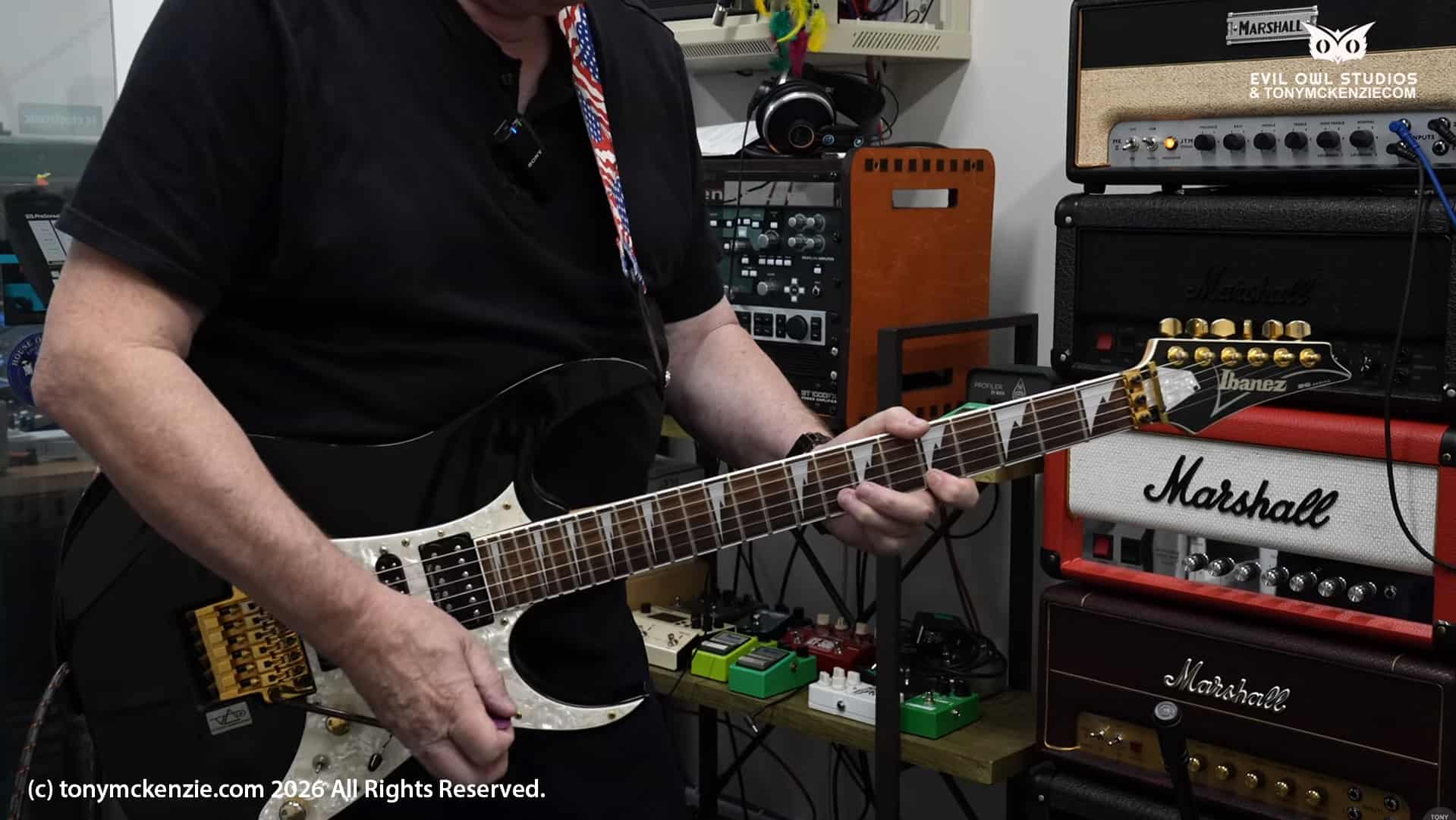
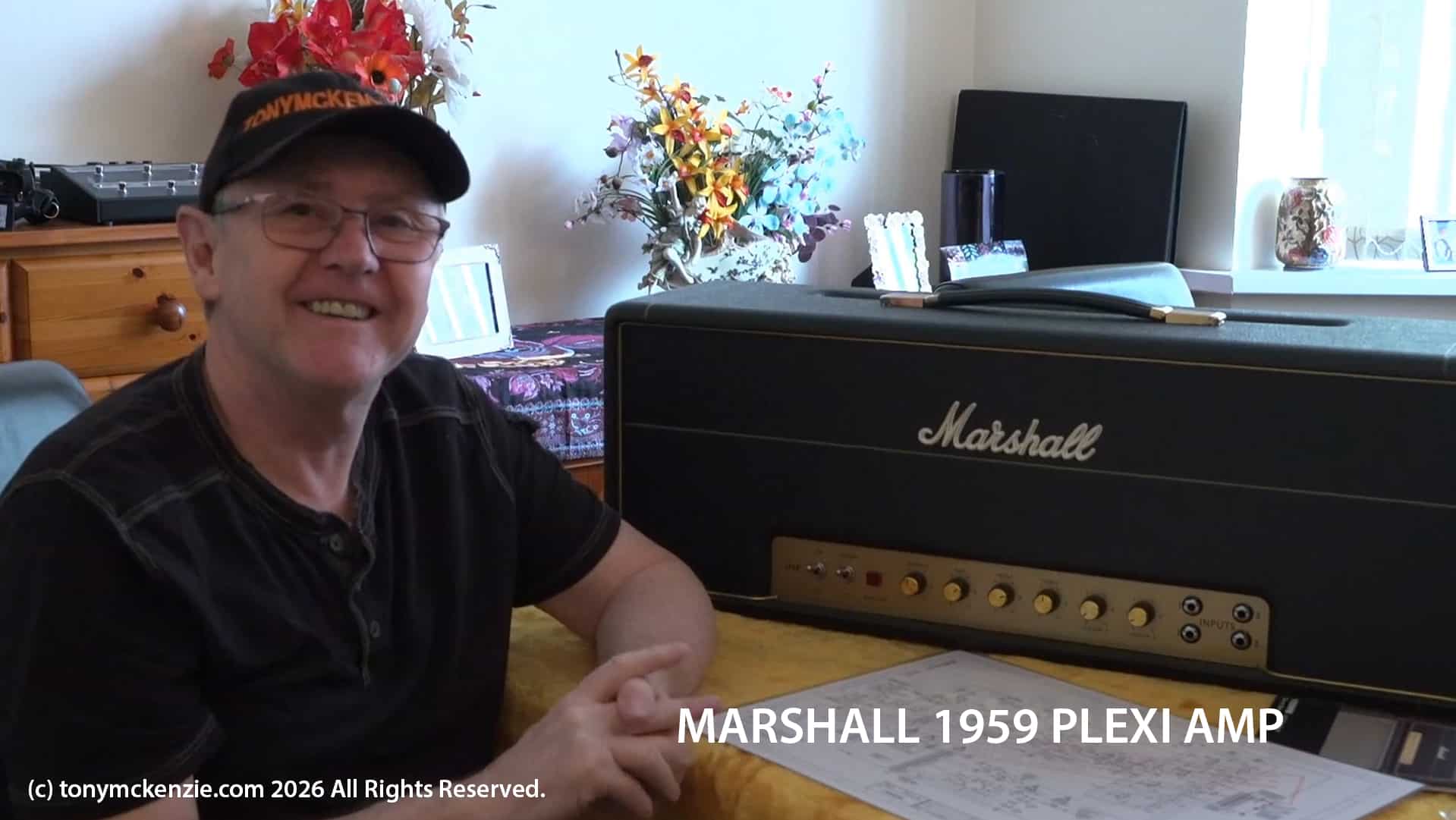
Well it might be easy for you to make a comparison with that second amp above, but really, they are different. While these two amps have a sort of 'similar' input (the 4 way connectors that you can bridge on both amps) and remember that the mighty plexi style amp is near enough always EL34, this JTM is very different with 5881 tubes - sort of similar/same as the 6L6 series. Right from the start that affects the tone. Some guys won't hear that difference but it is there. And my guess is this... imagine getting that original JTM that I showed earlier that is at Marshall, checking it out so it runs, and comparing that? Would it be the same? In reality I would not want it to be 'the same' because like the original plexi, that amp was built 'back in the day' and there are things today that they simply are not allowed to go and do. And that's a fact! Because this JTM of today is developed and created in the 2020's it can't use the same techniques as in that original JTM prototype. It would never be allowed to be sold and would fail those CE and other standards that have to be met.
So how can this amp sound like the original? It will be as near as you can get... but isn't that like those modelers and simulators? 'As near as you can get'? Of course I'm baiting the reader and most guitarists that play tube amps will tell me instantly that the modelers and simulators lack the 'feel' of the tone - and I agree they are right.
Using Drive Pedals
This amp though can deliver a great tone and although you might have to use the odd pedal to drive it a little, other than that the sound is not really compromised at all. It actually gets 'near' to cleans, the standard rock tones are there too, but if you want more get a pedal out. I tend to use an SL pedal that funny enough can emulate a Plexi amp and it drives the JTM just enough for a really good lead sound. But there were a few pedals that I found worked better for me and the JTM Studio and those are as follows:
- Ibanez Tube Screamer works well with this amp - I did try old and newer ones and even a hand wired TS but they all are quite acceptable.
- The Maxon OD808 seems to be 'similar' to the TS808 but try one just to see what you think
- You could try the Marshall pedals but I did not
- I use the Xotic SL Drive pedal to good effect for the style of music I play - it created a nice tone with that tube amp feel that is necessary for inspiration when you play
- I don't use this amp for 'metal' though as I have better amps for that genre...
So for me, the sound of this amp is quite refreshing and you can get the tones that other Marshall gear might prove harder to achieve. I do like the tones, but without the drive pedals because of what and how I play the amp would not quite drive enough for those styles.
Other General Points
Here is everything else I think about the JTM ST20H Studio amplifier for guitarists
Pricing
I paid about £770 for this amp here in the UK and I have already mentioned the $1300+ cost in the USA. List price in the UK is about £1100 or so (about $1450) so the USA price appears to be near list price. Whether that's good value for the USA guys it has to be assessed by the Americans as remember here that in the UK our price includes 20% tax too.
Cabs etc.
They do make some matching cabs for this JTM amp as well as a combo too I believe. Ha but if you stick it on an old Marshall 1960a cab this amplifier can really bring the house down! I have also used this amp with the 1x12 'Stealth' cab (with a V-Type speaker in it) that was for the JCM800 Studio Stealth amp I video reviewed (will be followed up with a written review also.
My Score For The JTM SC20H Studio Tube Amp
There has to be a score? Right? Find out how I rated this long awaited amp for guitarists.
I never did rate this amp in my video review and that was not related to the amplifier etc. but more really as I was a bit fed up with not getting viewers to receive when I posted a video often they were not really informed. But I guess that's a thing for YouTube and who really cares...
So I decided in the written review to include things that were missing from the original inside and out review so the score here for the JTM is:
10 / 10
And as you might imagine I recommend you buy one if you want something that is as near to the history of Marshall that you can get.
Conclusions
There's no getting away from it, this amp can actually sound very good in many styles of music. It takes the pedals well too so in many ways it becomes an all round guitar amp unless you play metal then honestly I would look elsewhere.
If you have read this far then I hope that you have a far better understanding of the amp than just watching many guys just sitting there playing and doing nothing else really. Consider this, even if you don't watch my playing section, my content will easily help you to decide about this amp when you do watch those other reviews I have mentioned on and off through this review. I am a fair way as I write to creating the new 21 written reviews and there are links for you to check the rest out. Thanks for visiting and I'll see you either here or on my YouTube channel
Thanks.
Links:
New 2026 written reviews on tonymckenzie.com
Audio Video Playing of the JTM ST20H Studio Amp
Marshall Written 1987x with 5851 Tubes Inside Out review
Marshall JCM800 Studio SC20HSB Inside and Out Review
© A B McKenzie 1997-2026. All Rights Reserved. All Trade Marks Acknowledged.